


ithin the IEEE, the EMC Society “punches above its weight class” in terms of standards development. We’re a small‑to-mid-sized society (< 4000 members) with a fairly large portfolio of standards (> 25). That’s not too surprising, since most readers of this magazine know that EMC engineers live and die by the requirements imposed by different standards documents.
In this article, I hope to do three things: 1) describe the standards development process within the IEEE EMC Society and encourage you to get involved; 2) provide updates on areas of active development; and 3) provide a list of currently available EMC standards.
A Technical Committee (TC) is made up of members who are all interested in a particular technical area and can provide advice as well as a path for prospective future members for a standard’s WG. Thus, the standards dealing with shielding that we discuss in this article are largely sponsored by TC4, which has a focus on electromagnetic interference (EMI) control.
In addition, we’ve formed certain Continuity Groups (CGs) to monitor standards after they’re published, of which the most active is the Shielding CG. These groups meet once or twice a year to keep an eye on how the associated technology is evolving and when standards will need to be updated. The CGs field any concerns and feedback from users of the standards. This helps ensure that when a WG is formed to renew a standard, they won’t be starting from square one.
SDECom serves a different purpose, primarily to educate WG chairs about the process and to coordinate with the IEEE Standards Association (IEEE SA) on bringing new and renewed standards to full, official publication. SDECom helps WGs make sure all the procedural boxes are checked with the full help and support of IEEE SA personnel. IEEE SA is the entity that officially manages all IEEE standards, including balloting.
One interesting thing that people may not know is that you don’t have to be an EMC Society member, or even an IEEE member, to participate in a standards working group. The only membership requirement is that you have to be an IEEE and/or IEEE SA member to vote in a balloting group for a particular standard.
A typical SACCcom meeting will have representatives from IEEE societies, CISPR, ISO, ANSI, AIAA, IEC, and others. There isn’t any better way to get an overview of the state of EMC standards globally than to attend (or call in! all EMC Society standards meetings are virtual or hybrid to the extent possible) one of the two or three SACCom meetings held each year.
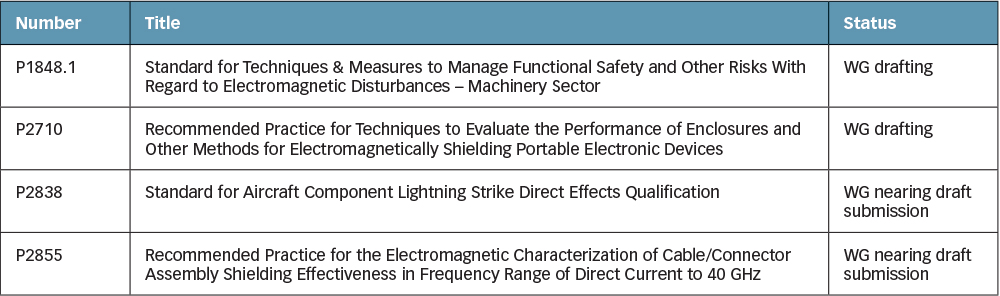
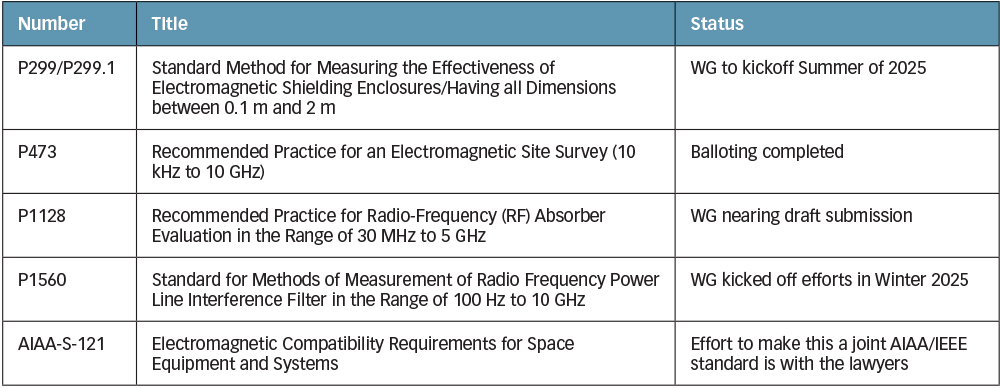
Other committees that are nearer to the beginning of the process are IEEE 1560 on power line filters, IEEE P2710 on measuring shielding effectiveness of flexible RF protective pouches (such as those used to shield and isolate cell phones), and IEEE P1848.1 on extending the risk management approach of IEEE 1848 to the machine sector.
The way to get involved is to register interest through the IEEE SA myProject system (https://development.standards.ieee.org). You may need to create a free myProject account, but a paid IEEE membership is not required. Once you have registered interest, you should get notices for upcoming WG meetings. You can introduce yourself to the chair, and after attending a few meetings, the chair can determine whether to admit you as an official WG member. The WG is where all the technical work gets done, including responding to comments from the voters in the balloting group. So that’s where your involvement and technical expertise will matter most.

In most cases, the reason for the inactive label isn’t technical. Since the IEEE SA does not have a stabilization process as many other SDOs do, renewing a standard requires as much effort and paperwork as generating a new standard (forming a new WG, submitting drafts for approval, new balloting, etc.). In some cases, it is easier to allow a standard to go inactive, knowing that it is still available to the public.