


y first exposure to wireless networking was when it became possible for me to send files to my printer over the 2.4 GHz band. That was almost 30 years ago. Data rates were not really fast, but fast enough to print documents or send e-mails. Since then, the number of devices using the unlicensed wireless spectrum and the available frequency band has grown significantly. Other than just being an interesting technology trend, many device manufacturers have found that using a wireless interface is more efficient and convenient than using traditional wired interfaces.
This is especially true for medical devices, especially in crowded emergency and operating rooms. (As a side note, I just had a doctor’s visit this morning and noticed the number of devices that still had wired interfaces to their sensors.) Multiple equipment with multiple wired interfaces can get in the way of lifesaving measures and can even present trip hazards.

- Wearable devices lead the market, growing from $5.73B in 2020 to $8.85B in 2024, driven by fitness trackers, smartwatches, and wireless ECG monitors;
- Implantable devices (e.g., pacemakers, neurostimulators) show steady growth, reaching $6.27B in 2024;
- Handheld and portable devices (e.g., wireless glucose meters, ultrasound systems) are gaining traction due to mobility and ease of use.
- Stationary devices (e.g., wireless imaging systems) remain the smallest segment due to limited portability; and
- The “Others” category includes emerging technologies and niche applications, growing to $2.91B by 2024.

In addition, visitors enter the hospital with smartphones configured to be wireless hotspots or connected to Bluetooth headsets, fitness bands, and smart watches. People change locations, make phone calls, and access Wi-Fi and LTE data networks and other wireless services during their visit, adding to the RF energy. At times, the “computers-on-wheels” and portable X-ray machines traveling the hallways periodically upload huge image files.
Yes, coexistence is a problem, not only in hospitals but anywhere large numbers of wireless devices are deployed. But wireless communication in a healthcare environment has become especially difficult. There are so many devices using RF that some are unable to establish or maintain a communications link at the level required for satisfactory operation. Devices that formerly worked in the engineer lab are failing to operate as required in the healthcare setting. The problem is further exacerbated by systems designed to support home healthcare technologies and that operate in home environments where the Internet of Things (IoT) includes radios to door locks, video doorbells, cameras, thermostats, and home appliances.
Ultimately, this leads to the risk of interference causing device malfunctions, data loss from patient monitoring devices, and potential impacts on patient safety. The purpose of this article is to explain the principles, challenges, and methodologies of coexistence testing from the perspective of a medical device manufacturer. Similar issues would exist for a hospital/clinic setting, but with a slightly different perspective (perhaps a future article?).
Here are some of the relevant regulations, guidance documents, and standards applicable to coexistence testing of medical devices.

- Wireless Quality of Service – The submission should include information to describe the wireless QoS needed for the intended use and use environment of the medical device. This includes addressing any risks and potential performance issues that might be associated with data rates, latency, and communications reliability as described in Section 3-b.
- Wireless coexistence – Any risks and potential performance issues that might be associated with wireless coexistence in a shared wireless environment should be addressed via testing and analysis with other wireless products or devices that can be expected to be located in the wireless medical device’s intended use environment. See Section 3-c.
- A summary of the coexistence testing, set-up, findings, and analysis;
- The wireless products (interferers) that were used in the coexistence testing, and their wireless RF frequencies, maximum output powers, and separation distances from the device;
- The specific pass/fail criteria for this testing;
- How the device and wireless functions were monitored during the testing and determined to meet the pass/fail criteria; and
- If it is reasonable to expect multiple units of the subject wireless medical device to be used in the same vicinity, the information should also address how the association and security between devices is established and maintained to prevent crosstalk among the devices.
Bluetooth Low Energy (BTLE) is an extension to the original Bluetooth and was designed specifically to allow for lower energy use and longer battery life. Like Bluetooth Classic, it uses multiple channels, but in a different scheme. Three channels are dedicated as advertising channels and are not used for data transmission. It also utilizes a 1 MHz bandwidth in the same frequency range, with channels spaced every two MHz. Because of the wider channel spacing, there are less (40) total channels available. With half of the channels available for transmission, it can make BTLE more susceptible to interference compared to Bluetooth Classic.
Versions 4 and 5 of Bluetooth have a maximum range of up to 60 meters, and possibly 240 meters for BTLE Long Range.7 Because of the ease of implementation of either type of Bluetooth, this technology can be found in medical devices, especially those that are partnered with an application that runs on a smartphone or PC.
Here is a brief description of the different Wi-Fi standards, with an emphasis on their use in the U.S.:
- 802.11b: Although it is the second Wi-Fi standard developed by the IEEE, it was the first implemented in September 1999. It uses the 2.4 GHz band, specifically 2401-2473 MHz. The channel bandwidths are 22 MHz, and it allows for 11 channels in the U.S. However, that does not mean that all 11 channels can be used in the same area, as 802.11b has overlapping channels. This standard has a maximum range of up to 35 meters.
- 802.11a: Released in September 1999, this standard makes use of the 5 GHz band only. It was the first expansion into the newly available 5 GHz band, allowing for higher data rates, but still limited to a 20 MHz bandwidth maximum. This was not an overlapping technology, thus allowing for up to 31 available channels and a maximum operating range of 35 meters.
- 802.11g: Released in June 2003, this standard uses only the 2.4 GHz band and a maximum bandwidth of 20 MHz. The smaller bandwidth allows for up to 4 channels in the band without overlapping. It has a maximum operating range of 38 meters.
- 802.11n: Released in October 2009, this was the first Wi-Fi standard to be branded by the Wi-Fi Alliance, known as Wi-Fi 4. It allows for both 20 and 40 MHz bandwidths and uses both the 2.4 and 5 GHz bands. Because of this, it also allows for a larger number of available channels, up to 43 for 20 MHz bandwidths, and 23 40 MHz bandwidths. It has a maximum operating range of up to 70 meters.
- 802.11ac: Released in December 2013, this standard is also known as Wi-Fi 5. It uses the 5 GHz band only, but allows for 20, 40, 80, and 160 MHz bandwidths, allowing for even higher data rates. It allows for 31-20 MHz, 14‑40 MHz, 7-80 MHz, and 3-160 MHz channels. It has a maximum operating range of up to 30 meters.
- 802.11ax: Released in May 2021, this standard is also known as Wi-Fi 6 (using 2.4 and 5 GHz bands only) and Wi-Fi 6E (E=Extended), which uses all three bands. This standard truly increased the capacity and capability of Wi-Fi, allowing for up to 103-20 MHz, 52-40 MHz, 21-80 MHz, and 10‑160 MHz channels. It has a maximum operating range of up to 30 meters.
- 802.11be: Released in September of 2024, this standard is also known as Wi-Fi 7 and uses all three bands. It allows for even wider bandwidths, adding 240 and 320 MHz channels. It also introduces the mandatory use of pre-amble puncturing, a technique that allows the device to notch out part of the channel in the presence of interference. This makes it one of the first standards to allow for managing interference in the operating channel. (Actually, this capability was available with Wi-Fi 6E but was optional). This standard has a maximum operation range of up to 30 meters.
- 60 GHz Wi-Fi: There are three different Wi-Fi standards using the 60 GHz band (802.11ad, aj, and ay) that are defined as multi-gigabit standards. They offer data rates between 1.08 GHz and 8.64 GHz with a maximum operating range up to 10 meters for 802.11ay. Because of the data rates, this standard may be used for applications that require very high data rates, such as high-resolution digital video. This band, while limited in operating range, would probably be the most immune to interference, as there are currently not many devices transmitting in this band.
- 2.4 GHz: 2.4 GHz allows for longer transmitting distances but is limited in the number of channels and has to deal with multiple other technologies using this band. Microwave ovens operate in this band and can represent a significant interference source as well.
- 5 GHz: The 5 GHz bands allow for more channels and wider bandwidths (up to 240 MHz) and are popular for devices that use wider bandwidths and higher data rates. However, the 5 GHz band has some incumbent users that have priority access to the bandwidth. These include various forms or radars using the 5250-5350 MHz, 5470-5730 MHz bands. For that reason, APs and some station devices that use these frequencies must employ a radar detection function that monitors for defined radar signals and, if such signals are detected, must stop transmitting in that channel and not attempt to re-use that channel for up to 30 minutes (this is known as dynamic frequency selectivity, or DFS). It is possible to design the interface to avoid those bands, but that reduces the number of available channels to eight 20 MHz channels.
- 6 GHz: The 6 GHz band was opened for unlicensed devices in the U.S. in April 2020. The U.S. was the first country to allow use of the entire 6 GHz band, covering from 5925-7125 MHz. This allows for many channel possibilities, but, like the 5 GHz band, comes with some restrictions. There are multiple licensed (incumbent) users in the 6 GHz spectrum. As part of the agreement to use this band, any unlicensed device that uses this band must employ a contention-based protocol (CBP) in the U.S. Similar to the DFS requirements, devices using this band must also employ a receiver detection function that monitors for incumbent transmitters, and if detected above a threshold value, cease transmissions in this channel. Unlike the 5 GHz band, the device does not need to move from this channel, but can wait for the incumbent to stop transmitting, and then reuse the channel.
- Criticality of device function: Does this device provide life-sustaining functionality, or just monitoring?
- Impact of communication failure: Can the device still meet its functional performance with a loss of data or delayed alerts?
- Recovery mechanisms: Is there a designed recovery mechanism? Can the device recover by re‑transmitting the lost or corrupted data? Is there a fallback, such as an audible or visible alert on the device?
- Packet error rate (PER)
- Latency
- Throughput
- Connection stability
- Sensitivity testing
- Time to recover
- Tier 1 represents the most thorough type of evaluation. Its purpose is to test those devices that have the highest consequences of unacceptable performance, or where the highest levels of uncertainty are required. This includes a wider range of unintended interference signals and the potential for interference from adjacent channel interference. This tier is for those products whose functional performance is the most critical.
- Tier 2 represents the mid-level type of evaluation. This Tier reduces the number of interference signals from Tier 1, and some testing is done for potential interference from adjacent channel interference. This Tier is for products that do not have such a critical performance requirement are not considered life-sustaining devices.
- Tier 3 represents the lowest level of interference testing. The intention is to provide the greatest insight into the EUT coexistence capabilities with the most limited amount of testing.
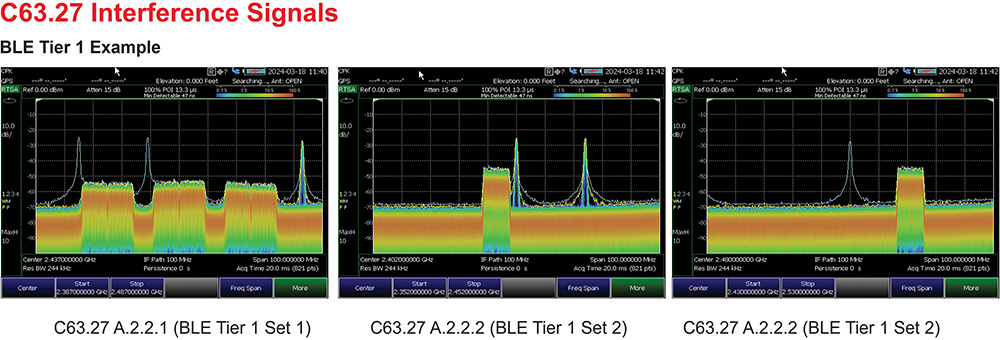
Figure 4 shows an example of testing a Bluetooth LE device for all three Tier 1 scenarios.
- Conducted: This environment is a fully conducted testing environment. The antennas are removed from the EUT, and all interference signals are fed into the EUT or companion device through cables. This environment allows for the most controlled testing, as you will not have to consider in-building Wi-Fi or Bluetooth signals being included in your testing. It also allows for the ability to use external components, such as variable attenuators, splitters, etc. for maximum control of the interference to EUT signal ratios.
- Dual Chamber: This environment moves towards a more realistic testing environment, as the EUT antennas are included in the test, and both the EUT and companion are in a shield chamber, virtually eliminating any external interference signals. All interference signals are then fed through antennas in each chamber. This environment is a bit challenging in that setting a desired interference signal level into the EUT takes some calculation of external measurements. Your test solution should provide a way to easily determine the radiated interference signal level to the EUT.
- Full Anechoic: This environment allows for the most control in testing the EUT and offers the most controlled testing environment. It shares similar issues to the dual chamber environment in determining the interference signal levels into the EUT. It also requires an anechoic chamber, which, if you do not have one, is a very expensive investment.
- Over-the-Air (OTA): This environment could be considered a poor man’s chamber environment. You basically test over the air in an open space, such as an unused conference room. There might be challenges in getting the distances far enough for far field, not to mention having to anticipate the in-building Wi-Fi and Bluetooth that will interfere with your interference testing.
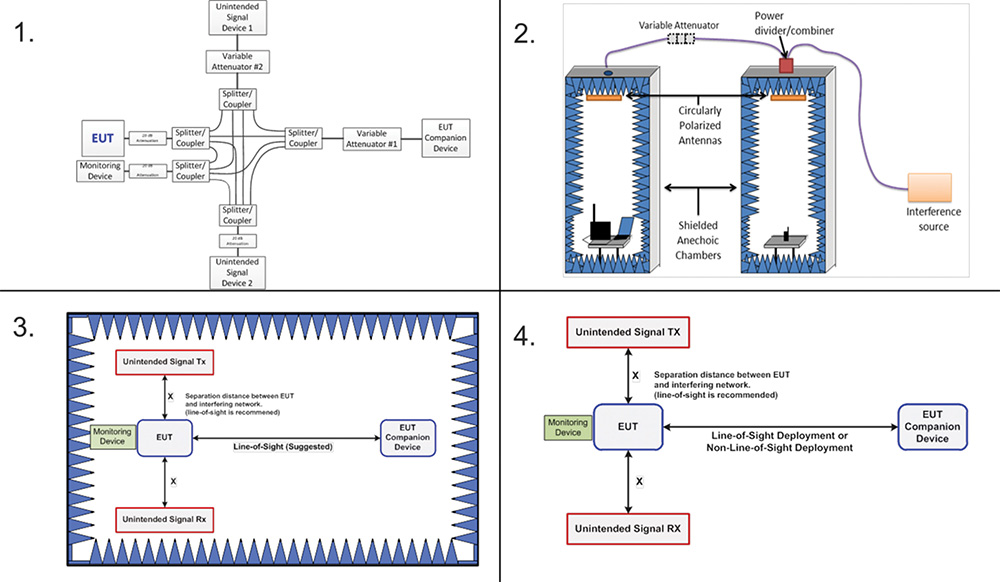
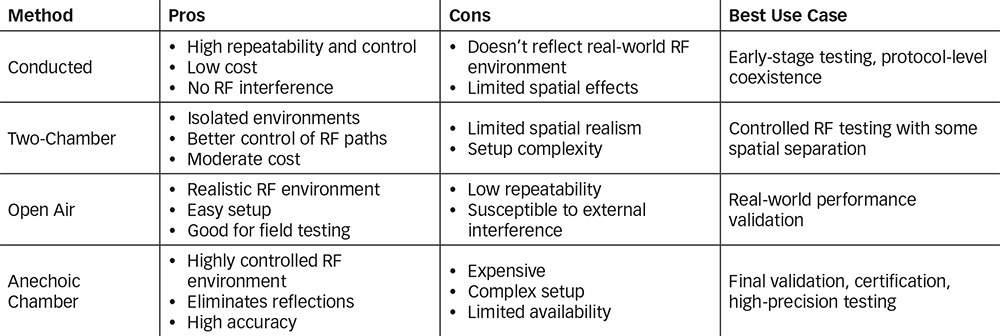
Figure 6 shows an example of automated signal generators and signal conditioning to run complex interference testing. It also shows using software to read the display of the EUT application to determine if the KPI has met the desired functional performance. In this case, the software is monitoring the portion of the smartphone application to determine if the device is still connected to its companion device.

- “Wireless Medical Devices Market Size | CAGR Of 12.1%”, Published: March 2025. Report ID: 141096
- https://www.ntia.doc.gov/files/ntia/publications/2003-allochrt.pdf
- https://www.fda.gov/regulatory-information/search-fda-guidance-documents/radio-frequency-wireless-technology-medical-devices-guidance-industry-and-fda-staff
- Available for purchase at: https://webstore.ansi.org
- Available for purchase at: https://aami.org
- https://en.wikipedia.org/wiki/Bluetooth#Specifications_and_features
- ibid.
- https://en.wikipedia.org/wiki/Zigbee
- https://en.wikipedia.org/wiki/IEEE_802.11