

nintended electromagnetic coupling shows up in more ways than we care to admit. Picture this: your latest PCB assembly comes back from fabrication, you power it up, clip on the scope, load the bring up code, and the screen fills with ragged edges and random spikes. The demo you expected to run clean now looks like a jittery mess, and the system that behaved in simulation suddenly appears unpredictable.
You ask around and hear the classic replies: “That is just noise,” or “That’s just crosstalk.” We have all been there. Those symptoms are almost always attributed to unintentional coupling between circuits, which is energy moving along paths we did not intend to create. The usual suspects are layout choices, component selections, cable and harness effects, or enclosure details that felt minor at the time but that have big consequences during bring up. These decisions generally range from:
- A slightly long return path, a decoupling choice that looks fine on paper; to
- A FET gate loop with more area than it should have can be enough to tip a marginal design negative.

Next, we will step into a near field versus far field coupling. We will discuss what changes in the reactive region, why fixes that work on some issues may not work on others, and how to recognize when a local magnetic or electric field interaction is dominating the behavior.
Finally, we’ll lay out a field-tested debug workflow for when someone asks, “Why does the circuit quit working when the motor starts?” The goal is not only to quiet the waveform today, but to give you a repeatable method to identify the path, identify the mode, and remove the coupling with minimal impact on schedule, so you can get back to your product.
- Conducted coupling: Energy rides on conductors and their return paths. It flows through intentional interconnects and unintended impedances in planes, cables, and grounds.
- Radiated coupling: Energy leaves a structure as an electromagnetic field and is received by another structure, much like an antenna.

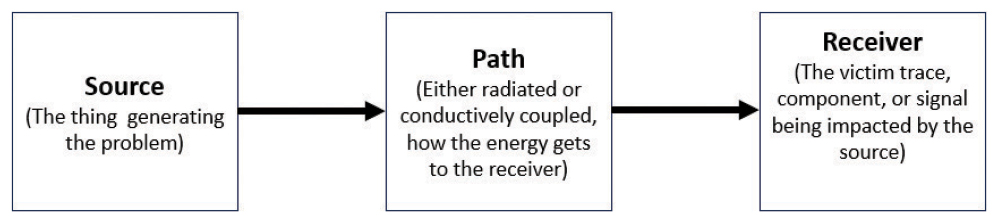
The first step in creating our mental scaffolding is to use the EMC/EMI model, and determine following:
- The Source of the coupling, often a signal with a fast edge rate such as a PWM drive signal or communications bus.
- The Path, or how the energy is coupling from the source to the receiver.
- The Receiver, which is often easily identified as it’s the device that is not delivering its intended function.
We will start with differential mode because it is the easiest to see and the fastest to fix during startup.
In Figure 4, the intended operating current is labeled idiff. It leaves the power supply, travels through the circuit under test, and returns to the source on its defined return path. Along the way, the loop encounters small but very real impedances in components, vias, traces, planes, and connectors.


- For resistive elements, the relationship is an IR drop,

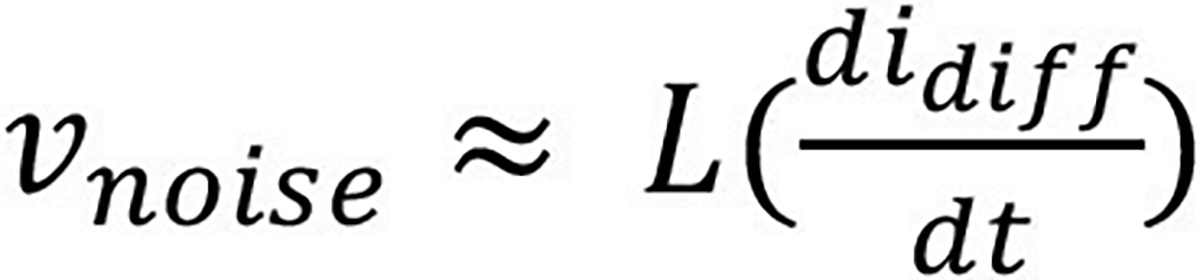
- For inductive elements, the relationship is
- For capacitive elements, the current that must be the source is

- , which shows up as extra ripple or ringing in the loop.
- The faster you drive current through a series impedance, the greater a voltage error, and
- The larger the loop geometry, the more susceptibility is created in nearby fields.
- Capacitor parasitics: The wrong dielectric or package, long pads, or tall stacks push up ESR and ESL. A single X7R 0402 may have about half a nanohenry of ESL; at 100 MHz, that is a few tenths of an ohm, resulting in noticeable ripple. Poor placement lengthens the loop from pin to capacitor and back, which adds trace and via inductance on top of the part’s own ESL.
- Inductor parasitics: DC resistance (DCR) of an inductor creates a drop under load. Leakage inductance and interwinding capacitance form resonances with surrounding caps. The wrong core material or a part driven into saturation increases effective impedance and injects sharp edges into the loop.
- Trace and loop parasitics: Narrow neckdowns, long detours, and unnecessary layer changes add resistance and inductance. A via is on the order of a nanohenry. A few millimeters of thin trace can add several nanohenries. With a 1-amp step in 50 nanoseconds, 10 nH makes about 0.2 V of unwanted drop. Split planes or slots that force the return to wander also enlarge the loop and raise the series impedance that the current must cross. Additionally, close routing and high impedances/low currents can result in mutual capacitive coupling both to return and to other traces, injecting noise currents on victim lines.
- Connectors and cables: Pin assignment, contact resistance, and pin inductance add series impedance. A single, fast, high-current pin next to a sensitive analog pin is a prime example of this.
- Measurement setup: Long ground leads on a scope probe add inductance and will show ringing that is not on the circuit. The probe can easily become the dominant parasitic in a sensitive loop.


Begin at the input. The input capacitors provide local DC stability on VIN. Without them supplying the transient current, every switching event pulls current through the upstream harness, and you will see dips on VIN. In the initial layout, the two input capacitors sit at a noticeable distance from the device.
- The fix is to reduce parasitics and shrink the current loop. Use several small case multilayer ceramic capacitors right at the VIN pins and the closest return so the mounting inductance is minimal. Parallel values to spread resonances rather than relying on one part to do all the work.
- Then, shorten and thicken the high current path. Feed VIN with a local plane instead of a long trace, and when a layer change is unavoidable, use multiple vias in parallel to keep the effective inductance low.


- We strive to keep this loop small and planar, making the copper continuous and wide so there are no skinny neckdowns at device pins or layer transitions that become the dominant impedance. Additionally, we minimize the exposed area of the phase node to reduce its capacitive coupling to nearby nets.
- Place the first output capacitors as close as practical to the inductor and the return so the AC component of the inductor current closes locally.
- Additionally, our focus remains on intelligent component choices to minimize parasitic, an inductor that does not saturate at peak current and whose DCR does not waste margin. Use output capacitors that hold value over bias and temperature. Favor packages and footprints that keep pads short and the current path direct. Shielded inductors and careful body orientation reduce stray fields into sensitive nodes.
With the differential path under control, the remaining noise that shows up at the chamber often comes from hidden common mode currents traveling along cabling and long traces.
- Power rail collapse, where a nominally stiff rail shows dips or ripple; and
- Ground bounce, where the reference no longer holds a steady zero volts.

These currents are sometimes called drift currents or antenna currents. They are tricky because the dominant path is geometric rather than schematic, so the loop may involve the PCB layout, a cable shield, and even the test setup, none of which are obvious in the schematic. As with differential mode, we will discuss the impact of common mode coupling on low voltage signaling in CMOS logic.
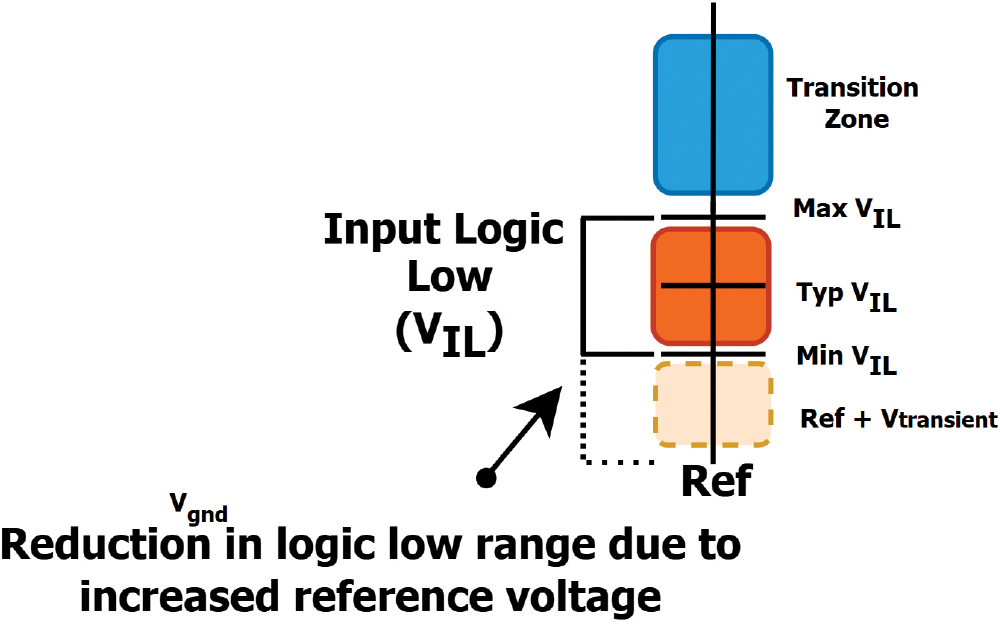
That shrinking margin tightens when the receiver decides on a one or a zero. Specifically for CMOS, the input thresholds voltage input high (VIH) and voltage input low (VIL) are defined relative to the local supply and the local reference; this relationship is shown in Figure 13.
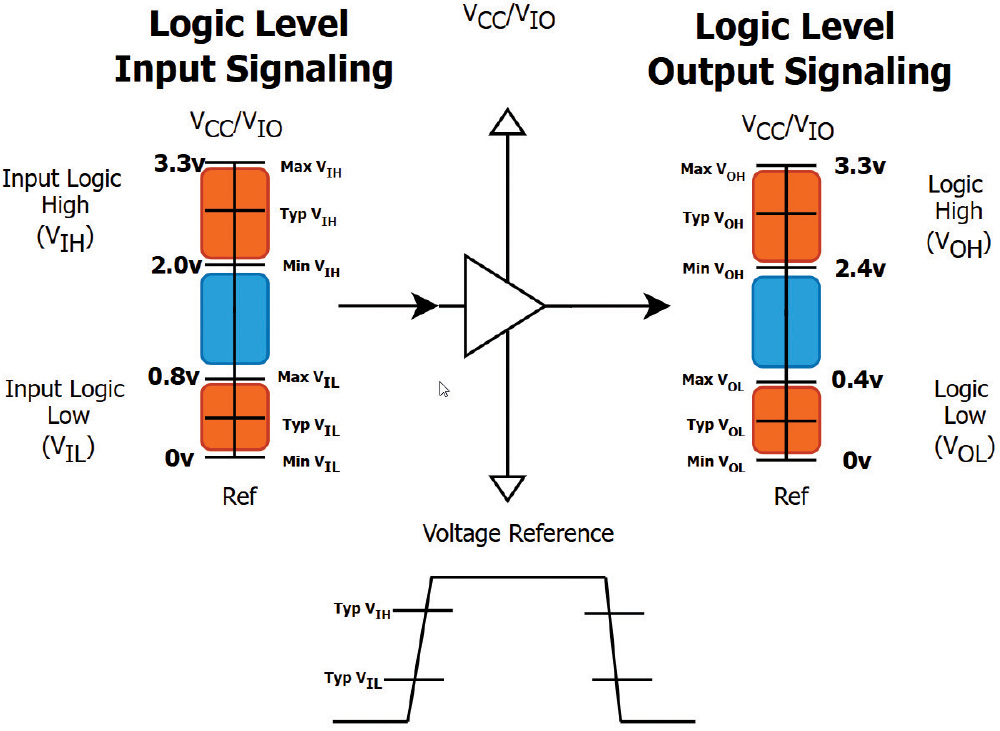
Figure 14 demonstrates this. The reference moves from zero to a transient positive value. That rise reduces the range where the gate recognizes a valid low. With enough bounce, the receiver can miss a low going transition entirely, which shows up as a missed edge in an SPI or I2C transaction. The same mechanism can also create a false height in a gate driver, as shown in Figure 15.


The most reliable way to keep common mode under control is to bake it into layout and system rules from day one.
This includes keeping return paths contiguous so currents can come back directly under their forward paths. Use zoning and floor planning so high current power stages and sensitive interfaces do not force each other across splits or long detours. Place inputs and outputs so they enter and leave the board without crossing cuts in the reference plane, and avoid plane slots that make the return wander. And in systems with long interconnects, treat the cable interface as its own circuit. Terminate shields with a continuous 360-degree bond at the connector or enclosure, not a long pigtail. Provide a local path that brings common mode current back to its source at the point of entry.


Balanced routing matters. Differential pairs and matched lines cancel fields and resist conversion to common mode when their impedances and environments are symmetrical. When the pair becomes unbalanced by skew, uneven reference, neckdowns, or a via only on one leg, that cancellation breaks. The remainder becomes common mode that couples to nearby structures and finds a large path through planes or cables.
Filtering for common mode works because it corrects those imbalances and supplies low impedance returns. At the interface, the common pattern is a line filter that includes a common mode choke close to the connector and short capacitive shunts to the reference or chassis on the board side of the choke. Inside the box, stitching capacitors across unavoidable seams or between local and chassis reference at high frequency give noise current a short loop. Where practical, reduce the


In differential mode radiation, the loop is formed by the intended signal and its return, as shown in Figure 20. The radiated field grows with loop area and with the current edge rate. To manage this:
- At the module level, the remedy is simple in concept: route high current or fast signal loops directly from source to load while keeping a solid, adjacent return so the loop stays small and planar.
- At the system level, use twisted pair or a shielded cable so the forward and return currents stay close together and cancel fields.


The next section of this article builds on this by mapping the dominant radiated coupling mechanisms and showing how to degrade the antenna that your layout or harness accidentally created.
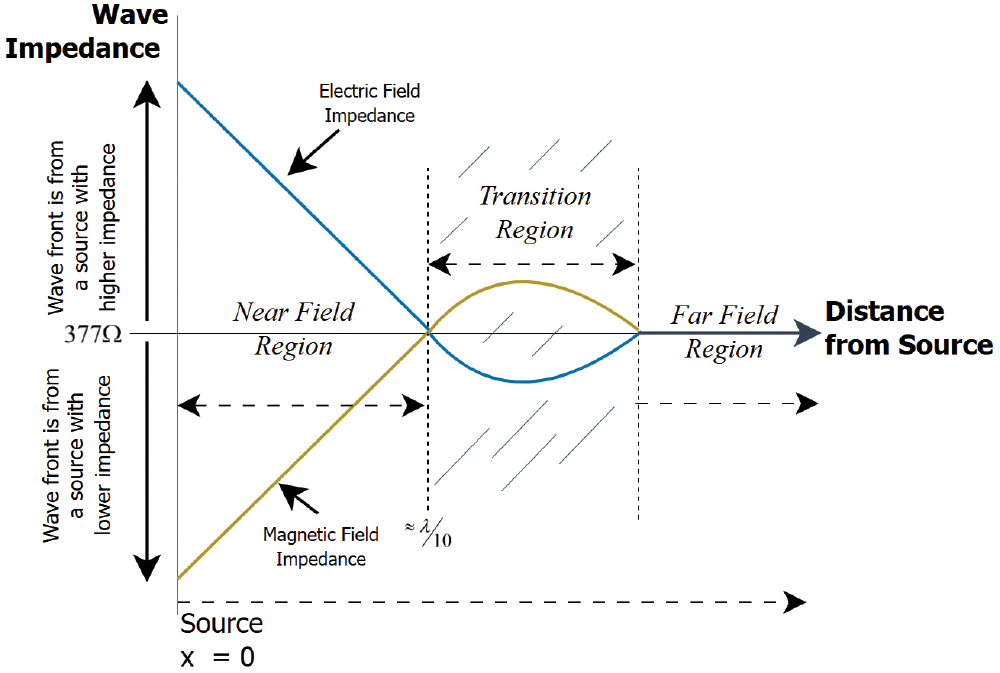
Up close in the near field, the electric and magnetic parts are not locked together. One often dominates the other, with both appearing out of phase. Energy is mostly stored and returned to the source rather than carried away. Farther out, the fields settle into a traveling wave where the electric and magnetic parts are in phase and tied together, and the ratio E/H approaches the impedance of free space (about 377 ohms). Shorter wavelength signals reach this traveling wave behavior at shorter distances. This transition point from the reactive, near field region to far field is thus governed by the following two relationships.

- For small sources where the physical size

- , the reactive near field is roughly within

- (about 0.10-.16 of a wavelength). Beyond that, the fields begin to behave like a radiating wave.
- For larger structures (enclosures, long cables, big boards) the start of the far field is better estimated by

- . Here, the size of the radiator matters as much as the frequency.
- Magnetic sources (current loops) or
- Electric sources (voltage on small structures).
Now we’ll focus specifically on near field coupling, defined by either the magnetic or electric field sources.


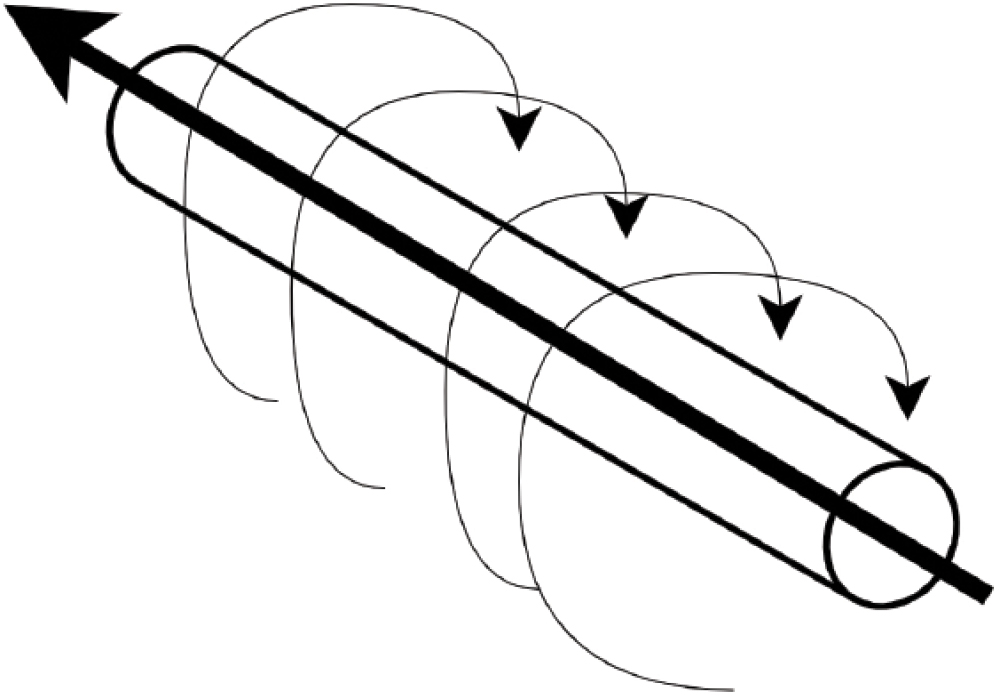

Envision a net, formed by a neighboring circuit, that catches time-varying magnetic field lines, which, through induction, creates a time-varying voltage in that loop.
You can connect this back to the layout and measurement anytime a loop exists. In Figure 26, an inner and outer loop exists, and they’re coupled through the shared flux from the source current’s magnetic field.


The net effect is a current injected into the neighboring circuit,
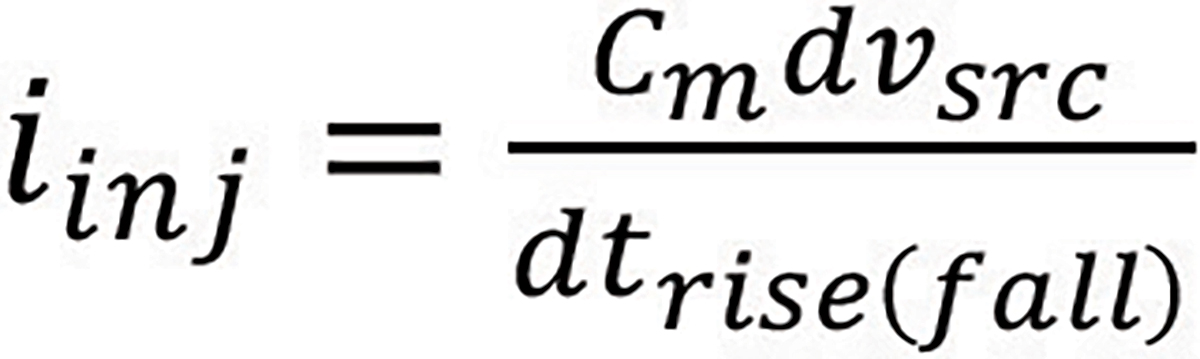


Where possible, reduce the source

And while we could next reduce the slew rate or voltage that the receiver is responsible for, that change often impacts the circuit functionally in an adverse way. The goal for mitigation of the impact is to either terminate or shunt the injected current away from the sensitive receiver.
This can result in:
- In systems with cables and interconnects, this results in a properly terminated shield. This results in the noise currents being shunted to a common return through a low impedance connection
- In PCB systems, guard traces, fencing, along with spacing to reduce and positively impact the parasitic capacitance is found, in addition to orthogonal routing.
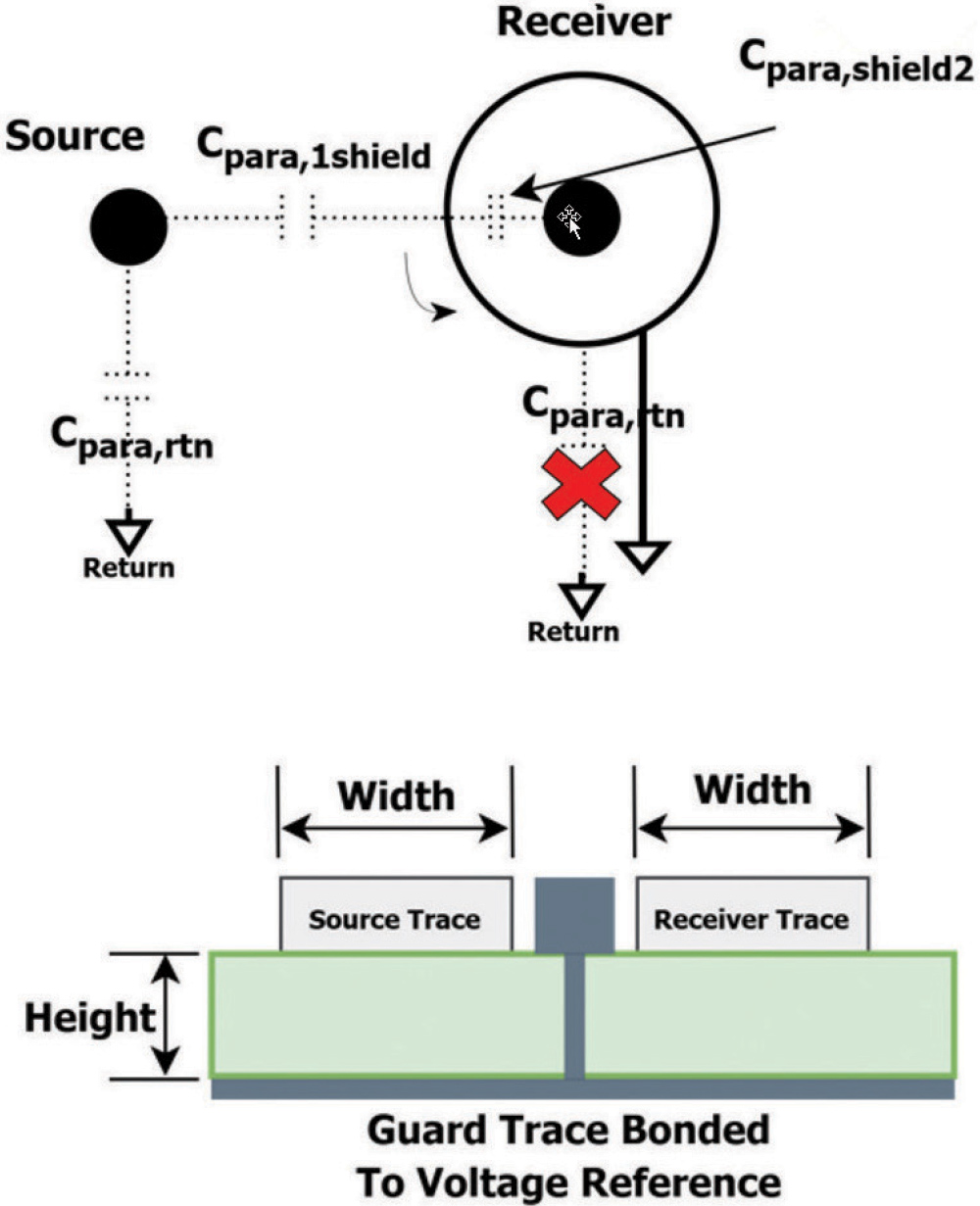

You can picture a driver launching current onto a cable shown in Figure 32.

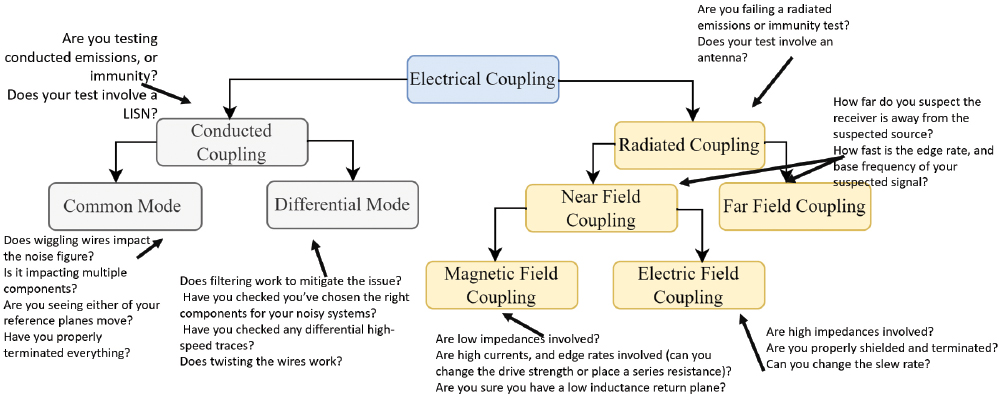
Use the framework you have built and first identify the source, the path, and the receptor; decide whether the dominant mode is differential or common; and check whether a conducted issue has turned into an antenna. Figure 33 is not exhaustive, but it should keep you oriented and help you work through the next problem faster.