

his is the second of seven articles devoted to the topic of shielding to prevent electromagnetic wave radiation. The first article, [1], discussed the reflection and transmission of uniform plane waves at a normal boundary. This article discusses the normal incidence of a uniform plane wave on a solid conducting shield with no apertures.

The incident wave upon arrival at the leftmost boundary ( ) will be partially reflected (
 ) and partially transmitted (
 ) through the shield. The transmitted wave () upon arrival at the rightmost boundary will be partially transmitted (
 ) through the shield.
The reflected wave (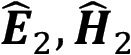 ) propagates back through the shield and strikes the first interface, incident from the right.
Once again, a portion of this wave is transmitted through the left interface and adds to the total reflected field in the left medium, and a portion is reflected and proceeds to the right.
The process continues in the same fashion, but the additional reflected and transmitted fields are progressively attenuated. If a shield has a thickness that is much greater than the skin depth of the material [3] at the frequency of the incident field, these multiple reflections and transmissions can be disregarded, and only the initial reflection and transmission at the left and right interfaces need to be considered.
The incident wave is described by (since air is treated as a perfect dielectric α0 = 0 and  )
)











Let’s demonstrate that. Recall from the previous article, [1], that the uniform plane wave was described by










- Bogdan Adamczyk, “Shielding to Prevent Radiation – Part 1: Uniform Plane Wave Reflection and Transmission at a Normal Boundary,” In Compliance Magazine, June 2025.
- Bogdan Adamczyk, Principles of Electromagnetic Compatibility – Laboratory Exercises and Lectures, Wiley, 2023.
- Bogdan Adamczyk, “Skin Depth in Good Conductors,” In Compliance Magazine, February 2020.