


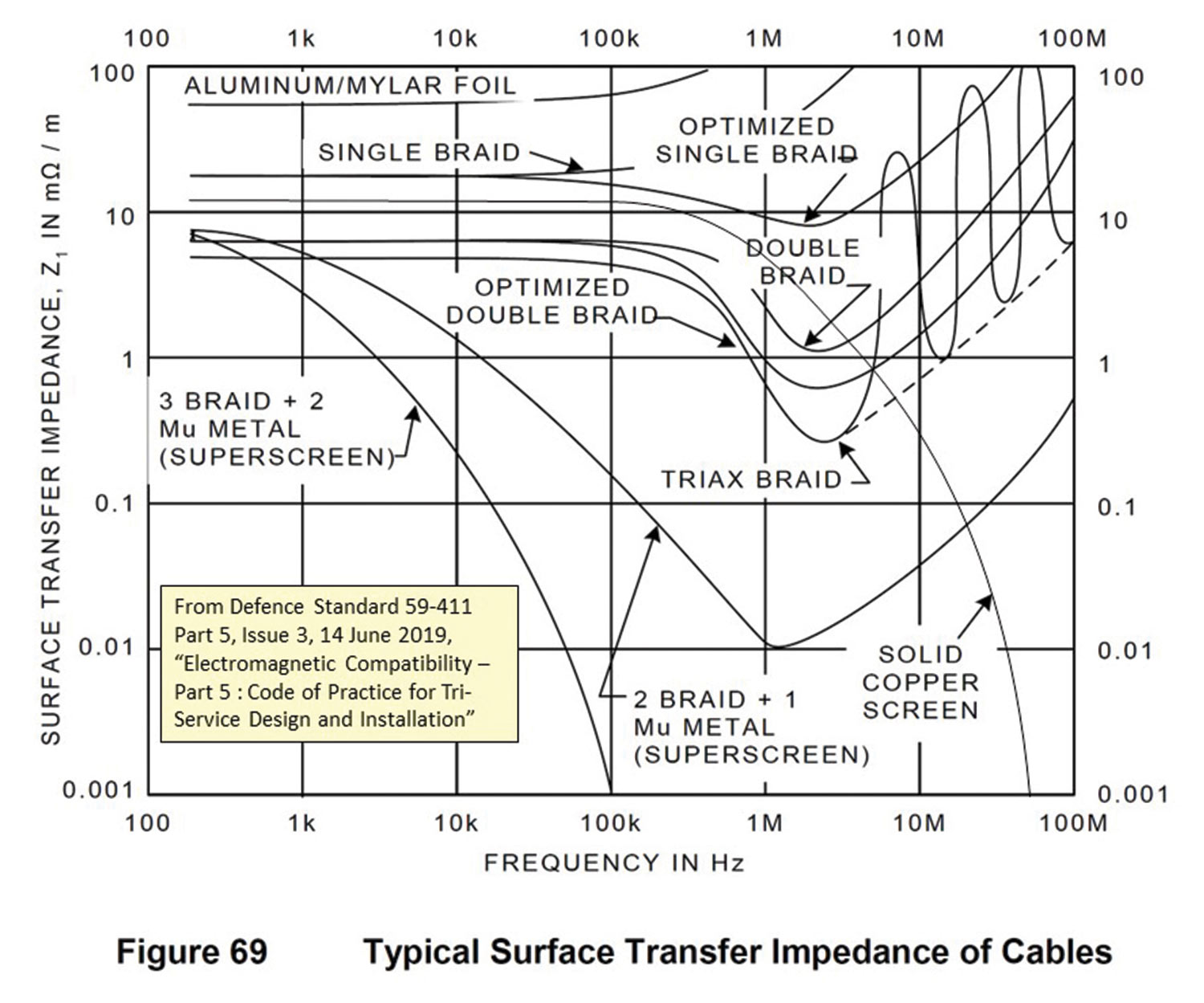
couple of years ago, I needed to know the shielding effectiveness (SE) of screened1 cables up to at least 18GHz, but – apart from coaxial cables intended for use in EMC2 test laboratories – I could only find information up to 100MHz, such as Figure 1.
Accordingly, I set out to make my own measurements with the resources and time made available to me.
In these measurements, I used many different constructions of cable to try to answer the perennial debate about how best to terminate the individual shields of multiple-shielded cables, including single or double overall braids (overbraids), and individual shielded cables contained within an overbraid.
But before I can describe the cables and results I am permitted to share with you (see Part 2 of this article), I first need to establish the basic rules for terminating cable shields, so that you understand why I did what I did.
Unfortunately, People Often Deviate from Good Shielding Practices
Except for conductors designed specifically for use as antennas, all conductors are often called accidental antennas [2]. For this reason, achieving a project’s EMC requirements quickly and cost-effectively often requires shielded (sometimes called screened) cables.
For these cable’s shields to provide the EMC benefits needed, they must be correctly terminated at their ends. Correct termination techniques for RF have been well-proven for decades (see References [1] and [3] through [14], which span the period 1976 to 2019).
Unfortunately, despite all this publicly available knowledge on well-proven shield termination methods, they are still neither well-known nor widely used.
Well-Proven Good EMC Practice: Always Terminate Shields 360°, at Both Ends
These guidelines were usually acceptable in most ordinary consumer, commercial, and light industrial applications up until the 1990s because their electromagnetic environments were quite benign. But they were never sufficient for applications with very tough electromagnetic environments, as covered by [1] and [3] through [8].
However, when personal/portable computers and digital cellphones became widespread during the 1990s, their large electromagnetic emissions at frequencies up to almost 1GHz meant that IEC and similar EMC test standards for immunity started to test with at least 3 Volts/meter up to at least 1GHz, which is roughly equivalent to a cellphone operating at full power 2 meters away. Such standards were then adopted as part of claiming compliance to the European Union’s EMC Directive.
Even electronic circuits that use low-frequency signals (say, below 20kHz) can be expected to demodulate and intermodulate RF noises (say, above 150kHz), as almost every designer of such products who took the trouble to perform these immunity tests discovered. [3] warned about this issue in the mid-1990s.
Now, in the 2020s, we can look back on thirty years of ever-worsening electromagnetic environments, and the EMC test standards for ordinary consumer, commercial, and light industrial applications now have to test immunity up to 6GHz or more. 28GHz will soon be necessary when 5G is extended into that frequency range as planned, see [15] and [16].
These days, the plain fact of the matter is that all analog and digital signals, and all power, are now heavily polluted with conducted RF noises up to at least 6GHz. These are common mode (CM) noises that are both picked up from the noisy electromagnetic environment, and created by the electronics themselves, even being emitted from analog inputs! (See [17].)
The result is that all guidelines for shielding low-frequency signals and power are now insufficient for EMC compliance, and techniques for shielding against high-frequency RF noises are always required, including instances when using RF filtering [18]. Reference [12] and all the other references in this article describe such techniques, and they all require terminating cable shields in 360°, and at both ends.
Based on my own experience and that of the many EMC experts I know worldwide, the good news is that doing this not only results in good EMC, but also the quickest and most cost-effective project designs, and the quickest and most cost-effective installations (see [19]).
There is also some persuasive real-world evidence for improvements in functional performance where legacy equipment and its installations have been redesigned to use shielded cables terminated in 360° at both ends (see the two examples in [20]).
And shield termination is sometimes called shield bonding, shield grounding, or shield earthing. However, I strongly advise against using terms that use the words ground or earth for anything other than electrical safety purposes (see [21]).
As for worries about so-called ground loops, hum loops, earth loops, etc., when bonding cable shields at both ends, see my blog [22] and remember that bonding cable shields at both ends has been a requirement for military electronics since 1976 (see [3] through [11]).
We can always deal with such noisy loops by circuit design, which I learned how to do in the 1980s. Without such circuit design, the only generic alternative for poor EMC caused by badly shielded cables is to use shielded panel-mounted filters and/or better cable shielding. Of the two, better cable shielding is quicker and more cost-effective unless we are stuck with legacy cable systems that can’t be replaced.
Note that fiber-optic converters and their cables may seem costly but can be more cost-effective overall, taking everything into account. I expect them to become more economically favorable year-on-year, going forward.
All the references at the end of this article warn against using pigtails, sometimes simply called tails.
Figure 2 shows that even a 5mm pigtail makes shielding worse than 360° termination by between 10 and 20dB over the range 1MHz to 1GHz. Note that manual pigtailing is very difficult indeed if shorter than 20mm, which Figure 2 shows is up to 30dB worse.
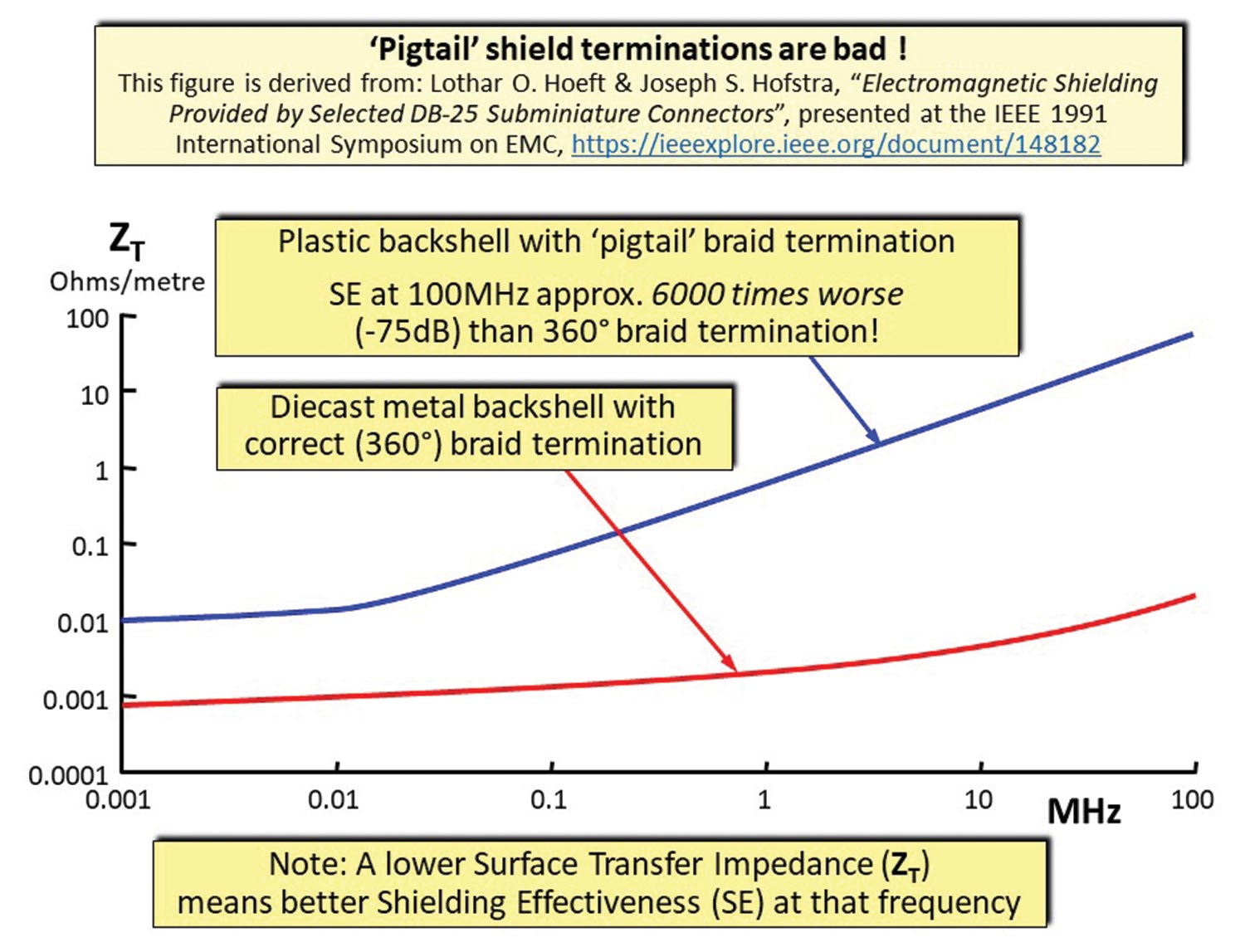
However, the shielding degradation caused by using pigtails instead of 360° terminations depends very much on the test method used. For example, a 1991 study [23] found that using a pigtail in a subminiature 25-way D-type made shielding 20dB worse at 1kHz (only 1kHz!) and 75dB worse at 100MHz (see Figure 3).

Figure 2: Effect of varying the length of a shield pigtail termination, from [1]
If, in ten years’ time, you remember only two points about this article they should be:
- Never use pigtails for terminating cable shields; and,
- Always terminate shields at both ends (dealing with the inevitable ground loops, hum loops, etc., by circuit design, see [22]),
For a simple method for predicting a cable’s SE from measurements of ZT (surface transfer impedance, as used in Figure 3), see [24].
A couple of years ago, I did some work for two suppliers of high-spec military equipment, involving projects that used a great deal of electronics that had to be interconnected with many bulky copper cables or cable bundles carrying analog and/or digital signals and/or power.
As their EMC specifications were required by their customers to be the toughest of all the UK’s Defense Standards, these cables or cable bundles were all shielded with two layers of overbraid, directly in contact with each other along their lengths, as recommended by [1].
Many of the cables or cable bundles contained internal braid-shielded twisted-pair (TP) or multicore cables, with their individual braids insulated from the whole cables’ or cable bundles’ overbraids by their individual plastic jackets.
The customers for these equipment designs had made several of their own proprietary specifications for EMC design, assembly, and installation part of the contract for supply. Unfortunately, their own specifications did not always agree with each other, or with [1] when it came to issues of how to deal with the individual shields and overbraids of the cables or cable bundles.
Each designer of the suppliers’ equipment cables or cable bundles seemed to have been differently confused by their customers’ inconsistent shielding requirements, with the result that different cable assembly drawings often differed from each other in their use of shield termination methods. Some cable assembly drawings even contained an eclectic mix of shield-terminating methods because they had been worked on by different designers at different times.
Enquiring as to why this was the case, I discovered that no designers at either supplier even knew about the existence of the official UK guidance on terminating shields in [1], despite compliance with [1] also being part of their contract requirements. This was even the situation with one supplier whose designers I had trained in good EMC design/assembly techniques three years beforehand. They relied almost entirely on subcontract designers, and in the intervening three years, these had all been replaced by new subcontractors who had not attended my course!
As well as the usual issues of which ends of the shields, or both, to terminate, whether pigtails could be used, and whether to connect internal cable shields to the overbraids or not, there was also the issue of whether to insert a thin insulating tube in between two overbraids.
Many of the cable bundles were 2 inches or more in diameter and, when assembled with two overbraids in direct contact with each other along their lengths, very stiff, making them difficult to install in military vehicles. Adding an insulating tube between their overbraids made them usefully more flexible, but I knew (from [3], [4], [1], and other reference materials) that this should reduce their shielding effectiveness (SE).
Some customers’ specifications required thin insulating layers between double overbraids without commenting on the likely impact on EMC. This might have been because they wanted the mechanical flexibility and didn’t realize that SE could be compromised. But it could also have been because they had seen some of the few references listed below (but not [1], [3], [4], [9], or [10]) that claim (incorrectly, in my view) that placing an insulating film between two overbraids along their length gives a 10 to 30dB improvement in SE, compared with two overbraids in direct contact along their length.
Other issues were that all the measurements I have seen published on cable shielding methods only covered up to 100MHz, and only for coaxial or triaxial cables. However, these projects had to pass the toughest EMC emissions and immunity tests up to 18GHz and were very far indeed from being simple coaxial or triaxial types. The guidance in [1], especially that shown in Figure 1, implies that, at and above 1GHz, few shielded cables could be expected to provide any useful shielding at all!
So, I wanted to discover for myself, and for the benefit of other designers on these projects, how best to design and assemble the shields in their cables or cable bundles, and above what frequency we might need to have to use filtering or galvanic isolation techniques (such as fiber-optics) because flexible metal shielding layers would be no use anymore.

Careful control of the entire test set-up tried to ensure that the RF coupling from the antenna to the cable and the room resonance effects were identical on every test so that they canceled out. The results showed that we were reasonably successful in this.
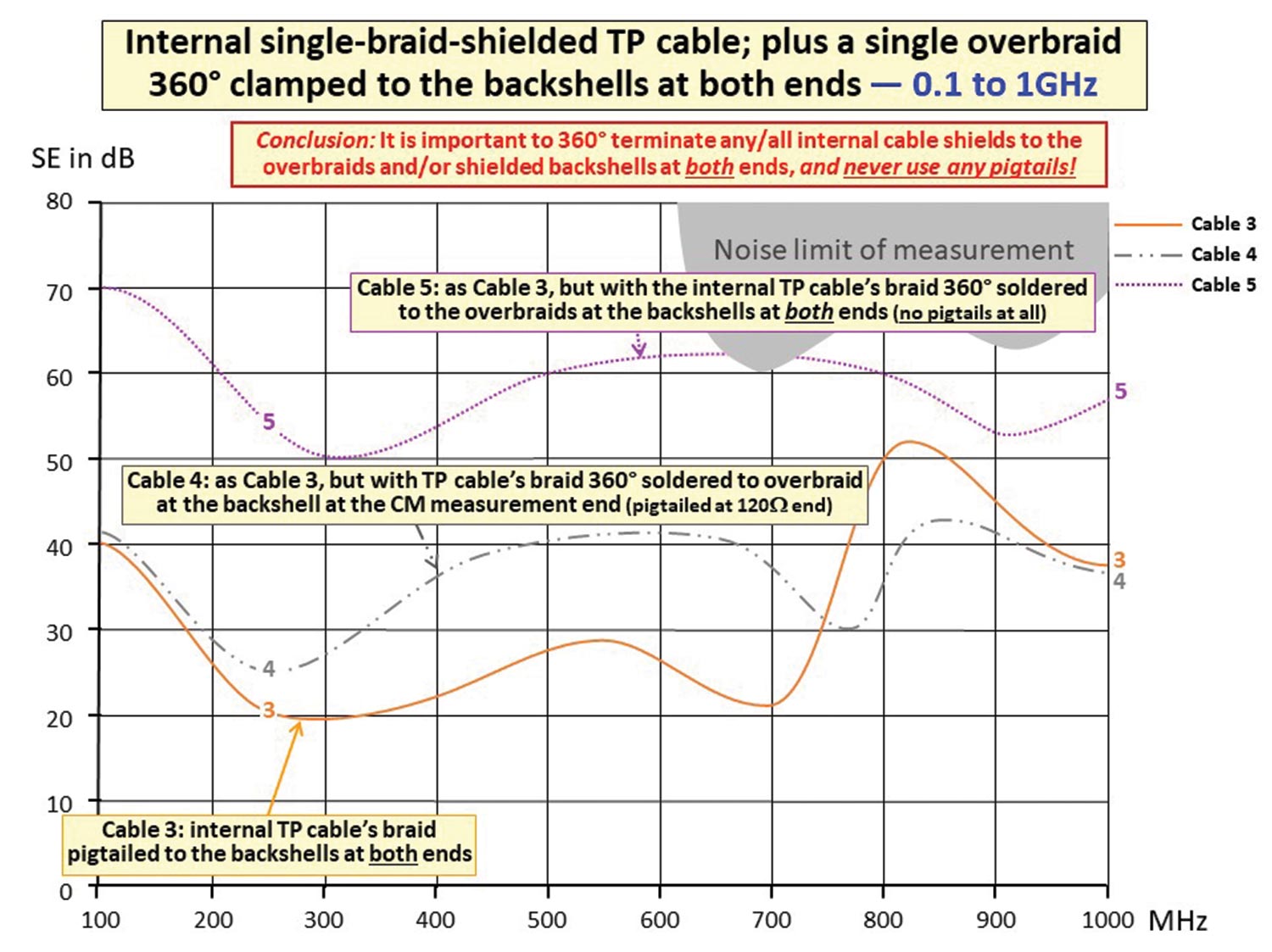
Cables 3, 4, and 5: single-braid-shielded TP cables with single overbraids (i.e., two shield layers in total) (See Figures 4, 10, and 11)
- Cable 3: Insulated single braid TP cable pigtailed to the backshells at both ends; plus a single overbraid 360° clamped to the backshells at both ends.
- Cable 4: Same as Cable 3, but with the internal TP cable’s braid now 360° soldered to the overbraid at the backshell at the CM measured end, but still pigtailed at the 120Ω end (see Figure 7).
- Cable 5: Same as Cable 3, but with the internal TP cable’s braid now 360° soldered to the overbraid at the backshells at both ends (i.e., no pigtails at all).
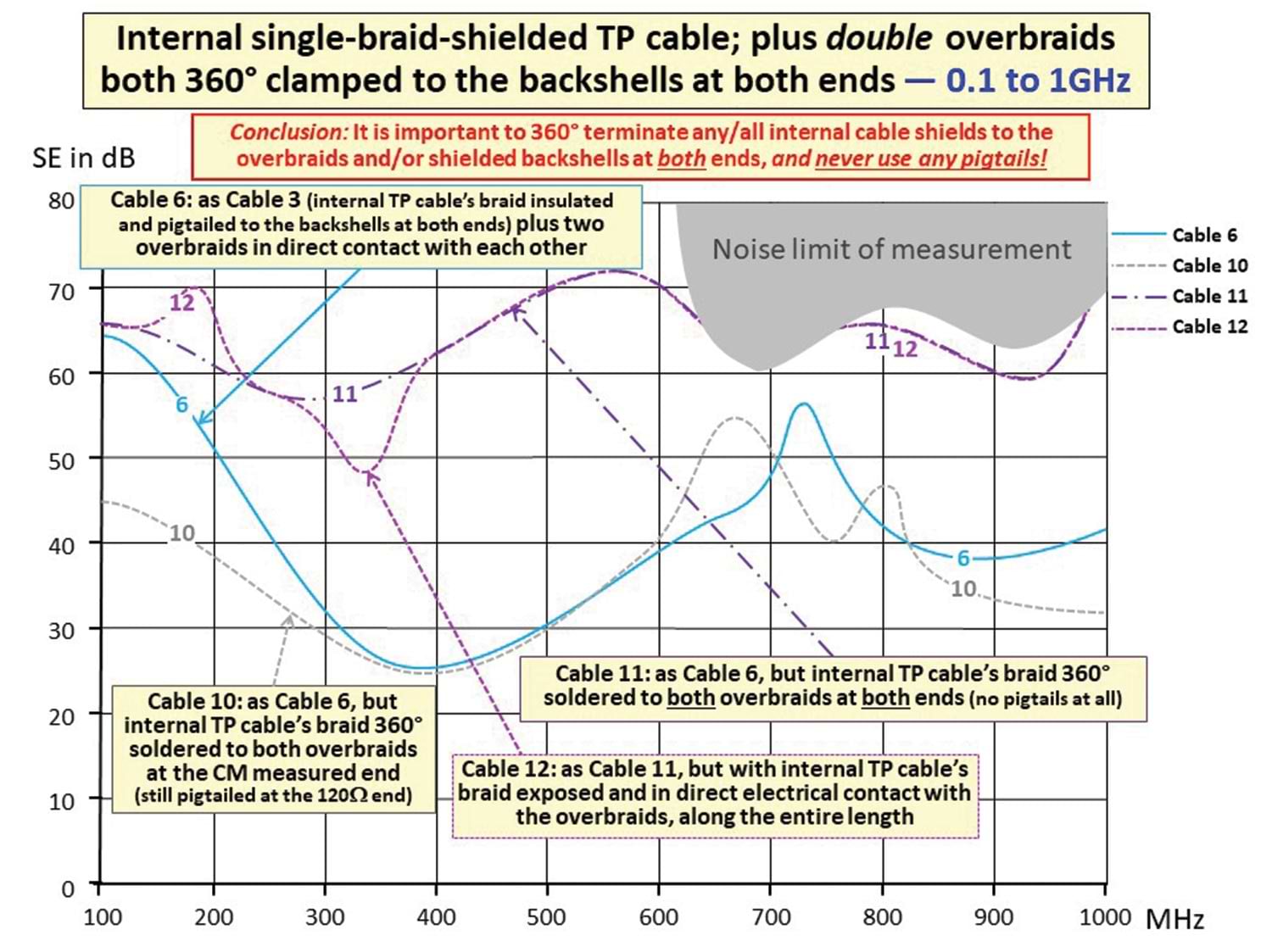
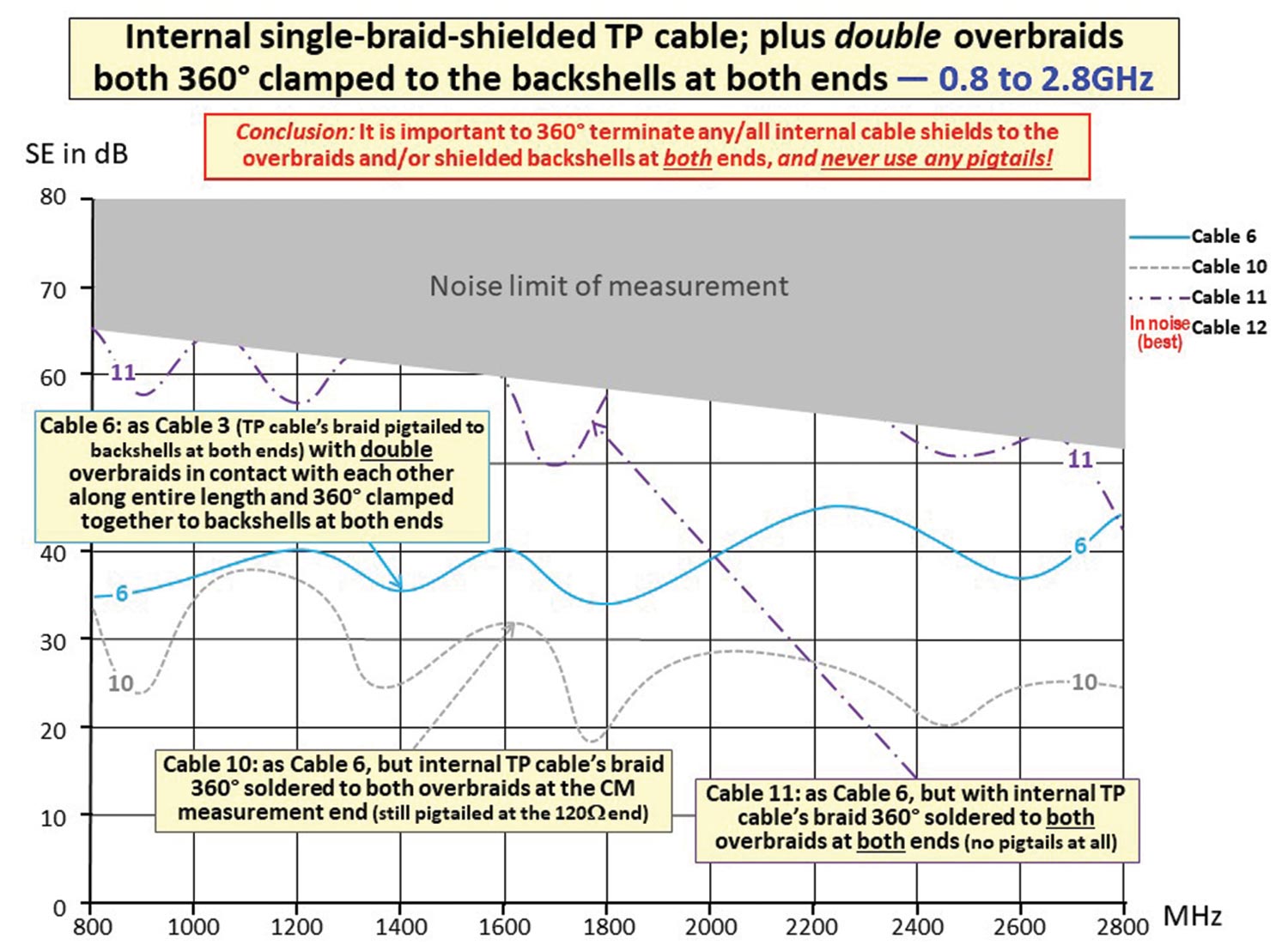
Cables 6, 10, 11, and 12: single-braid-shielded TP cables with double overbraids (i.e., three shield layers in total) (see Figures 5, 12, and 13)
- Cable 6: Same as Cable 3 (internal TP cable with an insulated single braid shield pigtailed to backshells at both ends), but now with double overbraids in direct electrical contact with each other along the entire cable length, and both overbraids 360° clamped together to the backshells at both ends.
- Cable 10: Same as Cable 6, but with the internal TP cable’s braid 360° soldered to both overbraids at the backshell at the CM measured end while still pigtailed at the 120Ω end (see Figure 7).
- Cable 11: Same as Cable 6 but with the internal TP cable’s braid 360° soldered to both overbraids at the backshells at both ends (i.e., no pigtails at all).
- Cable 12: Same as Cable 11, but internal TP cable’s braid exposed and making direct electrical contact with the overbraids along the entire length of the cable. That is, all three braided shields are in direct electrical contact with each other along the entire length of the cable, and all are clamped together in 360° to the backshells at both ends. This cable was very stiff!
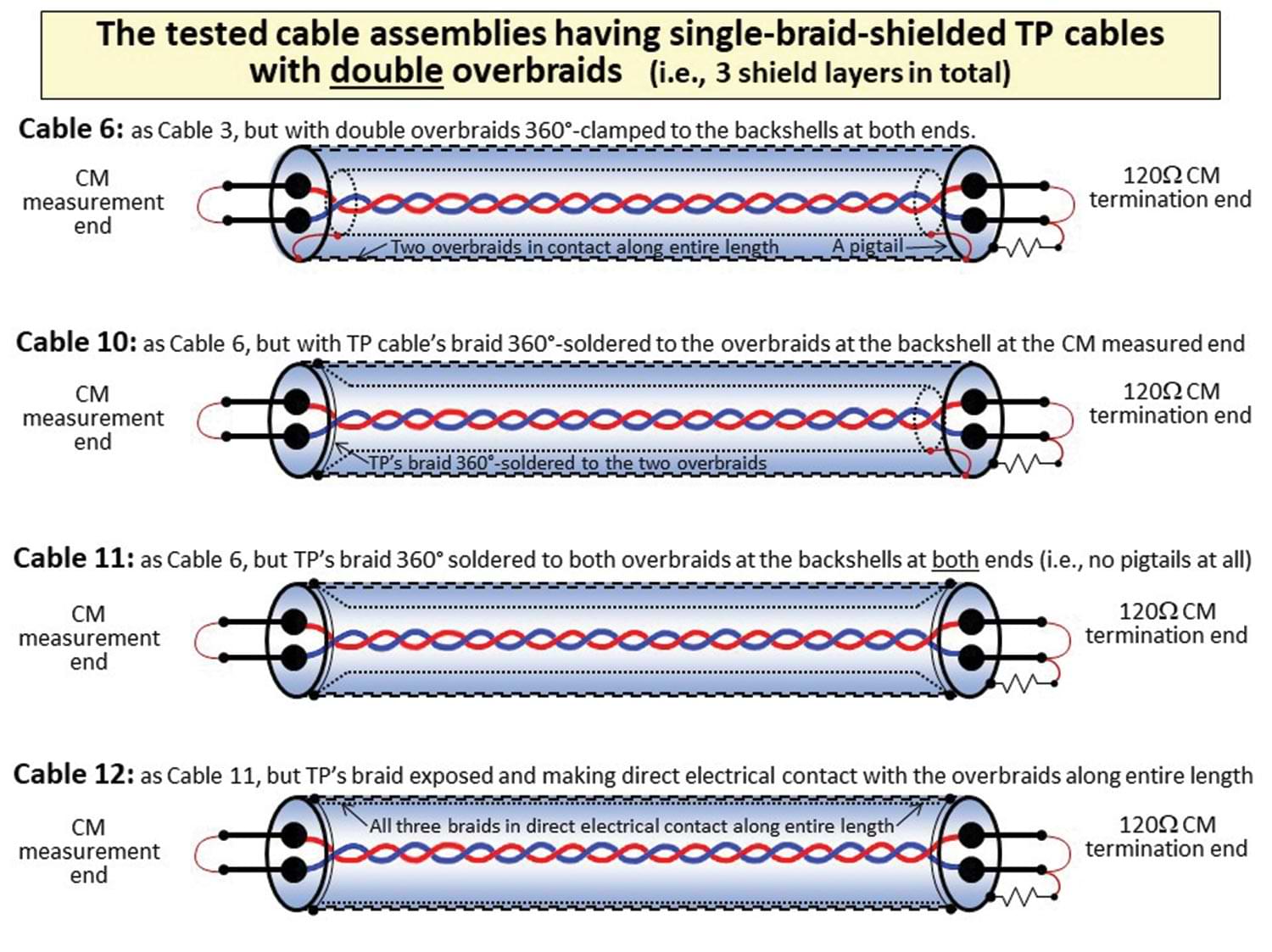
Figure 5: The cable assemblies having single-braid-shielded TP cables with double overbraids (i.e., three braided shield layers in total)
There are many ways of testing the SE of cable assemblies (i.e., cables plus their connectors), and each should be expected to give different results even with identical cable assemblies.
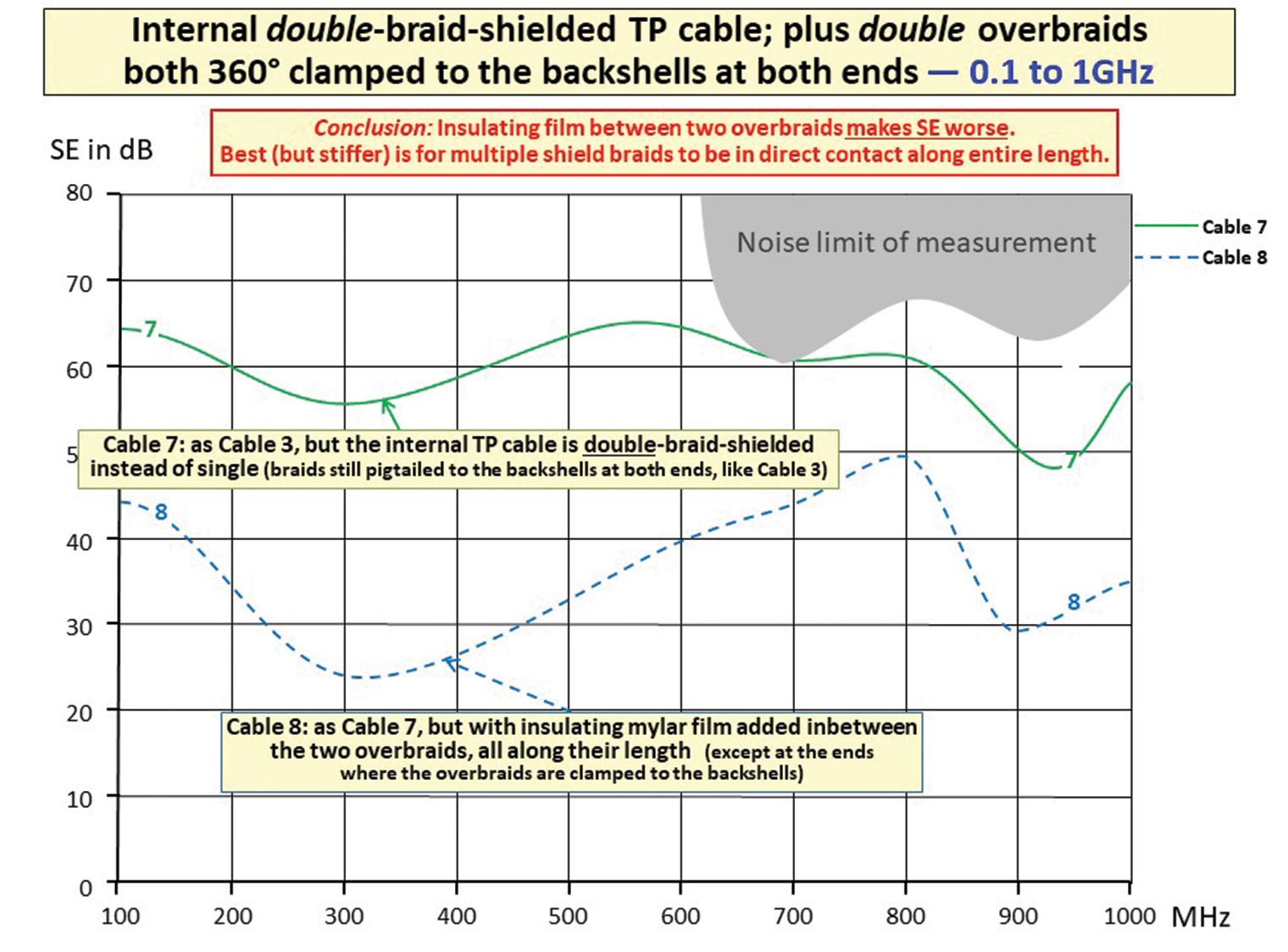
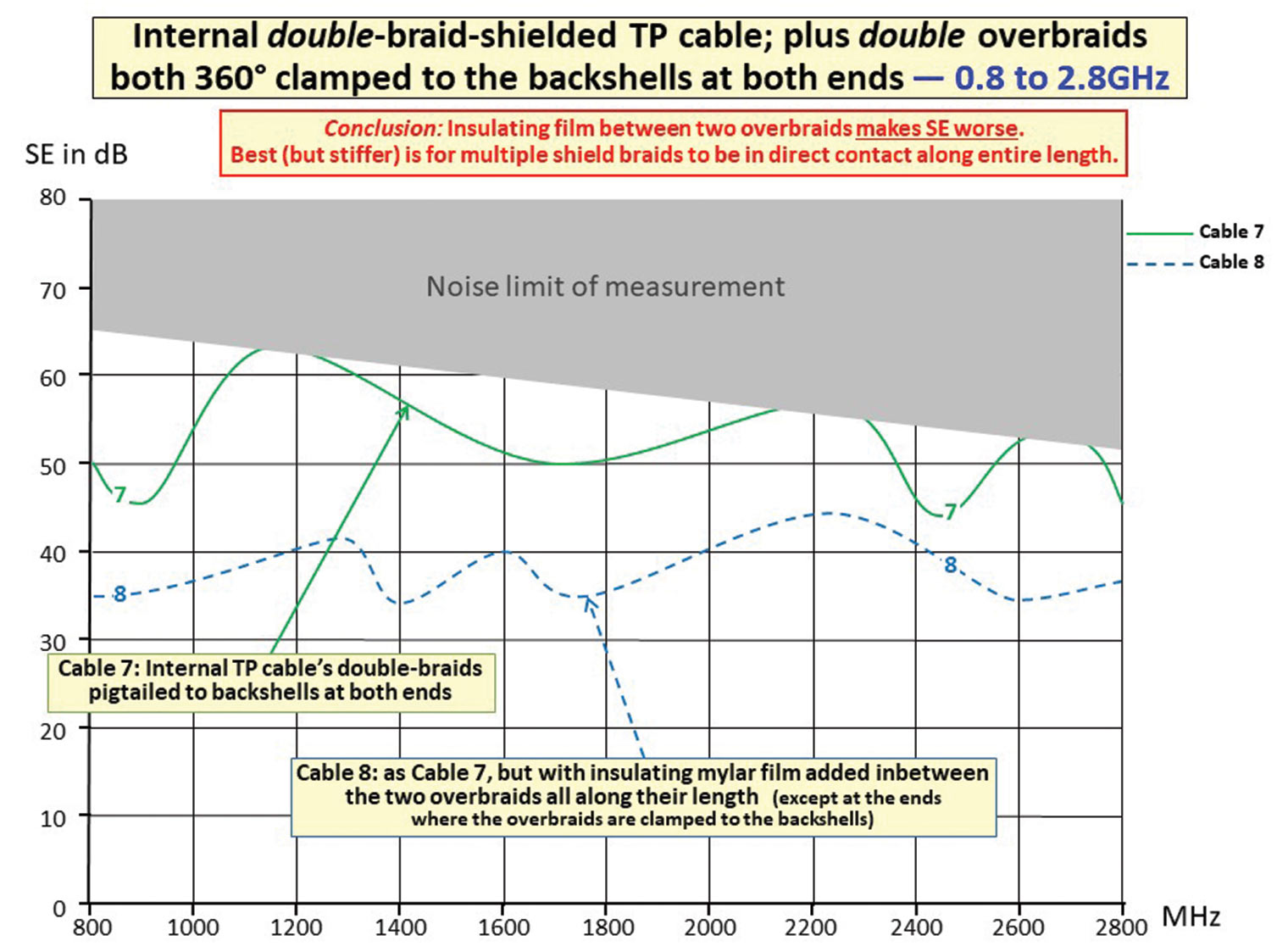
Cables 7, 8, and 9: double-braid-shielded TP cables with double overbraids (i.e., four shield layers in total) (See Figures 6, 14, and 15)
- Cable 7: Same as Cable 6, but with the internal TP cable having double braid shielding in direct electrical contact with each other along its whole length, plus an overall layer of insulation, and pigtailed to the backshells at both ends. Cable 7 also has double overbraids in direct electrical contact with each other along the entire cable, and 360° clamped together to the backshells at both ends.
- Cable 8: Same as Cable 7 but with thin mylar film inserted between the two overbraids (except where they are clamped together to the backshells at both ends).
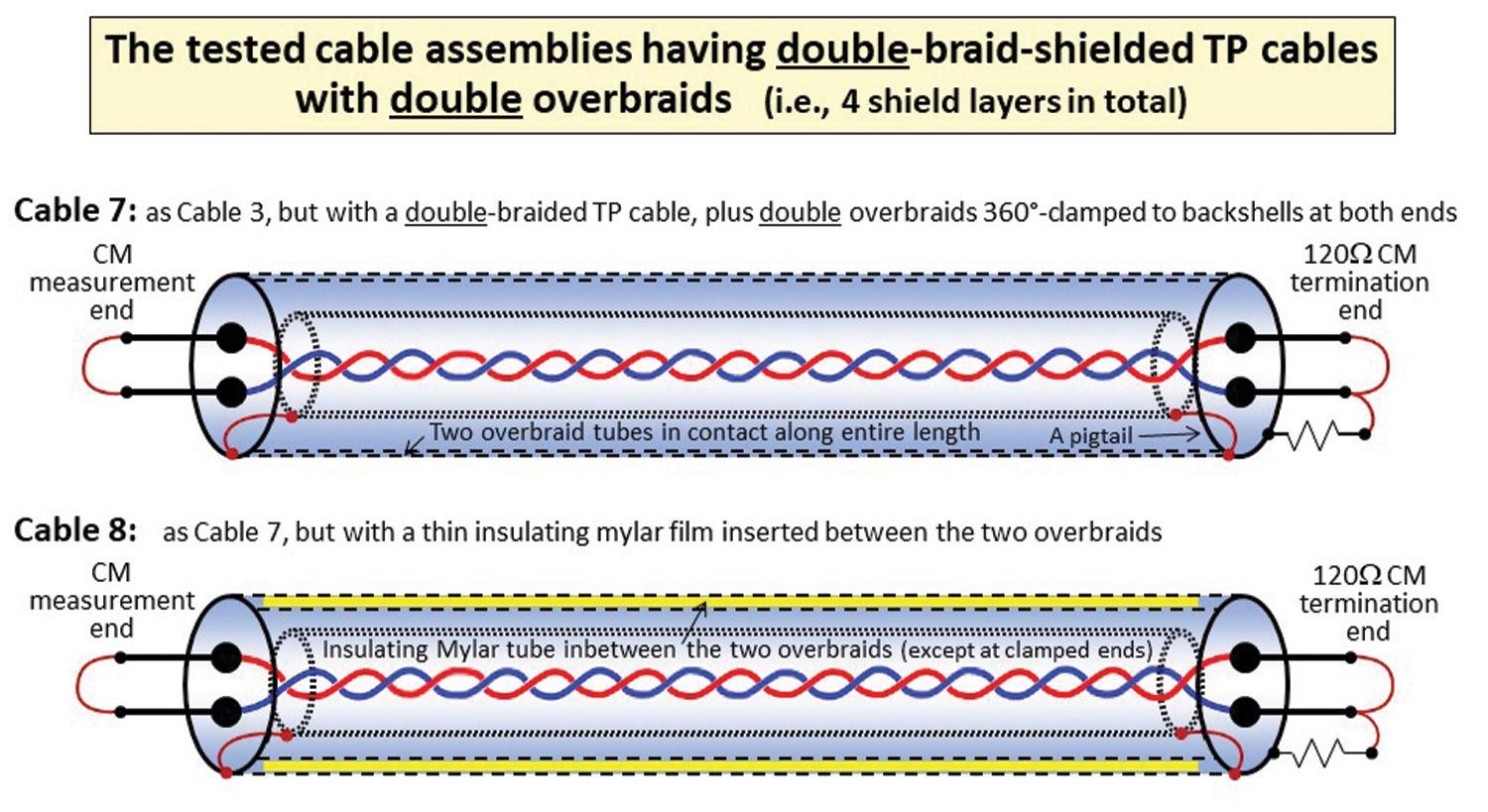
Figure 6: The cable assemblies having double-braid-shielded TP cables with double overbraids (i.e., four braided shield layers in all)

Figure 7: Sketch of the test set-up
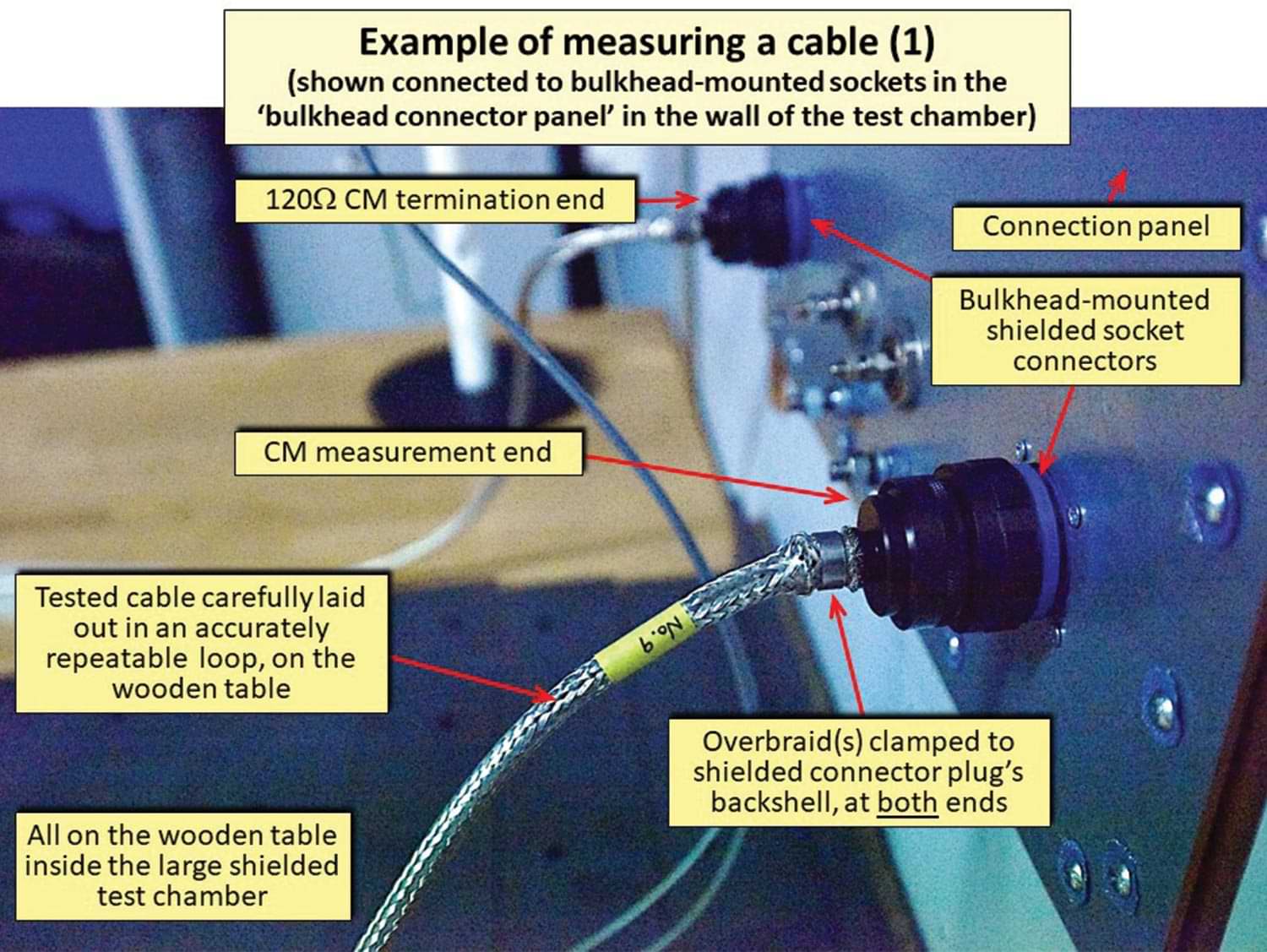
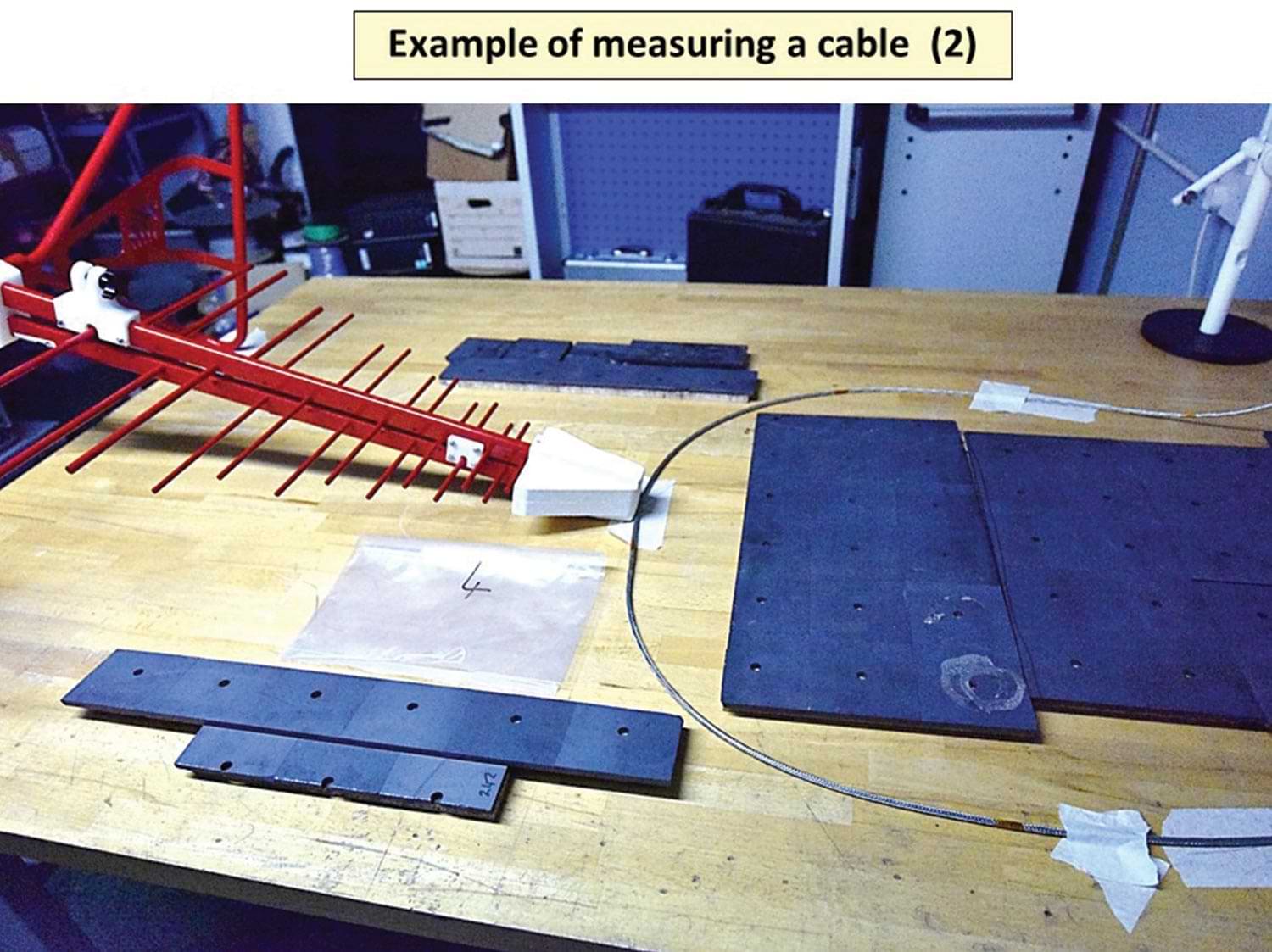
Figure 9: Example of measuring a cable, showing injecting RF into a cable

The worst of the imperfections in this method were canceled out by careful control of consistency and repeatability, and by subtracting the measured results for each cable assembly from the measurements of the Reference unshielded TP cable, Cable 2 (see above, and Figure 4).
The test chamber had once been a large TEMPEST chamber for secure communications, but for a long time had been used as a storeroom.
With a spectrum analyzer, near-field RF probe effective up to 6GHz, and a Tek box TBCG1 radiating comb generator, 100MHz – 6GHz, it did not take long to identify the RF leakages and fix them (corroded spring fingers around the door, and a telephone wire that had been brought in without RF suppression). A connector panel (visible in Figure 8) was designed, fabricated, and affixed to a hole cut in the chamber wall and also checked for RF leaks up to 6GHz.
I would have preferred either an anechoic chamber or a mode-stirred chamber, but at least the metal racking and the stored equipment in the room broke up most of its major resonant modes! And a few scraps of left-over ferrite tiles from an anechoic EMC test chamber were enough to deal with the worst remaining standing waves.
I was not interested in absolute values of SE, only in which cable design/assembly methods were the best for SE. In other words, their relative SE performances. I hoped to extract some general guidance rules for overbraid-shielded cables or cable bundles containing at least one individually shielded TP cable.
To help achieve this, with the imperfect test set-up briefly described above, a null cable (Cable 1, see Figure 4) was first measured. Being just an empty overbraid, the measurement identified any leakages from the antenna to the CM measurement pins of the bulkhead-mounted shielded connector, which included all chamber and panel leakages, and also the leakages inherent in the overbraid and its shield-bonding to the cable connectors, and from the cable connector to the bulkhead-mounted shielded connectors. This measurement showed that leakages were at or below the measurement noise floor for both frequency ranges.
Next, the Reference cable, Cable 2, was measured. This was an unshielded twisted-pair (TP) cable on its own, as shown in Figure 4, and previously described in detail.
Two different RF power amplifiers, one operating at 100MHz – 1GHz and a second at 800MHz – 2.8GHz, were used to cover the two frequency ranges reported in this article, with the above null and reference tests repeated for each amplifier.
To help achieve consistency between the different RF power amplifiers, a triaxial field probe with a fiber-optic cable passed through a waveguide-below-cutoff in the bulkhead connector panel was used to measure the field strengths around the antenna and the measured cables.
External low-noise preamplifiers with good, flat frequency responses over the measured frequency ranges were used before the spectrum analyzer’s input in cases where they would help reduce the noise floor.
All the other measured cables covered by this article consisted of the same null cable assembly used for Cable 1. Additional internal conductors and cables were made by the same very skilled cable assembler, in the same ways, with the same materials, and within a limited time span (a few days) so that we could assume consistency between them.
Given all the above and with the results from each amplifier, subtracting each cable’s results from the reference result should have substantially reduced the effects of:
- Frequency-related variations in the RF power output from each RF amplifier (see Figure 7);
- Frequency-related variations in the antenna’s response to the RF power from the power amplifiers;
- Frequency-related variations in the coupling between the antenna and the measured cables (see Figure 9);
- Frequency-related variations in the reflections from the shielded room (and the items stored in it);
- Frequency-related variations due to RF impedance mismatches in the shielded connectors, and the resulting resonances caused by the length of the cable between them; and
- There are many other possible causes of frequency-related variations in the measurements of the amplitudes of the CM noises picked up by the cables that are also reduced by the subtraction method described above, but they are all much smaller than the five listed above, so are not listed here.
Conclusions for Single-Braid-Shielded TP cables with a Single Overbraid – Cables 3, 4, and 5
- Above 100MHz, the SE of these cables does not generally appear to continually degrade at the rate of 20dB/decade implied in Figure 1. Instead, they generally degrade more gradually and become more consistent as frequency increases. I don’t know why this was the case and will not speculate here.
-
Fluctuations (frequency ripple) of up to ±12dB are seen on Cable 5, as predicted by the TRIAX BRAID curve in Figure 1, and I was pleased to have replicated it here.
Apart from the UK defense standards referenced later, most of the other documents do not mention this effect at all. In my experience, this effect is much less widely known in real-world engineering than whether shields should be terminated at one end, the other end, or both ends.
Ripples up to ±20dB are seen on Cables 4 and 3, which have pigtails at one or both ends, respectively.
- It is important to 360°-terminate any/all internal cable shields to the overbraids and/or backshells at both ends – and never use any pigtails.
Results for Single-Braid-Shielded TP cables with Double Overbraids – Cables 6, 10, 11, and 12
Conclusions for Single-Braid-Shielded TP Cables with Double Overbraids – Cables 6, 10, 11, and 12
-
Above 100MHz, the SE of these cables does not generally appear to continually degrade at the rate of 20dB/decade implied by Figure 1. The SE of Cables 10 and 6, which have pigtails at one or both ends, respectively, degrade more gradually than this as the frequency increases.
However, Cables 11 and 12 (which have no pigtails) maintain a consistent SE up to 1GHz.
Between 1GHz and 2.8GHz, Cable 11’s SE degrades gradually as the frequency increases, but Cable 12’s SE remained so good that it was in the noise floor and we could not measure it with this test set-up in this frequency range.
-
Fluctuations (frequency ripple) of up to ±6dB are seen on Cable 11, a little worse than this for Cable 12.
Ripples up to ±20dB are seen on Cables 10 and 6, which have pigtails at one or both ends, respectively.
- It is important to 360°-terminate any/all internal cable shields to the overbraids and/or backshells at both ends – and never use any pigtails.
Note: both of these cables use an internal TP cable with a double shield that is pigtailed at both ends.
- Above 100MHz, the SE of these cables does not appear to continually degrade as fast as the rate of 20dB/decade implied by Figure 1.
- Fluctuations (frequency ripples) of up to ±20dB are seen, which is fairly typical of all the cables that use pigtails, at one or both ends, in all these measurements.
-
Adding an insulating film between two overbraids makes SE worse (not up to 30dB better, as claimed in some of the later references).
It is much better for SE (although not for mechanical flexibility) for multiple overbraids to be in direct contact along their entire length.
- Comparing the measurements of Cables 7 and 8 with those of the other cables discussed in this article, we see that their rate of fall in SE as frequency increases and their frequency ripples affirm the need to 360°-terminate any/all internal cable shields to the overbraids and/or backshells at both ends – and never use any pigtails.
Few publications in the public domain (including mine) address how to terminate the shields of individually shielded cables within overbraided cables or cable bundles (ignoring those recommending pigtailing through connector pins!).
This is perhaps because it tends to be an issue for high-spec military or aerospace companies, whose internal design/assembly guides often seem to me to be specifying outdated or non-cost-effective practices, such as pigtailing via connector pins, or requiring a great deal of (costly!) manual assembly by skilled personnel (e.g., 360° soldering an internal braid to an overbraid).
How to cost-effectively terminate cable shields could, on its own, easily fill a whole article, but rather than extend this article by a few thousand words I’ve added Figures 16 to 18 on pages 138 and 139, taken from my training course on cable EMC [25], and hope they are sufficiently self-explanatory.
![Slide 2.7.23 from [25]](https://digital.incompliancemag.com/asset/2023/02/incomp_mar2023-getting_best_emc-figure16.jpg "Figure 16")
![Slide 2.7.24 from [25]](https://digital.incompliancemag.com/asset/2023/02/incomp_mar2023-getting_best_emc-figure17.jpg "Figure 17")
![Figure 18: Slide 2.7.25 from [25]](https://digital.incompliancemag.com/asset/2023/02/incomp_mar2023-getting_best_emc-figure18.jpg "Figure 18")
I would also like to thank the many people at LM(UK) who helped with these tests, particularly the following:
- Paul Moore (who made the resources available);
- Richard Clark (for helping convert his storeroom back into a shielded room);
- Chris Angove for his assistance with the shielded room and the measurements (including performing most of them and processing their data); and,
- Sean Tunn for his awesome knowledge and expertise in making shielded military cable assemblies.
- Ministry of Defence (UK), Defence Standard 59-411 Part 5, Issue 3, 14 June 2019, “Electromagnetic Compatibility – Part 5: Code of Practice for Tri-Service Design and Installation.”
- All conductors (including any metalwork) are accidental antennas (whether we want them to be or not!). See https://www.emcstandards.co.uk/the-physical-basis-of-emc and/or the webinars available at https://www.emcstandards.co.uk/understanding-emc-basics-a-3-part-series.
- Ministry of Defence (UK), Defence Standard 59-41 (Part 7)/Issue 1, 10 November 1995, “Electromagnetic Compatibility – Part 7: Code of Practice for HM Ships – Installation Guidelines.”
- Ministry of Defence, Defence Standard 59-41 (Part 6)/Issue 1, 26 August 1994, “Electromagnetic Compatibility – Part 6: Code of Practice for Military Vehicles – Installation Guidelines.”
- SSP 30242 Revision E, NASA, “Space Station Cable/Wire Design and Control Requirements for Electromagnetic Compatibility – International Space Station,” Revision E, 22 December 1998.
- MIL-HDBK-1857, 27 March 1998, “Department of Defense – Handbook – Grounding, Bonding, and Shielding Design Practices.” This is an unchanged re-issue of MIL-STD-1857 (EL), dated 30 June 1976.
- MIL-STD-1310G (Navy), 28 June 1996, “Department of Defense – Standard Practice for Shipboard Bonding, Grounding, and Other Techniques for Electromagnetic Compatibility and Safety.”
- NAVAIR AD 1115, “Electromagnetic Compatibility Design Guide for Avionics and Related Ground Support Equipment,” 3rd Edition June 1988.
- IEC 61000-5-2:1997, “Electromagnetic Compatibility (EMC) – Part 5: Installation and mitigation guidelines – Section 2: Earthing and cabling,” from the BSI and IEC web shops.
- “EMC for Systems and Installations,” Tim Williams and Keith Armstrong, Newnes 2000, 0-7506-4167-3, https://www.emcstandards.co.uk/emc-for-systems-and-installations2.
- Patrick G. André and Kenneth Wyatt, EMI Troubleshooting Cookbook for Product Designers, Scitech Publishing, 2014, ISBNs: 978-1-61353-019-1 (hardback) 978-1-61353-041-2 (PDF), see subsections 4.8.1 and 6.8.
- Henry W. Ott, Noise Reduction Techniques in Electronic Systems, Second Edition, 1988, Wiley Interscience, ISBN 0-471-85068-3.
- William G. Duff, Designing Electronic Systems for EMC, Scitech Publishing, 2011, ISBN: 978-1-891121-42-5.
- Elya B. Joffe and Kai-Sang Lock, Grounds for Grounding, Wiley, IEEE Press, ISBN: 978-0471-66008-8.
- “Unleash the Full 5G Potential with mmWave,” https://www.qualcomm.com/research/5g/5g-nr/mmwave.
- “Fact Sheet: Spectrum Frontiers Rules Identify, Open Up Vast Amounts of New High-Band Spectrum for Next Generation (5g) Wireless Broadband,” https://docs.fcc.gov/public/attachments/DOC-340310A1.pdf.
- “There are no low-frequency systems any more!” https://www.emcstandards.co.uk/there-are-no-low-frequency-systems-any-more. Also relevant:
https://www.emcstandards.co.uk/ground-power-bounce-cause-noise-emissions-from. - “Shielding and Filtering Don’t Work Independently of Each Other,” https://www.emcstandards.co.uk/shielding-and-filtering-don-t-work-independen. Also relevant: https://www.emcstandards.co.uk/skin-effect-and-surface-currents1.
- “Saving time and money with good EMC design,” https://www.emcstandards.co.uk/saving-time-and-money-with-good-emc-design2.
- https://www.emcstandards.co.uk/testimonials-2014 https://www.emcstandards.co.uk/testimonials-2017
- “What’s in a name?” https://www.emcstandards.co.uk/what-s-in-a-name.
- “Earth Loops, Ground Loops, and Hum Loops,” https://www.emcstandards.co.uk/earth-loops-ground-loops-and-hum-loops.
- Lothar O. Hoeft and Joseph S. Hofstra, “Electromagnetic Shielding Provided by Selected DB-25 Subminiature Connectors,” IEEE 1991 International Symposium on EMC, August 12-16, 1991, Cherry Hill, NJ., ISBN: 0-7803-0158-7, https://ieeexplore.ieee.org/document/148182.
- Michel Mardiguian, “Simple Method for Predicting a Cable Shielding Factor, Based on Transfer Impedance,” Interference Technology Magazine, EMC Directory & Design Guide 2012, http://www.interferencetechnology.com/wp-content/uploads/2012/03/Mardiguian_DDG12.pdf.
- Cherry Clough Consultants’ EMC Training Course, Module 2, EMC in Cable Interconnections; course notes, https://www.emcstandards.co.uk/2-emc-in-interconnections-techniques-for-cables.
- In the context of this article, the words: screened; screen, or screening may be replaced by shielded; shield, or shielding respectively, and vice-versa, without any changes in meanings.
- EMC = Electromagnetic Compatibility, the engineering discipline of ensuring that: a) electromagnetic emissions are low enough for radio/telecommunications and other electronic equipment to function as intended without suffering from unacceptable electromagnetic interference (EMI); and that, b) the electromagnetic immunity of equipment is sufficient for it to function as intended in the electromagnetic environment expected to be present where it is used.