

ireless connectivity has had such an impact on how we conduct our daily lives. With the wires removed, we are suddenly able to be connected to almost anyone, anywhere and anytime. According to a report released by IDC Research, 3.8 billion Wi‑Fi devices were shipped in 2023.
Over the last few years, the number and complexity of Wi‑Fi standards has grown. The United States (U.S.) opened up the 6 GHz band, while the European Union (EU) opened up about half of the 6 GHz bands for Wi‑Fi 6E and now Wi‑Fi 7. Although the Wi‑Fi 7 standard has yet to be formally adopted, manufacturers have already released Wi‑Fi 7 products. Each new standard offers more: more bandwidth, more data transfer options, and more capability.
However, one of the final steps to introducing new wireless products to the market is regulatory approval. And with each wireless standard, the regulatory requirements get more challenging. Focusing primarily on the U.S. and EU, this article will review the changes introduced by each wireless standard and discuss the measurement challenges in achieving regulatory approval.
Table 1 shows the significant changes introduced with the 802.11ax standard and their impact on the radio interface.
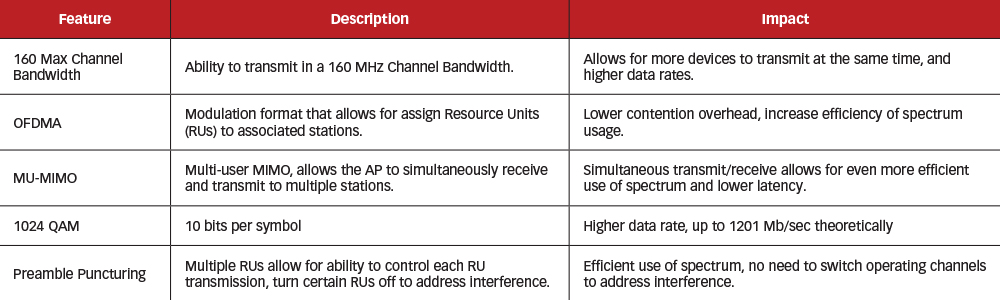
Perhaps the first thing most will notice is the wider bandwidth. This allows for the use of 160 MHz, or 80+80 MHz noncontiguous channel bandwidths in the 5 or 6 GHz frequency bands. This allows for more data to be transmitted compared to the previous 80 MHz. This is optional but most likely standard for these devices.
Orthogonal Frequency Division Multiple Access (OFMDA)
An extension to the OFDM that was already available, this system allows for sharing of the channel with multiple clients simultaneously. This is a mandatory feature for both the down link (DL) and up link (UL) and allows for a more efficient use of the spectrum.
Multiple User – Multiple Input Multiple Output
This feature, along with OFDMA, allows for up to eight spatial streams and simultaneous transmissions to each client. This feature potentially allows for continuous transmission and reception to multiple clients at the same time. The Down Link (DL) MU-MIMO is mandatory, and Up Link (UL) MU-MIMO is optional.
1024 Quadrature Amplitude Modulation (QAM)
1024 QAM is an extension of the modulation technique used for the previous standard, 802.11ac. This means that the I/Q constellation has 1024 points in its constellation and allows for transmitting 10 bits per symbol, allowing for higher data rates over previous standards.
Preamble Puncturing
This is an optional feature for Wi-Fi 6, and I am not aware of any commercial products that have enabled this feature. This feature is used with OFDMA to allow transmissions to be stopped in certain subcarriers, mostly as a way to avoid interference from other signals (noise or other transmitters). This allows the devices to continue transmitting in the same channel but avoiding parts of the channel while the interference is present.
Table 2 shows the significant features added for 802.11be and its impact on the radio interface.
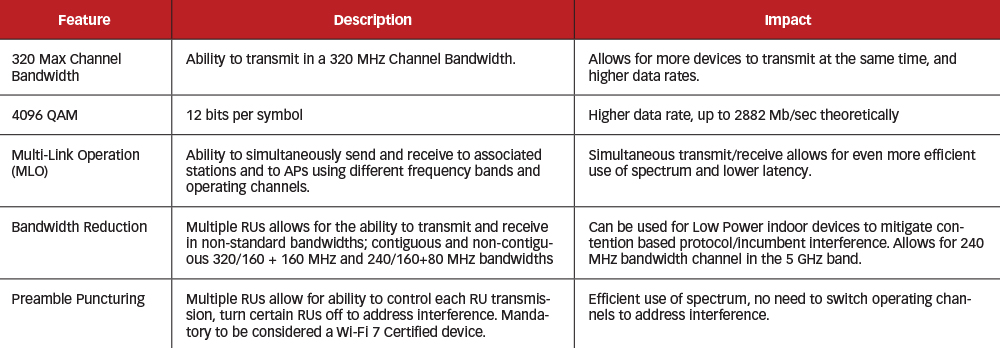
This is optional for both the 5 and 6 GHz band but typically the first feature to be implemented due to the increase in potential data rates. It is even possible to implement a 240 MHz bandwidth as well. I know of one commercial AP that is using a 240 MHz channel in the 5 GHz band.
4096 QAM
4096 QAM allows for 4,096 points in the constellation, as compared to 1,024 for Wi-Fi 6. This equates to 12 bits per symbol, compared to 10 for Wi-Fi 6. Thus, again, higher data rates, theoretically up to 2882 Mbits/sec.
Multi-Link Operation (MLO)
MLO allows sending/receiving packets concurrently on multiple channels which can be either in the same band or different bands. It is designed to provide:
- High spectrum efficiency
- Low latency
- Load balancing
- High reliability
With the adaptive connections possible with Wi-Fi 7, it is possible to reduce the bandwidth of the current operating channel. This could be for either avoiding interference in part of the channel, or a way to optimize the use of the network when only part of a nominal channel is available. This allows the devices to stay on the same channel instead of either stopping transmissions or having to find a free channel. This is not the same as preamble puncturing.
Preamble Puncturing
While optional for Wi-Fi 6, it is mandatory for Wi-Fi 7 certified devices. This allows the devices to notch out, or puncture, part of the original channel to avoid interference and keep transmitting on the current channel. While the overall data rate may reduce, it prevents the devices from having to vacate the whole channel and move to another channel.
“The 6 GHz band is currently populated by, among others, microwave services that are used to support utilities, public safety, and wireless backhaul. Unlicensed devices will share this spectrum with incumbent licensed services under rules crafted to protect those licensed services and enable both unlicensed and licensed operations to thrive throughout the band…”
“…The harmonisation decision will make 480 MHz of additional spectrum available in the 6 GHz band. It will almost double the amount of available spectrum, adding to the 538.5 MHz available in the 2.4 GHz and the 5 GHz bands…
“…Member States shall make this frequency band available for the implementation of Wi‑Fi by 1 December 2021…”
The FCC is responsible for setting the rules and specifications for devices that use the spectrum in the U.S. Those specifications are found in the Code of Federal Regulations (CFR). The following sections contain the rules and specifications for the different frequency bands in the U.S.:
- Part 15 Subpart C Intentional Radiators – 15.247 Operation with the bands 902-928 MHz, 2400-2483.5 MHz, and 5725-5850 MHz – for the 2.4 GHz band; and
- Part 15 Subpart E Unlicensed National Information Infrastructure (U-NII) Devices – 15.407 General technical requirements – for the 5 and 6 GHz bands.
- KDB 558074 D01 Meas Guidance v05r02 – Measurement Guidance for the 2.4 GHz band;
- KDB 905462 D02 UNII DFS Compliance Procedures New Rules v02 – Dynamic Frequency Selection for the 5 GHz band;
- KDB 789033 D02 General UNII Test Procedures New Rules v02r01 – Measurement Guidance for the 5 GHz band;
- KDB 987594 D02 U-NII 6 GHz EMC Measurement v03 – Measurement Guidance for the 6 GHz band; and
- KDB 987594 D05 AFC DUT Test Harness Testing v01r01

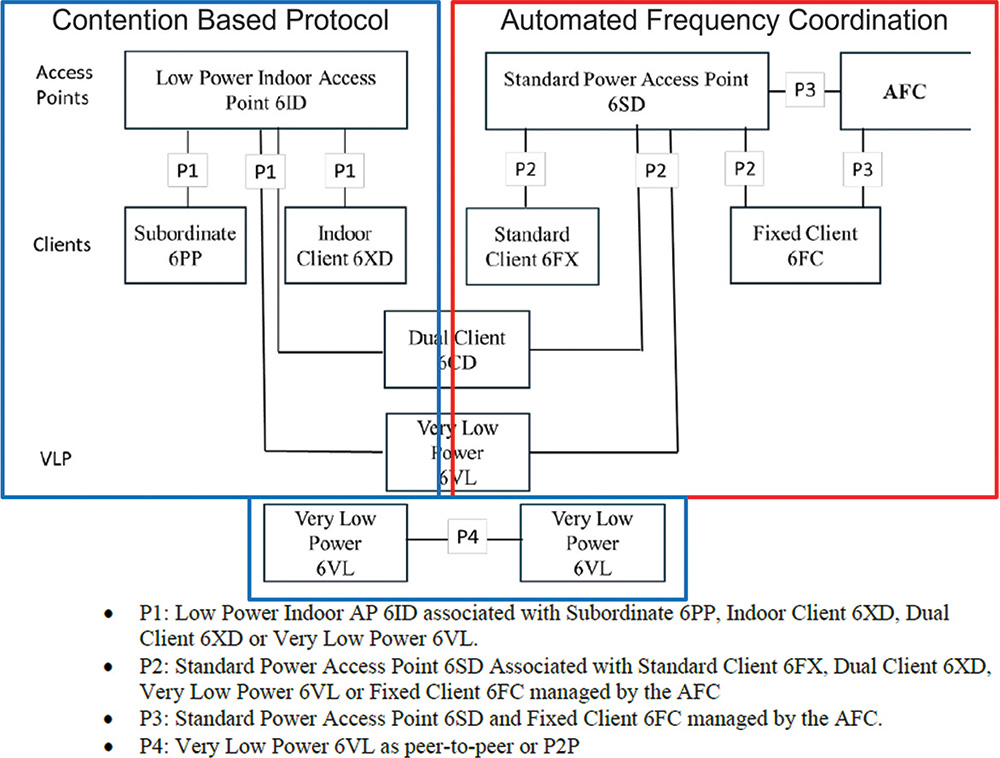
The devices on the right side were recently authorized for use by the FCC (August 2023). These devices must be associated with a standard power (SP) access point (AP) and are managed by an automated frequency coordination (AFC) system. These devices are typically designed for outdoor use and thus must ensure they are not transmitting on frequencies that are known to be used by incumbents in the immediate area.
Figure 2 shows the recently approved (October 2024) equipment classes that now include very low power (VLP) devices. These devices may be connected to an access point or operate in a peer-peer association (think augmented reality (AR), etc.). Note that VLP devices that are in a peer-peer association are not required to be managed by an AFC system unless they are also connected to an SP AP. VLP devices can be used either indoors (LPI environment) or outdoors (SP environment) and must implement a CBP and Transmit Power Control (TPC) functionality. With the recently published Third Rule and Order, the FCC also allows these devices to use the whole 6 GHz band (5925 – 7125 MHz).
EU
The European Commission determines the directives for radio devices (known as the Radio Equipment Directive, or RED). Article 3(2) of the RED states that:
- EN 300 328 V2.2.2 – covers the harmonized standards for the 2.4 GHz band;
- EN 301 893 V2.1.1 – covers the harmonized standards for the 5 GHz band, including DFS; and
- EN 303 687 V1.0.0 – covers the harmonized standards for the 6 GHz band.
- Restricted equipment classes – Similar to the FCC approach, ETSI only allows two types of equipment classes for use in the 6 GHz band:
- Low power indoor (LPI): Similar concept as the FCC, limited power and for indoor use only; and
- Very low power (VLP): Right now, this is for narrowband restricted devices. Currently, no AFC system is in use in the EU.
- No channels above 6425 MHz – Rather than worry about interference in the upper half of the spectrum, the use of unlicensed devices is not allowed.
- Adaptivity interference testing – This method has been in use for many years, and for all frequency bands. ETSI has a more restrictive approach to devices managing incumbents and is similar to CBP in that devices must stop transmitting while incumbents are transmitting.
- Punctured channel masks – For those devices employing channel or preamble puncturing, there are very well-defined emission masks for the punctured sub-channels as part of the harmonized standard.
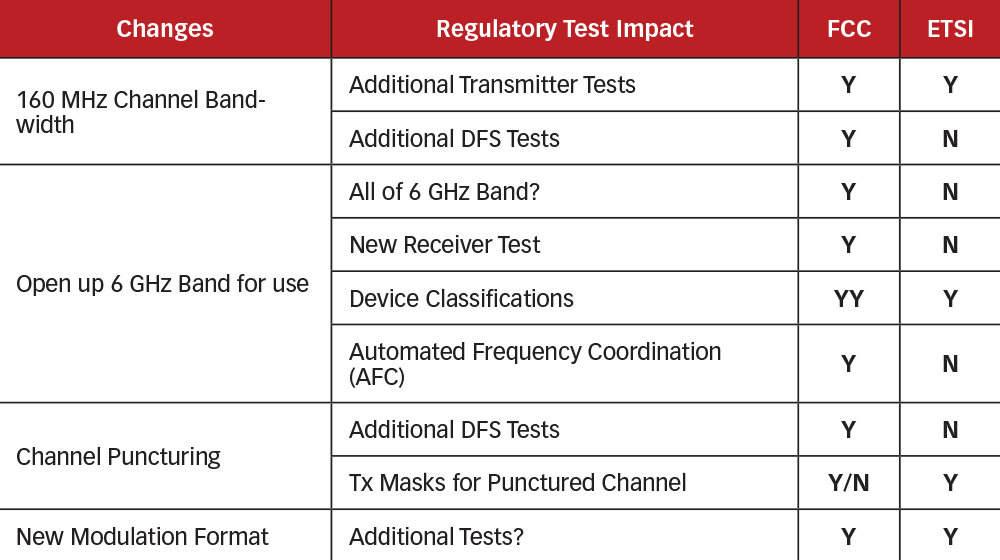
Table 3 lists the regulatory testing impact of the changes introduced with the Wi‑Fi 6E standards.
160 MHz Bandwidth
- Adding a new bandwidth will require additional transmitter tests for both the FCC and ETSI. These tests are required for each operating mode of a device, which includes the channel bandwidth, and for each frequency band with the new bandwidth.
- The additional bandwidth will add DFS tests for the FCC. The FCC requires that several of the tests be conducted for each channel bandwidth (KDB 905462). For ETSI, the focus is on testing, potentially, the lowest and highest bandwidth, so this is not adding any additional testing.
- As mentioned earlier, the FCC opened up the whole 6 GHz band, allowing for 60-20 MHz channels, and seven (7) 160 MHz channels. More channels mean more testing, as tests are typically on the low, mid, and high channels of the band. For the EU, there are only three (3) 160 MHz channels available.
- The FCC added a new receiver test for LPI devices, contention-based protocol. Any device that is associated with an LPI AP must employ a CBP system. VLP devices must also employ a CBP system even if they are not connected to an LPI AP. ETSI has always had a receiver-based detection system, so this does not add any new receiver tests.
- As discussed above, both the FCC and ETSI manage the 6 GHz band by defined classes of equipment. Each device will have specific maximum output power limits and interference management techniques.
- The FCC has added the AFC requirement for standard power devices, those that would typically be used outside. This relies on a requirement for the AP to request frequency and power limits based on its geolocation. All devices connected to that AP must also adhere to the frequency and power limits dictated by the AP. ETSI currently does not employ an AFC system.
- If the feature is employed in Wi‑Fi 6E, it can be used in the 5 GHz band to avoid interference with detected radar signals (DFS Requirement). This will require additional tests for the punctured channel. It is unclear if ETSI requires additional tests for DFS for punctured channels in the 5 GHz band.
- No new Tx masks are required for the FCC for the 6 GHz band. There are Tx mask requirements for the 5 GHz band. ETSI currently has Tx masks specified for punctured channels in both the 5 and 6 GHz bands.
It is currently unclear if this will add new testing, but both the FCC and ETSI require that the devices be tested under the worst-case conditions. It is also unclear if the higher-density QAM modulation will represent a worst-case condition, but it will have to be investigated as part of pre-compliance testing to determine its impact.
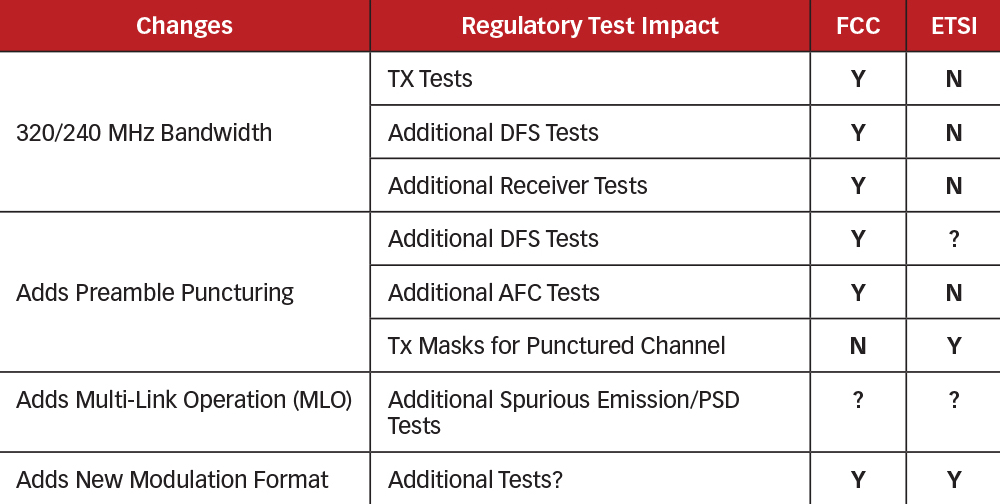
320/240 MHz Bandwidth
- Similar to the requirement for Wi‑Fi 6E, adding a new bandwidth will require additional testing for the FCC for all operating modes for transmitter tests. ETSI does not currently support bandwidths greater than 160 MHz.
- The possibility of using a 240 MHz bandwidth in the 5 GHz bandwidth will add additional DFS testing for the FCC only. ETSI currently does not support bandwidths wider than 160 MHz.
- Similar to the requirement for Wi‑Fi 6E, the FCC added CBP tests for LPI devices in the 6 GHz band. ETSI already has receiver tests, so there are no additional tests required.
- Similar to the requirement for Wi‑Fi 6E, the use of preamble, or channel, puncturing in the 5 GHz band will require additional DFS tests for the FCC only. ETSI supports preamble puncturing, but it is unclear if additional tests would be required to satisfy DFS requirements.
- The FCC will have new tests for the AFC functionality for punctured channels for devices that are either a SP AP or connected through a SP AP. ETSI currently does not support an AFC system.
- The FCC does require a spectral emission mask for the 6 GHz band but does not require different masks due to preamble puncturing. It does, however, require a Tx emissions mask for punctured channels in the 5 GHz band. ETSI has already defined spectral emission masks for punctured channels in the 5 and 6 GHz bands.
This feature allows a Wi-Fi 7 device to transmit on more than one channel or frequency band at one time. This change may or should require additional testing. The FCC states that it is recommended to verify that a device, when transmitting in different bands, does not exceed the spurious emission requirements, or if transmitting in the same band, that the total power spectral density (PSD) does not exceed the limits. I have seen several test reports where the test lab indicates that they have looked at the MLO operation and saw nothing of concern. It is unclear if there is a similar requirement from ETSI on this topic as well.
New Modulation Format
It is currently unclear whether this will add new testing, but both the FCC and ETSI require that the devices be tested under the worst-case conditions. It is also unclear if the higher-density QAM modulation will represent a worst-case condition, but it will have to be investigated as part of pre-compliance testing to determine its impact.
CBP was implemented as part of the requirements for LPI devices that are operating in the 6 GHz bands. The overall requirement is that, if there is an incumbent signal detected by a device at a level of -62 dBm or lower anywhere in the channel, the device must stop transmitting completely in that channel until the incumbent is no longer detected.
For Wi‑Fi 7, it is possible for paired devices to use bandwidth reduction, that is, reduce the bandwidth of the operating channel to avoid the incumbent signal. If your devices support that, you would be required to perform the CBP test in this scenario. This will require a tuned measurement on the sub‑channel where the incumbent was detected.
The FCC has not provided any guidance for addressing this issue, so we advise consulting with an FCC-authorized Telecommunications Service Body (TCB) for final review and approval. However, a suggested measurement procedure would likely include the following steps:
- Set the center frequency of the spectrum analyzer to the center of the sub‑channel where the incumbent was detected.
- Set frequency span to zero span.
- Ensure that the resolution bandwidth (RBW) is not too wide to detect the signal from the remaining channel.
- Use the existing CBP measurement procedure for 90% detection probability.
At the October 2023 TCB Workshop, the FCC summarized the results of discussions between industry and the FCC on the subject of emission mask requirements for punctured channels in the 6 GHz band. After lengthy discussions and review, the FCC stated (and included in KDB 987594) that if channel puncturing is used in the 6 GHz Band:
- For standard power devices, the emission mask of a channel that has employed channel puncturing and the emission mask requirements are the same as those for the whole operating channel. The device, however, must comply with all AFC requirements; that is, the power level within the punctured sub‑channel must be at or below the power that the AFC systems would permit across the whole sub‑channel.
- For low power indoor devices, channel puncturing is not permitted, as CBP must be used if incumbents are detected anywhere inside the operating channel.
5 GHz Band
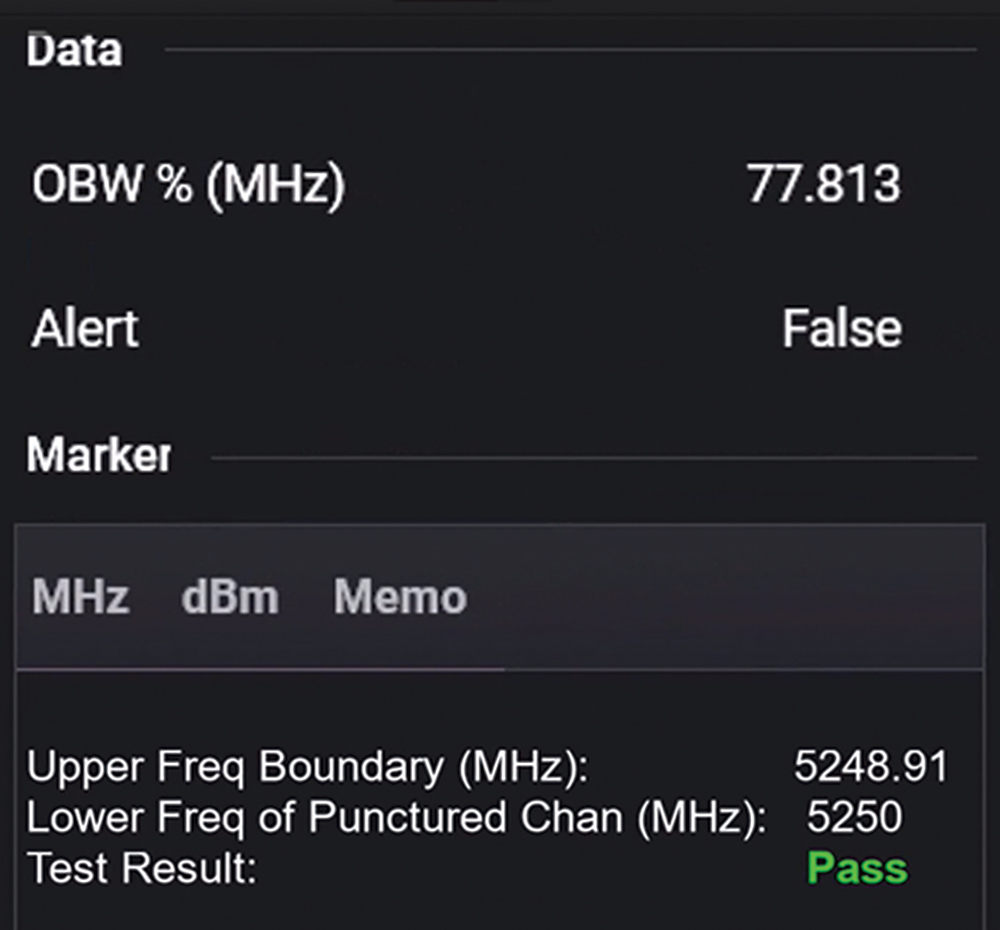
The 5 GHz band represents a different challenge for emission masks for the 5 GHz band. Currently, there are no in-band emission mask requirements for the 5 GHz band. But the FCC made a change to address when channel puncturing is used to avoid an incumbent/radar signal in the 5 GHz band. From KDB 789033 D02:
- Measure emissions or 99% bandwidth of both sides of puncture
- Verify that the bandwidth upper frequency of left sub‑channel is not greater than the center frequency of sub‑channel – 10 MHz and
- Verify that the bandwidth lower frequency of the right sub‑channel is not greater than the center frequency of sub‑channel + 10 MHz.
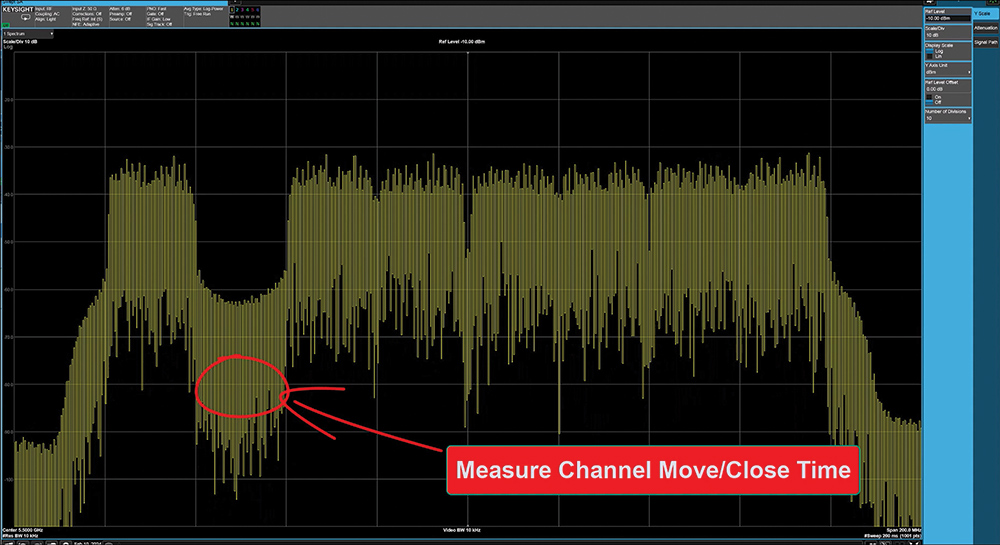
Another other requirement added by the FCC for channel puncturing and DFS Testing is:
Once again, there is no current measurement guidance on how to do this, so the following is a reasonable engineering best guess for a procedure:
- Set the center frequency of the spectrum analyzer to center of channel (“sub‑channel”) where radar was detected;
- Set frequency span to zero span
- Ensure RBW is not too wide to detect signal from remaining transmission; and
- Use the existing channel move and close time measurement procedure.
In KDB 987594, the FCC indicates that the Wi‑Fi Alliance (WFA) AFC Test Harness is to be used to verify the requirements for SP APs and devices controlled by an SP AP. The test harness emulates an AFC system to request information from the equipment under test (EUT) and return the requested frequency/channel and power (PSD) limits. RF test equipment is required to monitor the frequency and power of the EUT to then verify it does not exceed the defined limits.
The test harness is only available through the Wi‑Fi Alliance. It does have the ability to incorporate RF test equipment but is limited to whatever drivers have been developed by test equipment vendors. Many companies (including mine) have yet to develop drivers for incorporation into the test harness and are reviewing the requirements for integrating its drivers into the test harness. But keep in mind that a test report generated by the test harness is required in order to be accepted by the FCC.
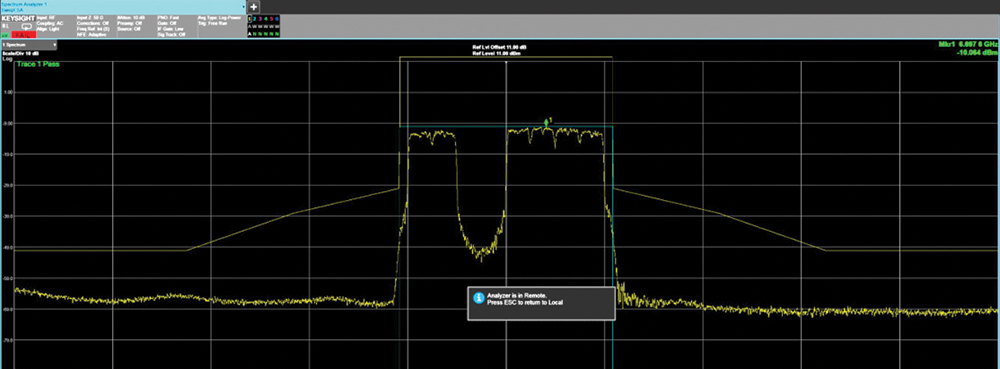
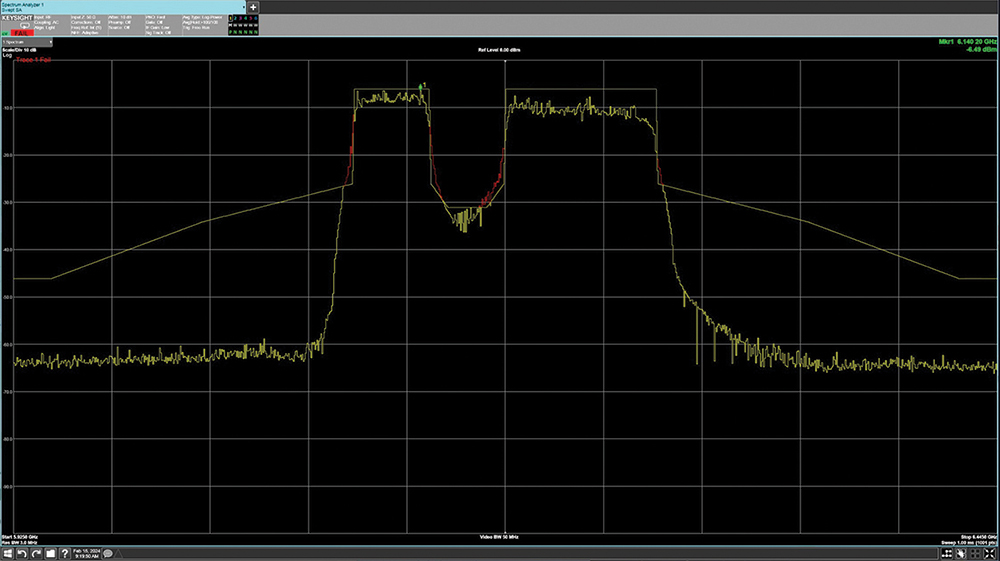
ETSI has much more stringent emission mask requirements for any 6 GHz channel that employs preamble puncturing to notch out part of the channel. Figure 6 shows an example (taken from Annex D of EN 303 687) of the mask where the third-20 MHz channel of an 80 MHz channel is punctured.
Figure 7 shows an example of using testing software to make a measurement on a punctured channel where two-20 MHz channels are punctured, and the applicable emission mask taken from EN 303 687.

- No preamble puncture allowed for indoor devices using the 6 GHz band to avoid CBP; however, bandwidth reduction is allowed.
- Preamble puncturing is allowed in the 5 GHz band to avoid interfering with local radars.
- Unknown emission mask requirements for the punctured channel in the 5 GHz band, other than comparing the 26 dB or 99% bandwidth to the punctured sub‑channel.
- Outdoor devices under the control of a standard power AP must also meet the requirements of an AFC system.
- It is unclear if there are additional requirements or if preamble puncturing is allowed for DFS capabilities in the 5 GHz band. It is possible to use a Notified Body to review and approve measurement techniques.
- Preamble puncturing is available in the 6 GHz band and uses procedures in EN 303 687.
- ETSI currently does not support bandwidths greater than 160 MHz. The next version of EN 303 687 addresses this but is not expected to be formalized anytime soon.
- Finally, it is possible to submit measurement procedures and results to Notified Bodies for approval of the capabilities described above. Several commercial products have been approved for Wi‑Fi 7 use in the EU.
- Test results were generated using Keysight XA5002A FCC Regulatory Testing Software
- Test results were generated using Keysight XA5002A FCC Regulatory Testing Software
- Test results were generated using Keysight XA5001A ETSI Regulatory Testing Software
