

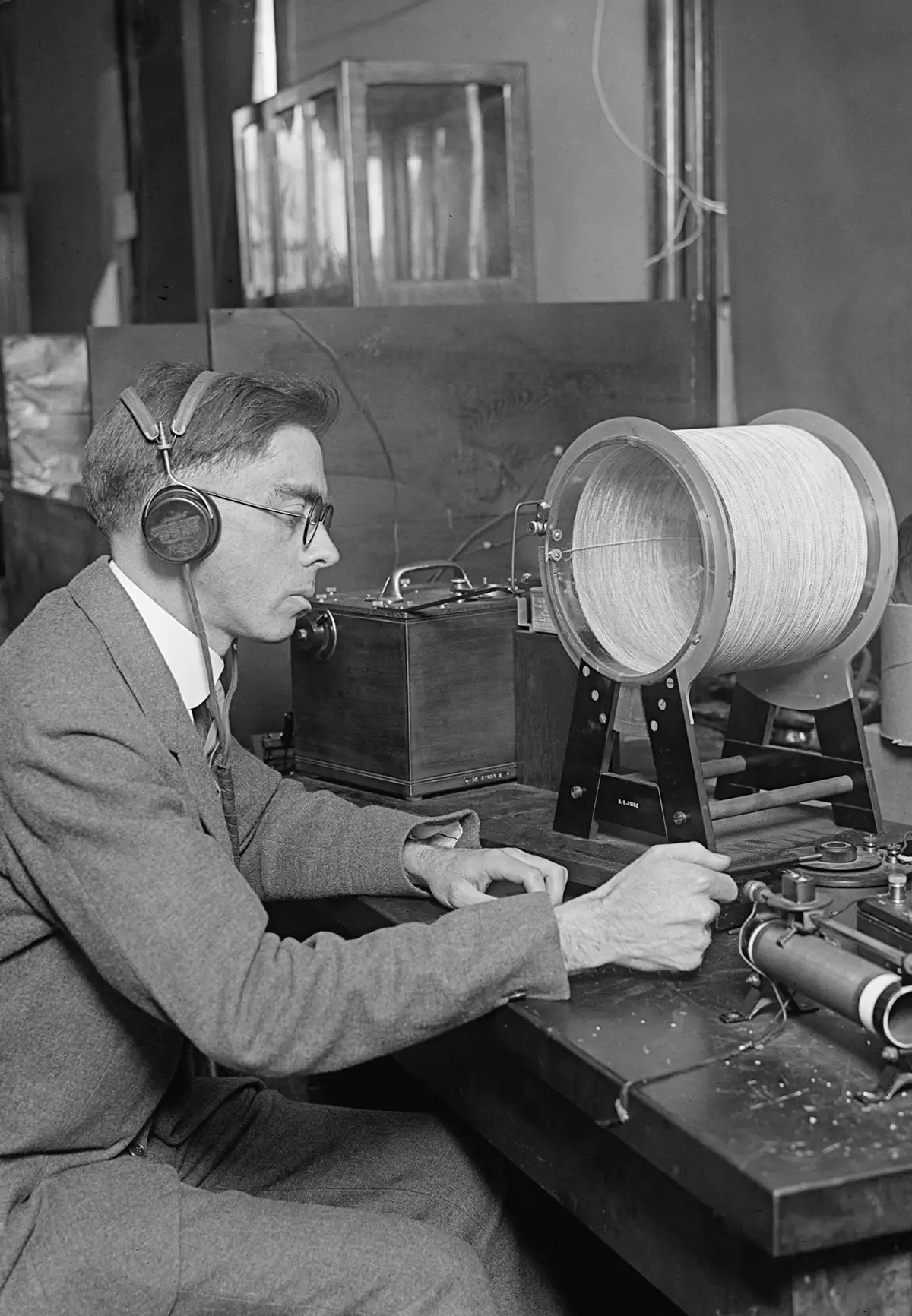
rom the time that Heinrich Rudolf Hertz first demonstrated the transfer of electrical energy from one antenna to another in the late 1880s, humanity has witnessed, observed, and enjoyed the fruits of electromagnetic radiated fields. The electromagnetic waves first produced by Hertz in his lab in 1886 were proof that James Clerk Maxwell’s 1864 theory of “electromagnetic waves” was correct.
Hertz published a series of papers in the last years of the 1880s that verified the characteristics of the “Hertzian Waves” with respect to frequency, amplitude, speed (velocity of light), and other physical parameters. Hertz never realized the practical importance of his discovery and did not explore the applications of the “Hertzian Waves,” which became known as “radio waves” over time.
However, many premier scientists of the day did recognize the importance of the discovery, including Guglielmo Marconi, Nikola Tesla, Edwin Armstrong, Lee DeForest, and many others.
Wireless telegraphy was the first commercial use of the “radio waves” proven to exist by Hertz. The Boer War in the late 1890s showcased the first military use of wireless telegraphy; both warring nations used it to communicate between the units of their armed forces in that war.
Experiments continued in the 1890s and early 1900s to extend the range of the “radio waves” until the first messages were successfully sent from Europe to the United States.
As radio technology developed, radios became more popular and more prevalent, leading to interference between radio transmitters. To control the interference, countries met to develop an agreement to control the interference since the radio waves did not recognize or respect country geographical boundaries. The result was a “Final Protocol” signed at the Berlin Conference in 1903 that stated that “services be organized in such a way as to avoid interference with other stations.” This agreement was further strengthened in a second agreement signed at the Berlin conference in 1906.
The first radio law passed by the United States was the Wireless Ship Act of 1910, which required ocean-going vessels to be equipped with “an efficient apparatus for radio communication.”
The Carpathia, one of the ships that heard the Titanic’s SOS call and came to save the survivors of the Titanic, had to come from fifty-eight miles away, and it took several hours for it to arrive. Anyone thrown or left in the cold water after the Titanic sank did not survive long enough to be rescued. People in the Titanic’s lifeboats or left clinging to wooden pieces of furniture/fixtures were rescued by the sailors of the Carpathia.
As a result of the Titanic disaster, the U.S. Congress passed the Radio Act of 1912, which dictated that each ocean-going ship had to have a radio room that was in operation 24 hours a day. This same legislation put the Department of Commerce in charge of licensing radio transmitters in the U.S., which consisted primarily of maritime (ship radio stations) and amateur radio stations.
After studying the device, the FCC proposed that the operation of low-power transmitters without a license would be allowed if they met proposed standards that were so low in amplitude that they could not interfere with interstate communications. The new rules were called “the Low Power Rules.” These new rules required the use of minimum power and precautions against interference, plus the radiated field was limited to 15 microvolts per meter (uV/m) at a distance equal to the wavelength divided by 2 pi. These rules were adopted in November 1938 and remained in effect for low-power communication devices until 1957.
It wasn’t until April 1954 that the FCC issued a Notice of Proposed Rulemaking (Docket No. 9288) in which low-power devices were divided into two categories: 1) incidental radiation devices in which the RF energy is generated as a by-product of normal operation; and 2) restricted radiation devices in which RF energy is generated deliberately. Based on replies from industry, the FCC released new rules in December 1955, which established a table of permissible radiation limits for all receivers operating (tuning) between 30 and 890 megahertz.
A second report and order in Docket No. 9288 was issued in 1956 and 1957. It addressed community antenna television receivers and low-power communication devices (miniature transmitters).
Led by the Computer and Business Equipment Manufacturers Association (CBEMA), the computer industry started meeting with the FCC to discuss the technical situation. The leading computer manufacturer at the time was IBM, and the other major U. S. manufacturers were Control Data Corporation, Univac, Digital Equipment Corporation, Honeywell, National Cash Register (NCR), Burroughs, and Xerox. The meetings were usually attended by one EMC engineer from each company, except for IBM, which sent two engineers and a lawyer.
The FCC started the discussions due to an increasing number of complaints regarding interference to radio and TV signals from computers. As the number of home computers (personal computers) began to increase in the late 1970s, the meetings between the computer industry and the FCC became more frequent.
FCC Docket No. 20780, which was released in 1976 to address restricted radiation devices, was the vehicle the FCC used to develop the case for limits on emissions from computers.
The FCC said that…
The FCC rules for computers defined two different classes of equipment: Class A for commercial computers and Class B for personal/home computers. The limits for Class A equipment were three times more relaxed than those applicable to home computers (in technical terms, about 10 dB more relaxed), resulting in higher limits.
FCC Public Notice DA 99-1640 was released in 1999. It stated:
The importance of the TCB program was further enhanced by the release of ET Docket No. 03-201 (FCC 04-1665). One of the FCC Commissioners at that time had the following to say about the Docket:
Re: Modification of Parts 2 and 15 of the Commission’s Rules for Unlicensed Devices and Equipment Approval; ET Docket No. 03-201
“The development of wireless ISPs and the advent of so‑called hotspots using unlicensed spectrum has been one of the Commission’s great success stories over the last several years. I support this item because it continues our efforts to promote the development of unlicensed devices and services. The tremendous growth of WiFi in the 2.4 GHz band was facilitated by the licensing (or more appropriately the “unlicensing”) approach initially adopted by the Commission for this band. Part 15 of our rules allows manufacturers to develop technologies for the unlicensed-bands that anyone can use without a license. We must continue this policy approach so that we encourage as many avenues or technologies as possible for broadband and other important services to reach consumers, no matter where they live.
“My goal as a policymaker is to maximize the services and information that flow over our airwaves. A regulatory framework for innovation can provide the necessary conditions that support the growth and development of spectrum-based services, including continued use of the unlicensed bands. Such a framework functions in a manner akin to a greenhouse, in which plants are protected from the elements by a structure and are nurtured so that they can thrive on their own within it.
“I believe that in the NPRM adopted today, the Commission properly strives for such an approach to spectrum management. We want to enhance our existing Part 15 structure so that it continues to encourage the growth of the unlicensed industries, but also controls the elements, like minimizing interference that may impact existing and future operators. Just as a greenhouse can support different types of plant forms, our framework for innovation does the same – it must be flexible enough to accommodate all different kinds of technologies, such as those used with the latest antennas. Our framework does not choose which technology will survive, and which will not, but it must create an environment that allows the different seeds of technology to truly have an opportunity to grow and develop on their own. I believe that we have such an approach here, and I am optimistic that our framework for innovation will enable new technologies in the unlicensed space to continue to meet the public’s demand for broadband more efficiently.”
In its FCC ET Docket No. 99-231 – Notice of Proposed Rulemaking, the FCC amended Part 15 of its rules relative to spread spectrum devices. It proposed changing the rules for frequency hopping devices operating in the 2.4 GHz band with a maximum output power of 1 Watt to allow for wider operational bandwidths.
- E. W. Allen, Jr., and Herman Garlan; “Evolution of Regulatory Standards of Interference,” Proceedings of the IRE Professional Group on Radio Frequency Interference; 18 August 1961.
- “FCC and Electrical Interference,” Interference Technology Engineers’ Master (ITEM) 1977.
- Art Wall, “Understanding FCC Regulations for Computing Devices,” 1980.
- “Federal Radio Commission,” Wikipedia, 2025.
- “FCC Proposes Rule Amendments for Radio Frequency Devices (Docket 20780),” News – FCC – Report No. 11843 – Action in Docket Case – April 20, 1976.
- Kenneth R. Carter, “Unlicensed To Kill: A Brief History of the Part 15 Rules,” Vol. 11, No. 5, pages 8-18, 2009.
- “Communications Act of 1934,” Wikipedia, 2024.