

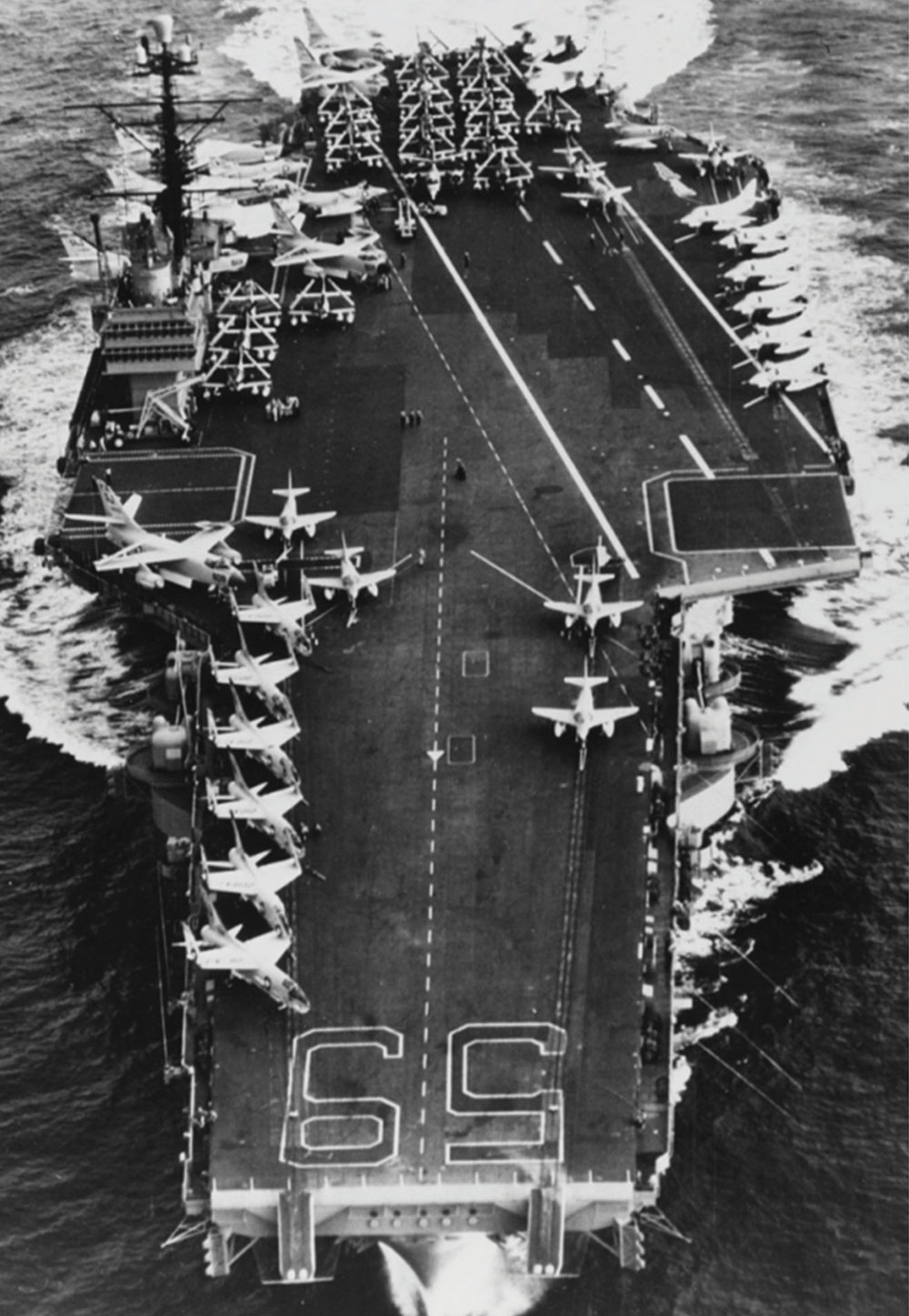
n 1967, while on patrol in the Gulf of Tokin, the United States Navy Carrier USS Forrestal was executing wartime missions over North Vietnam. At 10:45 AM local time, the ship was preparing to launch more than 27 A-4 Skyhawk and F-4B Phantom Fighter jets, all fully fueled and armed with a mixture of iron bombs, precision missiles, and Zuni rocket launchers. At 10:51 AM, an F-4B experienced an un-commanded Zuni missile launch on the flight deck, striking a neighboring A-4 and starting a fire causing a series of devastating secondary explosions. Quenching the fire nearly capsized the ship, which was ultimately saved through the heroics of the sailors who served aboard the Forrestal.
Although the US Navy conducted an extremely thorough accident investigation, many follow‑up technical articles in the aerospace and NASA literature, including current EMI design books, blamed the initiation event on EMI from on the on‑board AN/SPS-43 VHF search radar. This article is aimed at reinforcing the official USN record regarding the accident’s true root cause. The Forrestal’s many “lessons learned” led in part to the creation of an entirely new discipline called “insensitive munitions” within the Electromagnetic Compatibility community and is therefore a critical event to understand.
On July 29th, 1967 the Navy Carrier USS Forrestal (CVA‑59) experienced one of the most tragic accidents in the modern US Naval aviation history.
While preparing to launch a 27-plane strike mission into North Vietnam, an un-commanded Zuni rocket was launched on deck from an F-4B fighter, striking an A-4 Skyhawk aircraft across the deck, causing an initial fuel‑fed fire. Within 94 seconds, huge secondary explosions rocked the carrier launching one of the most devastating fires in US Navy history since the Second World War. This accident and the lessons the US Navy learned from it completely changed everything about modern US Naval aviation from fire-fighting to launch procedures to designing weapons to be hardened from electrical faults and direct contact with fire.
The 1967 Forrestal accident investigation correctly identified the root causes of the fire. However, over subsequent years researchers and engineers began to insert or augment their own perspectives, biases, and conclusions about the fire which upon close inspection are in direct conflict with the original Forrestal accident conclusions. Several citations and alternate history myths have only grown over the years to the point that original root causes were either lost or highly distorted. To illustrate, I have randomly chosen three such references.
In July 1995, a NASA EMC Design book produced by NASA’s Marshall Space Flight Center [1] published the following version of the Forrestal accident and its conclusions (note the underlined text below is the author’s emphasis):
![Figure 1: US Navy Carrier USS Forrestal (CVA-59) with its ship logo (inset) [5]](https://digital.incompliancemag.com/asset/2026/03/the-radar-pt1-fig01.jpg)
The Forrestal could carry and perform air operations with 85 jet aircraft of various types. In 1967, these types included the Phantom F4-B, the A-4 Skyhawks, E-2C Hawkeye radar plane, S3-B Vikings, A3 Sky Warriors, and various helicopters. The Forrestal was not nuclear-powered like her later cousins, as its engines were powered by oil-fired boilers. The bunker fuel oil on board had important implications later in the 1967 accident.
When the McDonnel Douglas F-4B Phantom jet became operational with the US Navy in 1963, the USS Forrestal was the first carrier to host an F-4B squadron. If the reader is not familiar with flight operations on a flight deck of this historic era, some important background is required to understand both the complexities and dangers of working around a flight deck. Since print media does not offer a good way to visualize complex carrier operations, I have posted a short US Navy video of the F-4B operations on the USS Forrestal from 1963. To assist in understanding the rest of this article, I strongly suggest watching it to provide context (https://youtu.be/2LDPKwS91s8).[6]
Watch the deck crews carefully during the launch and landing or recovery operations. Consider all the dangerous tasks that must be completed by the deck crews even under peacetime or training operations. There are many inherent flight deck dangers associated with moving jet tugs, steam catapult cables, jet blasts, etc. If you served on a carrier deck crew, you knew that injuries and fatalities were commonplace. Also note that, in this video, none of the aircraft shown have armed and operational weapon systems, although several of the pictured F-4Bs had external fuel tanks.
If you ever encounter a sailor who has served as one of the colored deck shirt crews on a carrier, you would soon learn of the dangers. One sailor interviewed had the following perspective:
The last three jersey sets had the most dangerous jobs on deck. The Green jerseys were responsible for handling the bridle, executing catapult attachment and, upon landing, detaching the arresting gear. The Blue jerseys were aircraft handlers, elevator operators, as well as tow and start cart drivers. Lastly, the Yellow jerseys (or “mini-air Bosses”) were the plane directors and aircraft handling officers assigned to each of the four catapults. They were the sailors who gave the final command to launch.
![Figure 2: Mark 82/83/84 Vietnam-era iron bombs of yield 500/1,000/2,000 lbs. (Courtesy NMUSAF) [7]](https://digital.incompliancemag.com/asset/2026/03/the-radar-pt1-fig02.jpg)
The Diamond Head was a logistics vessel assigned through the US Navy Systems Command, and therefore decided to supply the USS Forrestal with 26 aging Korean War era AN‑M65A1 1000 lbs. bombs[9] (Figure 3) instead of the Mark 83’s. When these 26 bombs were transferred to Forrestal, there was an immediate uproar from the Forrestal’s munition’s safety officer. The munitions squadron was extremely upset about the poor condition of the AN-M65A1 weapons, many of which were rusting, and several were leaking contents. Apparently, the Diamond Head had picked these weapons up from ammo dumps in the Philippine Islands and was supposed to transport them back to the States for disposal. In their poor condition, the Diamond Head likely transferred these weapons to Forrestal to get rid of them.
![Figure 3: Korean Era AN-M65A1 1,000 lb. “Thin-Skinned” bomb [9]](https://digital.incompliancemag.com/asset/2026/03/the-radar-pt1-fig03.jpg)
This decision had momentous implications since the AN‑M65A1 were “thinned-skinned” bombs that were not rated to survive direct exposure to fire. Historically, these weapons were known to explode in ~50-80 seconds with direct fire contact, and sometimes faster!
![Figure 4: McDonnel Douglas A-4 Skyhawk equipped with a 200-gallon JP-5 tanks and 6 Mk81 250 lb. bombs [10]](https://digital.incompliancemag.com/asset/2026/03/the-radar-pt1-fig04.jpg)
On 29 July 1967, the USS Forrestal had planned to launch three different combat strike missions. One mission was to launch at 0700, the second at 1100, and the third at 1500. To get rid of the 26 old AN‑M65A1 bombs, the plan was to send 10 bombs out on five A-4s with the 0700 strike. Ten more bombs would go with the 1100 strike using five A-4s, and the remaining six AN-M65A1 bombs would be used on the 1500 strike using three A-4s. The hope was to get these volatile weapons off the ship by the end of the day on 29 July 1967.
The A-4 Skyhawk, like most jets of its era, required a specialized ground cart to start the engines before being launched. Figure 5 shows a typical USN carrier ground start cart connected to an A-4 on the carrier USS Constellation. Generally speaking, it took several minutes to start the engines from the ground start cart. Once the engines were up to speed, the pilots switched over their main power from the ground start to internal aircraft power. Starting an A-4s was therefore a well-known and safe routine.
![Figure 5: Jet ground start cart on Carrier USS Constellation connected to and starting an A-4 Skyhawk [11]](https://digital.incompliancemag.com/asset/2026/03/the-radar-pt1-fig05.jpg)
![Figure 6: A USAF F4 Phantom with a ground start cart [12]](https://digital.incompliancemag.com/asset/2026/03/the-radar-pt1-fig06.jpg)
![Figure 7: F-4 showing two power toggle switches used to switch aircraft power from a ground start cart (EXT or LOWER position) to the left or right aircraft engine generator (L Gen/R Gen‑Upper position) [13]](https://digital.incompliancemag.com/asset/2026/03/the-radar-pt1-fig07.jpg)
Looking at the actual control column itself, we can also understand the controls necessary toggle one of the many weapon systems installed on the F-4B. Figure 8 shows a close‑up of the control column itself with two of the firing or trigger buttons. Since the F-4 had multiple‑weapon stations for bombs, Zuni rockets, and air‑to‑air missiles, the pilot could select which firing button triggered which weapon though, for the Zuni rockets, the lower buttons were typically‑selected.
![Figure 8: F-4 cockpit showing a close-up of the control stick and weapon stations trigger (firing) buttons [14]](https://digital.incompliancemag.com/asset/2026/03/the-radar-pt1-fig08.jpg)
![Figure 9: (L) An F4-B with two LAL-10 launchers each controlling two 4-tube 5” Zuni rockets (R) [15,16]](https://digital.incompliancemag.com/asset/2026/03/the-radar-pt1-fig09.jpg)
The fourth interlock was the landing gear doors. If the gear doors were open, as one would expect on deck, a landing door interlock switch was supposed to prevent launching the weapon if the landing gear doors were open. The last two weapon safety interlocks occurred on the LAL-10 launcher that held the Zuni rockets themselves. These two safety interlocks are shown in Figure 10.
![Figure 10: LAL-10 Launcher TER safety pin and friction fit power/control “pigtail” [17,18]](https://digital.incompliancemag.com/asset/2026/03/the-radar-pt1-fig10.jpg)
In addition, the right pigtail friction fit power and firing line connector had to be attached. This pigtail connected the aircraft power and all firing path connections between the F4-B and the LAL-10 launcher. If someone forgot to plug this pigtail in before flight, none of the weapon systems controlled by the LAL-10 would be functional. This connection was also supposed to be done at the catapult, hence the friction-fit nature of the quick disconnect connector. With these six interlock systems in place, the USN Systems Command’s official engineering position was that “it (would be) impossible to accidentally fire a weapon controlled by the LAL-10 on the deck.”
Let’s return for a moment back to the master arm and weapon station interlocks. Again, using the NMUSAF cockpit photograph, the USAF version of the master arm switch is shown in Figure 11. However, the USN’s F4-B master arm and weapons emergency jettison cockpit switches had a slightly different configuration as shown on the far right of Figure 11. Again, during aircraft start‑up, the pilot’s hands were on the throttles (left hand) and the external power to generator switches (right hand), and nowhere close to the master arm or jettison switches.
![Figure 11: Close-up of the “master arm” weapon station switches in USAF F-4 and USN F4-B [19,20]](https://digital.incompliancemag.com/asset/2026/03/the-radar-pt1-fig11.jpg)
![Figure 12: USS Forrestal’s AN/SPS-43 and SPS-30 radars [21,22]](https://digital.incompliancemag.com/asset/2026/03/the-radar-pt1-fig12.jpg)
![Figure 13: Pilot landing aid television system (PLATS) camera and operator location on USS Forrestal [23]](https://digital.incompliancemag.com/asset/2026/03/the-radar-pt1-fig13.jpg)
The most important takeaway here is that the PLATS camera was constantly filming every takeoff and landing, and this system would play an outsized role in recording the subsequent accident. To see a typical PLATS video from the USS Forrestal, please visit https://youtu.be/VuCe73IJD7U. Note that the original Forrestal PLATS system recorded the exact time of day to second accuracy and the exit velocity of the launched aircraft from the Ships SPS‑30 radar, to ensure the catapult was launching the aircraft well above its specified stall speed.
To avoid any possible “electrical glitch” prior to making the final LAL-10 launcher weapons connections, the approved procedure during training was for the red shirt weapons personnel to make the final weapons pigtail connections and remove the TER safety pins at the catapult just before launch, as shown earlier in Figure 10. If this were done in haste, as frequently happened during the launch of large combat raids, pigtail electrical pins could and were frequently bent, therefore subject to potential shorts in future connections. The real problem, however, was that the Vietnam pilots and their squadron commanding officers complained that making these connections at the catapult significantly slowed down the rate of aircraft launches, and inhibited aircraft recoveries. Connecting all the weapons pig tails could add minutes to each launch depending on the A-4 and F-4B weapons loadout and the size of the strike.
During their transit from Norfolk to the Gulf of Tonkin, the flight deck crews on the Forrestal were briefed by previous Pacific Command carrier weapon handler crews that they had created an ordinance safety “work-around.” In essence, to speed up launches, the red shirt munitions pigtails were to be attached well before arriving at the catapult, and frequently before the aircraft engines had been started. Furthermore, the Forrestal’s red shirts and their munition officer supervisors indicated that this procedure had been approved “by waiver” by previous Pacific Fleet Carrier captains. With this waiver in place, the Forrestal red shirt deck crews were now solely reliant on the “TER safety Pin” that, in theory, was designed to electrically and mechanically prevent a Zuni weapon launch command from the LAL-10 launcher unless the TER pin was pulled. So, the procedure was supposed to be that the red “remove before flight” TER Pins would be pulled at the catapult, while the power and firing line pigtail were already connected.
This is where the first inconsistency of practice took place. While the TER pin was supposed to be pulled out at the catapult, in large combat strikes the TER safety pin was often removed prior to arriving at the catapult. Furthermore, the red jerseys noticed that the TER safety pin had a very loose friction fit. During a launch, the deck winds were typically between 33-39 miles per hour. As related in post-accident witness statements, in several incidences the TER pin was dislodged completely and blown out by the deck winds alone. In the days preceding July 29, 1967, several TER pins and their red flags were seen on Forrestal’s deck during post-launch “Foreign Object Damage“(FOD) sweeps of the flight deck.
Regarding the supposed “safety waiver” mentioned above. It turns out only Captain John Belling could approve such a safety waiver. A former decorated carrier aviator himself, Captain Belling later testified he was never notified of the pre-catapult LAL-10 pigtail connection and early removal of the TER safety pin before the catapult. In the subsequent investigation board, he stated that he would never have approved this new procedure. Reviewing Captain Belling’s many safety messages and “Family Grams” written and read to crew on the voyage from Norfolk to Yankee station, he clearly and consistently emphasized flight deck safety measures even over combat operational efficiency.[24]
It’s now July 29, 1967. The fateful morning of the accident has finally arrived.
- Leach, R.D., and Alexander, M.B., Editor, NASA Reference Publication 1374 titled Electronic System Failures and Anomalies Attributed to Electromagnetic Interference, Marshall Space Flight Center, July 1995, pp 7, para 2.3.1.
- Paul, Clayton R., Introduction to Electromagnetic Compatibility, Wiley, Second Edition, pp 1.3, page 13.
- Joffe, Elya B., “Electromagnetic Compatibility (EMC) – an Evolving Discipline from the ‘Garbage of Electronics’ to Global Intersystem Compatibility A Historical Review with Personal Perspectives,” Proceedings of the IEEE International Conference Microwaves, Communications, Antennas and Electronic Systems, COMCAS 2008, May 2008.
- Attribution uncertain, but frequently attributed to Mark Twain.
- Courtesy USN and National Archives, 31 May, 1962, KN-4507.
- You Tube Archive Source.
https://youtu.be/2LDPKwS91s8 - Photo Courtesy of the National Museum of the United States Air Force (NMUSAF).
- Saffold, Ray G., “Safe Arming Times for the Mk 81, 82, 83, 84, and M117 Low Drag Bombs,” United States Naval Ordinance Laboratory Report NOTR‑69-135, White Oak, Maryland, 1 August 1969.
- Photo Courtesy: https://old-wiki.warthunder.com/AN-M65A1_Fin_M129_(1,000_lb)
- Photo Courtesy: https://www.historynet.com/arsenal-4-skyhawk
- National Geographic History Channel, Single Frame Grab from “Seconds from Disaster Aircraft Carrier Explosion,” Original Broadcast 9-1-2021.
- Frame grab from https://www.youtube.com/watch?v=rT_gLtwAjBs
- Photo Courtesy NMUSAF
https://media.defense.gov/2022/Feb/08/2002935433/-1/-1/0/220208-F-AU145-1011.JPG - Photo Courtesy: NMUSAF
https://media.defense.gov/2022/Feb/08/2002935433/-1/-1/0/220208-F-AU145-1011.JPG - Photo Courtesy: http://www.revuair.com/2017/07/25/we-will-not-forget-3
- Photo Courtesy: Pinterest https://www.pinterest.com/pin/pinterest–324048135678007426
- National Geographic History Channel, Single Frame Grab from “Seconds from Disaster Aircraft Carrier Explosion,” Original Broadcast 9-1-2021.
- National Geographic History Channel, Single Frame Grab from “Seconds from Disaster Aircraft Carrier Explosion,” Original Broadcast 9-1-2021.
- Photo Courtesy: NMUSAF
https://media.defense.gov/2022/Feb/08/2002935433/-1/-1/0/220208-F-AU145-1011.JPG - Photo Courtesy: https://navyaviation.tpub.com/14313/css/Armament-Safety-Override-Switch-364.htm
- Courtesy USN and National Archives, 12 August 1967, Accession #: 330-CFD-DN-SC-04-09140.
- Courtesy Wikipedia – Jon ‘ShakataGaNai’ Davis, https://en.wikipedia.org/wiki/AN/SPS-43#/media/File:SPS-43_radar_of_USS_Hornet_(CVS-12)_2008.jpg
- Inset Camera Photo from National Geographic History Channel, Single Frame Grab from “Seconds from Disaster,” Original Broadcast 9-1‑2021, Original from US Navy PLATS Camera.
- Killmeyer, Kenneth V., Fire, Fire, Fire on the Flight Deck Aft; This Is Not a Drill, Autherhouse Publishing 2018, Family Grams to Crew from Captain Belling, pp 82-85 and pp 85-88.

_2008.jpg)