

or those that follow our “On Your Mark” columns, you know the emphasis placed on the value of ANSI Z535 – the U.S. standards that create a guide for the design, application, and use of signs, colors, and symbols intended to identify and warn against hazards and for other accident prevention purposes. These standards, along with their international counterpart, ISO 3864-2, are effective starting points in helping you to develop adequate warnings. Recently, we had an exciting new development in this family of standards: the release of an all-new seventh standard. In this article, we’ll explore the new standard and how its principles can be used to create effective warnings that drive safety.
The new standard aims to offer a comprehensive system for presenting safety information in a variety of digital formats. The standard’s focus on safety information in digital media includes a wide purview: electronic/digital manuals; electronic/digital user guides; e-instructions; digital maintenance or service manuals; visuals, animations, or videos; e-warnings in reference to phones, tablets, or computers. It provides a framework for the design, placement, and duration of safety messages within these electronic collateral materials.
“The ANSI Z535 committee recognized the limitations of existing standards – which were created mainly with static, printed materials in mind – and the need to adapt to the dynamic, interactive nature of electronic media,” says Angela Lambert, an ANSI Z535 committee member and head of standards compliance at Clarion Safety Systems. Lambert is also a subcommittee member of ANSI Z535.7, part of a small group of experts that championed the standards’ development.
According to ANSI Z535.7’s introduction, “Historically, there has been a lack of widely available or generally applicable graphic systems for presenting safety information in electronic media.”
“ANSI Z535.7 was written intentionally to complement ANSI Z535.4, which focuses on safety labels for physical products, and ANSI Z535.6, which addresses safety communication in manuals. The new standard builds on the foundation of the .4 and .6 standards, to provide guidance for digital media, in line with an organization’s comprehensive safety strategy,” Lambert says.
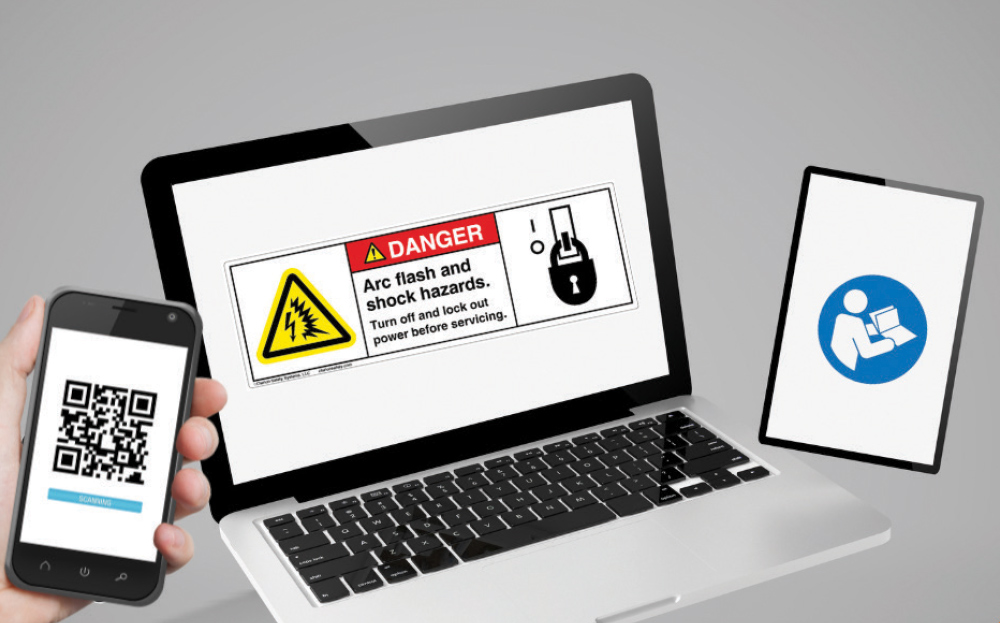
ANSI Z535.7 recognizes that electronic media’s nature is dynamic and has many variables when it comes to format. The standard needs to be able to address videos or animation, as well as content that is interactive, contains both visual and auditory components, may not be accessed in a linear or page by page format, and may be contained in multiple systems. While this type of fluidity is not simple to standardize across every product and situation, the standard aims to provide a communication system that applies to a range of products and industries – a common direction for the use of ANSI Z535 elements that can be applied effectively across electronic media formats.
“While the standard doesn’t dictate the specific safety messages included in electronic media, it offers guidance on formatting them effectively. That means it can help engineers or manufacturers to figure out how to communicate safety information in the mediums they use. The guidelines closely follow the .6 standard and reference the .4 standard; there aren’t necessarily any surprises for those that already are knowledgeable on ANSI Z535 best practices, but there is clarity on how to warn effectively digitally, and how to present a cohesive safety message in print and electronic formats,” Lambert says.
As examples, ANSI Z535.7:
- Categorizes safety messages into four types based on risk levels, referencing ANSI Z535.6 for guidance.
- Covers key components of safety messages, including proper signal word use to indicate risk severity levels.
- Emphasizes clear design principles of safety messages to enhance a user’s understanding and ability to take actions to mitigate risk effectively.
“What I can also tell manufacturers and engineers is that ANSI Z535 is committed to continuing to provide updated safety resources and guidelines that are responsive to our changing environment. In fact, revisions will begin soon on ANSI Z535.7. Technology changes fast, and the standard will be responsive to that so that the guidelines stay current and impactful,” Lambert says.
