

To calculate AF, two pieces of information are required: 1) λ, which is wavelength in meters, and 2) antenna gain (G) as a power ratio. Once this information is known, then AF is calculated using this basic formula:
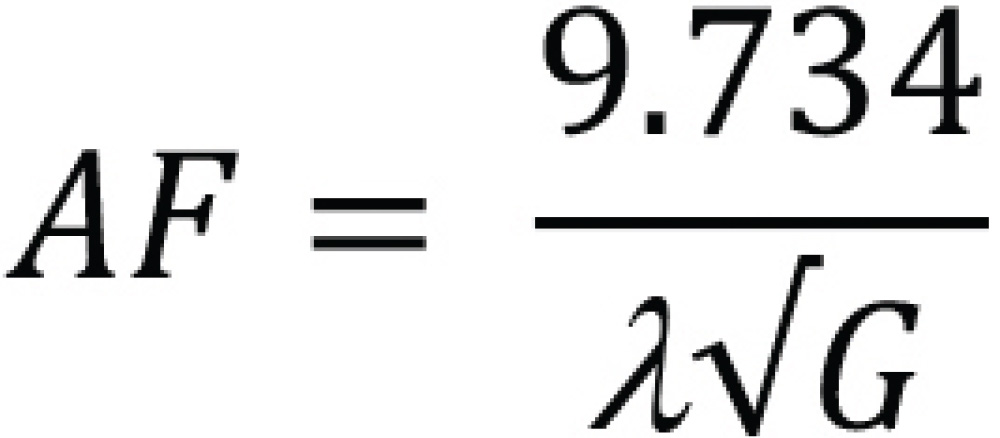
Recall that the purpose of the antenna in a radiated emission test is to couple the E-field emanating from the equipment under test (EUT) to the measuring device (measuring receiver or spectrum analyzer). Since E-field strength limits are provided in terms of volts per meter (at a specific distance from the EUT), and the measuring device is calibrated in volts, then the antenna must be calibrated in terms of volts output for a given E-field strength at each test frequency. Makes perfect sense, right?
Given a value in dBmV obtained from the measuring device, an AF in dB/m from the antenna calibration report, and cable loss in dB, then the E-field (E) in dBμV/m emanating from the EUT is easily calculated as follows: