
EMC concepts explained
Image Theory: Radiation From Hertzian Dipole Above Ground Plane
T

his article presents the derivation of the radiated far fields from a Hertzian dipole antenna above the ground plane using image theory.

1. Hertzian Dipole Antenna
An electric dipole, often referred to as a Hertzian dipole, shown in Figure 1, consists of a short, thin wire of length l carrying a constant current  positioned symmetrically at the origin of the coordinate system and oriented along the z-axis.
Hertzian dipole
Figure 1: Hertzian dipole
Ideally, the wire is infinitely short; practically, a wire of the length l << /50 ( = wavelength) can be considered a Hertzian dipole.

The far field of a Hertzian dipole has only a θ component (in a spherical coordinate system) and is given by [1].

equation
The complete derivation of this result is given in [2].
2. Image Theory
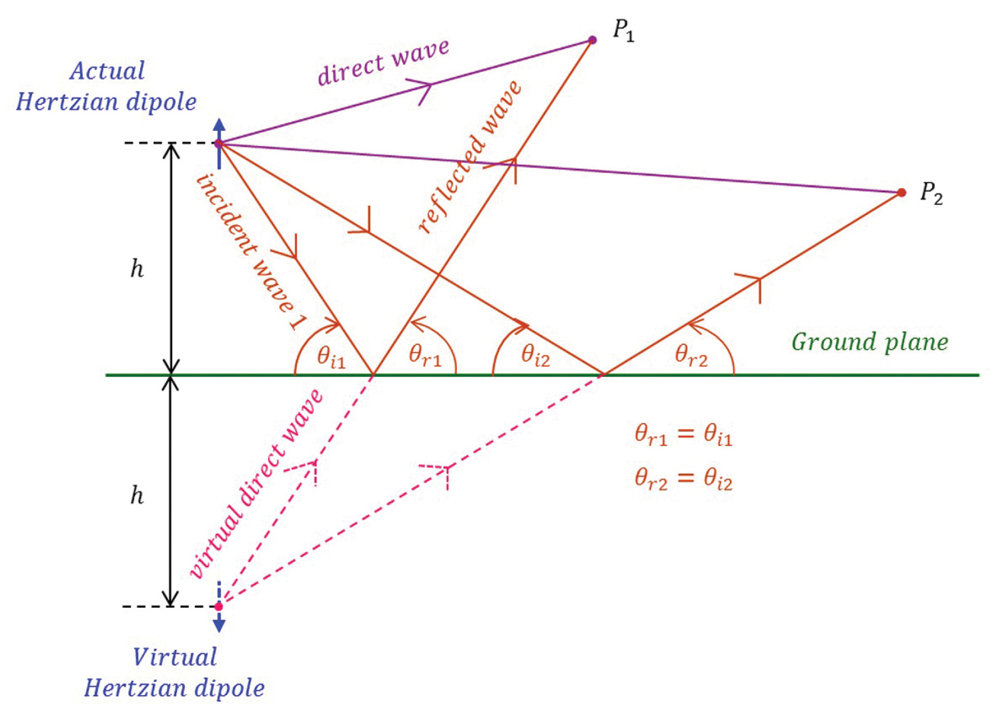
In image theory, a radiating antenna (actual source) is placed at some distance h from a perfect conducting plane. An image of this antenna (virtual source) is placed below the conducting plane at the same distance, h, as shown in Figure 2 [3].
Hertzian dipole and its image
Figure 2: Hertzian dipole and its image
Because of the reflecting ground plane, the total field at an observation point P is the sum of the direct wave and the reflected wave. Obviously, there are no fields below the ground plane.

Instead of obtaining the total field by summing the actual direct and reflected waves, we add the direct wave from the actual source and the direct wave from its image (virtual source) to obtain the same result (above the ground plane). When considering the virtual direct wave, we pretend that the ground plane does not exist and, therefore, the virtual wave has a direct, unobstructed path to the observation point.

Why are we using this approach? Because the calculation of the fields using the actual waves is quite complicated, whereas the calculations using image theory are quite simple, as we shall see.

3. Radiation from Hertzian Dipole above Ground Plane
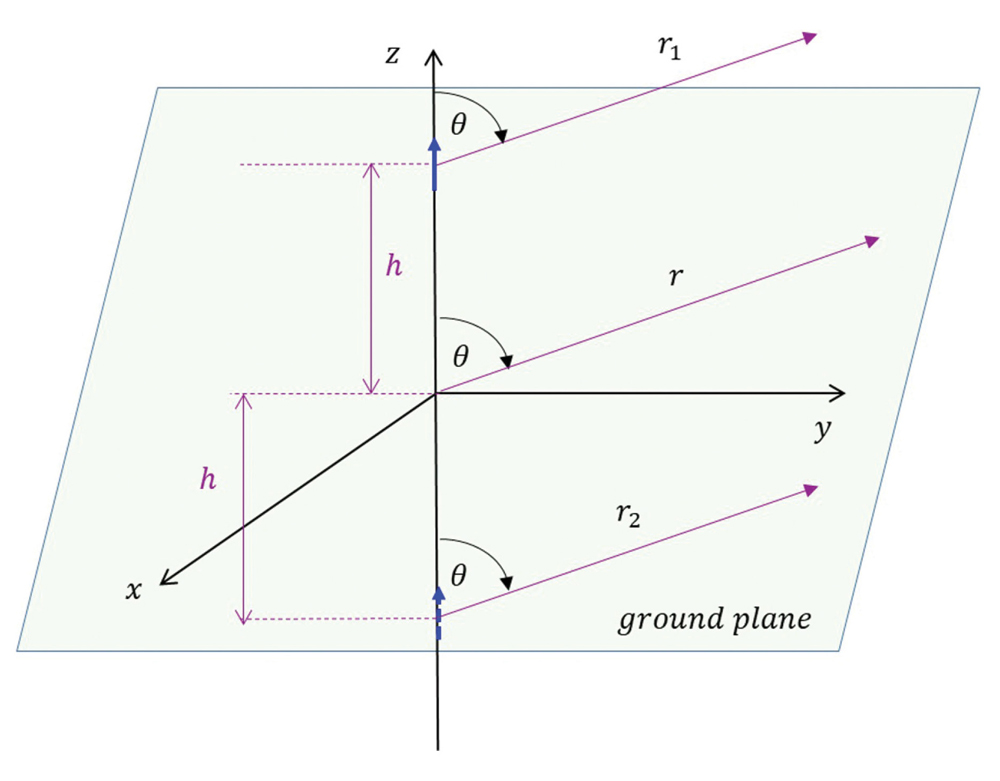
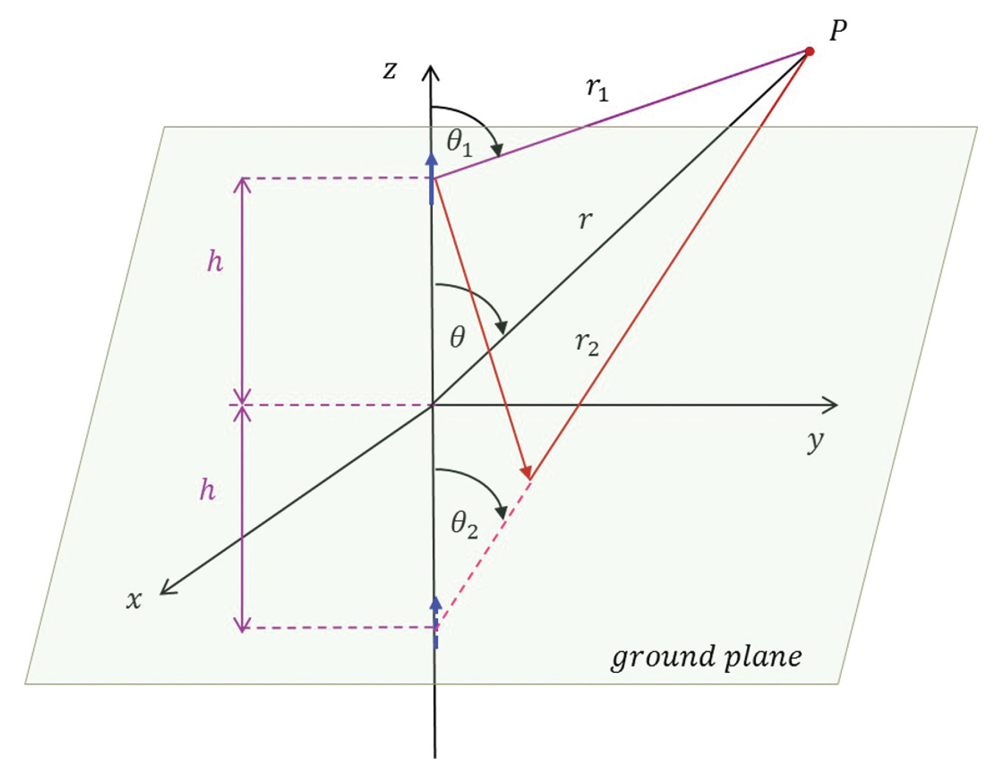
Consider the geometry shown in Figure 3.
Direct waves from the Hertzian dipole and its image
Figure 3: Direct waves from the Hertzian dipole and its image
The source is an infinitesimal dipole of length l, carrying a constant current I0. The observation point P is in the far field. The direct component of the E field at the observation point is, [2]
equation
The virtual component is
equation
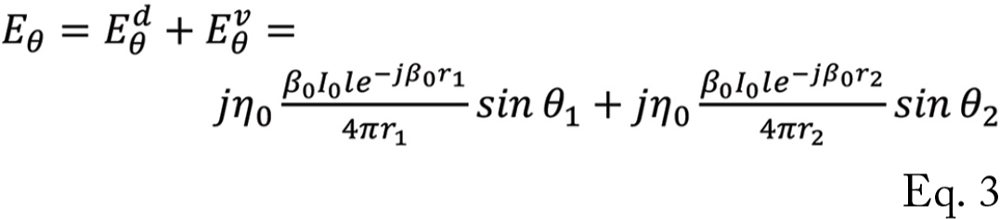
The total field at the observation point is
equation
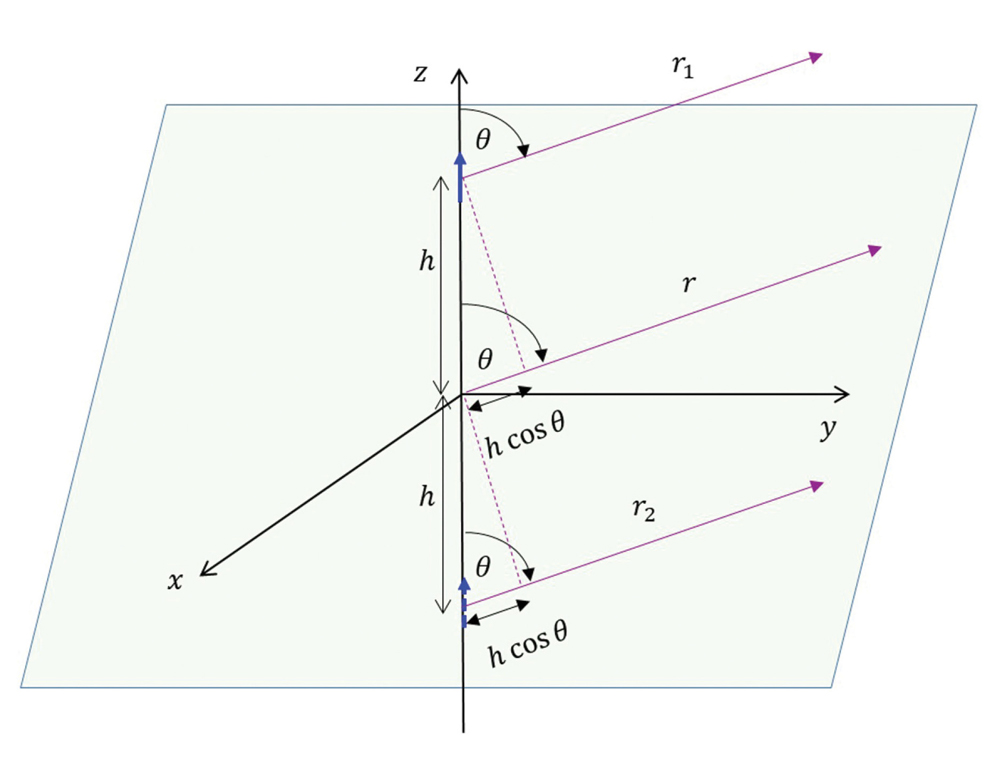
In the far field, r >> h and the lines from the actual and virtual dipoles to the observation point may be considered parallel, as shown in Figure 4.
Parallel-ray approximation
Figure 4: Parallel-ray approximation
This is often referred to as the parallel-ray approximation.
Obviously, we have
equation
equation
From Figure 5, we have
equation
equation
Parallel-ray approximation geometry
Figure 5: Parallel-ray approximation geometry
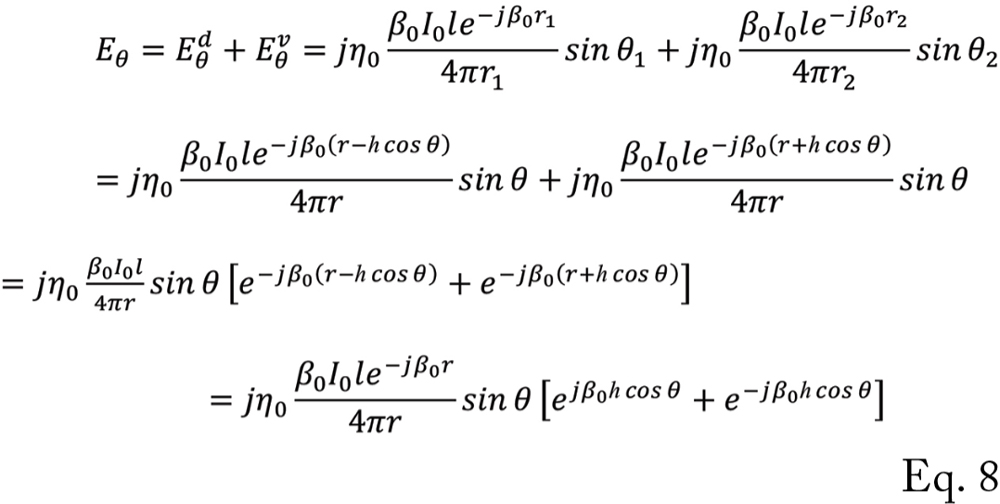
We will use the approximations in Equations 4 and 5 when substituting for r1 and r2 in the phase component of the expressions in Equation 3. That is,
equation
equation
When approximating the amplitude components, we may further approximate r1 and r2 as
equation
equation
Thus,
equation
Using the Euler identity for a cosine function, we arrive at
equation
References
  1. Paul, C. R., Introduction to Electromagnetic Compatibility, 2nd Edition, John Wiley and Sons, New York, 2006.
  2. Bogdan Adamczyk, Foundations of Electromagnetic Compatibility with Practical Applications, Wiley, 2017.
  3. Balanis, C. A., Antenna Theory Analysis and Design, 3rd Edition, Wiley Interscience, Hoboken, New Jersey, 2005.

Share this story:
Bogdan Adamczyk headshot
Dr. Bogdan Adamczyk is professor and director of the EMC Center at Grand Valley State University (http://www.gvsu.edu/emccenter) where he performs EMC educational research and regularly teaches EM/EMC courses and EMC certificate courses for industry. He is an iNARTE-certified EMC Master Design Engineer. He is the author of two textbooks, “Foundations of Electromagnetic Compatibility with Practical Applications” (Wiley, 2017) and “Principles of Electromagnetic Compatibility: Laboratory Exercises and Lectures” (Wiley, 2024). He has been writing “EMC Concepts Explained” monthly since January 2017. He can be reached at adamczyb@gvsu.edu.