
Part 2
n 1967, while on patrol in the Gulf of Tonkin, the United States Navy Carrier USS Forrestal was executing wartime missions over North Vietnam. At 10:45 am local time, the ship was preparing to launch more than 27 A-4 Skyhawk and F-4B Phantom Fighter jets, all fully fueled and armed with a mixture of iron bombs, precision missiles, and Zuni rocket launchers. At 10:51 am, an F-4B experienced an un-commanded Zuni missile launch on the flight deck, striking a neighboring A-4 and starting a fire, causing a series of devastating secondary explosions. Quenching the fire nearly capsizes the ship, which is ultimately saved through the heroics of the sailors who served aboard the Forrestal.
Although the US Navy conducted an extremely thorough accident investigation, many subsequent technical articles in the aerospace and NASA literature, including current EMI design books, blame the initiation event on EMI from the onboard AN/SPS-43 VHF search radar. This article is aimed at reinforcing the official USN record regarding the accident’s true root cause. The Forrestal’s many “lessons learned” led in part to the creation of an entirely new discipline called “insensitive munitions” within the Electromagnetic Compatibility community and is therefore a critical event to understand.
In the February 2025 issue of In Compliance Magazine, Part 1 of this article laid the critical groundwork to describe how the US Navy conducted peacetime and wartime carrier operations in 1967 during the Vietnam War. Combat carriers were stationed 60 miles off the coast of North Vietnam in the Bay of Tonkin at a location named “Yankee Station.” The supercarrier USS Forrestal (CVA‑59) had transited from Norfolk, Virginia to Yankee Station, arriving on July 25, 1967. In Part 1, we presented the fateful events preceding the launch of the planned 1100-hour-long strike mission on July 29, 1967. We described how air operations were conducted, what equipment was used, what the deck personnel were doing, and some fateful decisions made in the days and moments leading up to the event.
We now pick up our story at 10:40 am local time on the flight deck of the USS Forrestal on July 29, 1967. Pilot Jim Bangert was in his F4-B cockpit preparing for the 1100 strike launch. His Brown Jersey plane captain had signaled the deck crews to bring over and attached the F-4B ground start cart necessary for Jim to start the two engines of his F-4B. His aircraft was equipped that day with two LAL-10 launchers, each with three 5” Zuni rocket launchers with a total of 24 rockets.
At 10:40 am, all of the planned 27 combat aircraft for the 1100 launch were in various states of preparation and readiness. Aircraft were prepositioned and spread among the two front catapults (Catapult #1 and Catapult #2) and the two waste catapults on the angled deck (Catapult #3 and Catapult #4). Usually, the first aircraft to be launched were the S-3 tankers, A-3 reconnaissance aircraft, the E-2 Hawkeye radar surveillance, and the vanguard helicopter that takes station astern of the carrier during launches in case a pilot ditches their plane. These aircraft were being jockeyed in forward Catapults 1 and 2. The main body of strike aircraft composed of A-4s and F-4Bs were spread across the aft of the Forrestal and were to be launched on the waste Catapults 3 and 4. Already fueled, the ground carts began to circulate amongst these strike aircraft to start their engines.
Jim Bangert was an F-4B pilot assigned to aircraft #110, his aircraft currently occupying the furthest aft and starboard (right) side of the flight deck. As parked, he was angled slightly to the left. Bangert’s F-4B would be using the new Zuni 5 rocket weapon system, and he had found out only moments earlier at his preflight briefing that his aircraft would be using the Zuni rocket system. Bangert was exceptionally safety conscious, and he served as his squadron’s armament safety officer. Bangert was uncomfortable with the deck Red Shirt arming crews plugging in the LAL-10 launcher power “pigtails” before the catapult. His crew assured him that this new procedure was “approved.” He knew the LAL-10 TER safety pin was his ultimate safety backup when he climbed into the cockpit, which gave him some comfort of safety.
Meanwhile, across the deck, A4 pilots Fred White, John McCain, and Dave Dollarhide were prepping their respective A-4 Skyhawk. A total of 5 A-4s on the left aft deck were equipped with two each of the AN-M65A1 1000 lb. bombs along with a 400-gallon JP-5 centerline fuel tank. Because these bombs were not the usual MK82/83/84 class weapon, they were attached to the A-4 using an older canvas strapping system instead of the typical MK80 series hard mount. After visually inspecting their payloads, all the A-4 pilots climbed into their cockpits using an 11 ft. detachable cockpit ladder. Once settled into their cockpits, the Brown Jersey plane captains armed their ejection seats and then removed the 11-foot cockpit ladders. Soon, the ground start cart will arrive, and they’ll all be on their way.
At 10:45 am, Weapon Loader Petty Officer 2nd Class James Wilson of VF-11 connects the LAL-10 launcher friction fit power pigtail and removes the TER safety pin on Jim Bangert’s F-4 prior to engine start. Bangert is already in the cockpit and knows nothing about the safety pin being removed. His F-4B, with 24 Zuni Rockets, is connected to one of Forrestal’s ground start carts. He starts his right and left engines per protocol and lets the engines spool for a few minutes before switching his aircraft to its two internal 400 Hz generators. It is now 10:51 am. The configuration of the Forrestal at this very moment is shown in Figure 1.
![Figure 1: Forrestal aircraft at 10:51 am[25]](https://digital.incompliancemag.com/asset/2025/03/the-radar-img01.jpg)
Please note: Reference numbers are continued from Part 1
The Forrestal was not configured at this moment in time to accept any landing aircraft, it’s logistically and physically impossible. This reference is completely debunked.
The moment of the accident initiation is at hand. At this exact time, one may wonder what is currently stationed on Forrestal’s flight and hanger decks. Fortunately, there is an exact USN accounting; let’s take a moment to review all the flammables on the flight deck.[26]
There were 27 fully fueled and armed aircraft for the 1100 strike. These were armed with ten 1,000 lb. AN‑M65A1 bombs, eight 750 lb. AN‑M117 bombs, 64 MK82 500 lb. bombs, 144 5” Zuni rockets, each with a 125 lb. warhead, 24 Sidewinder and 23 Sparrow air-to-air missiles, and six Shrike missiles. All the aircraft on deck held a combined total of 40,000 gallons of JP-5 jet fuel. The “bomb dump” behind Forrestal’s island on the flight deck held weapons for the planned 1500 strike. These included 34 750 lb. AN-M117 bombs, 22 MK82 500 lb. bombs, two LAL-10 launchers with eight more Zuni rockets, and nine more Shrike missiles. Below deck, the hanger bay #1 contained an additional 53 tons of munitions, including six more of the AN-M65A1 bombs, 73 750 lb. AN-M117 bombs, 35 Mk 82 500 lb. bombs, 16 of the 300 lb. Mk81 bombs, four CBU-24B 830 lb. bombs, two Sidewinders, and two Sparrow air-to-air missiles.
At exactly 10:51:23 am on July 29, 1967, Pilot Jim Bangert, following normal preflight procedures, switched his aircraft from ground start power to his internal left and right aircraft generators by switching the two switches shown in Figure 7 in Part 1 of this article. Throwing these switches sent a power transient throughout the jet, including to the LAL-10 plug and its Zuni payload. Bangert felt a Zuni rocket launching which struck an opposing A-4 Skyhawk with Lt. Commander Fred White in the cockpit (see Figure 2). He testified later his F4-B master ARM was off, his right hand was on the two power switches above, and his left hand was on the throttles and not on the F4-B control column.
![Figure 2: At 10:51:23, Bangert’s F-4 fires a Zuni into Fred White’s A-4[27]](https://digital.incompliancemag.com/asset/2025/03/the-radar-img02.jpg)
The Forrestal’s Repair 8 squadron was chiefly responsible for aircraft crash, recovery, and fire control. Their leader, Chief Petty Officer Gerald Farrier (Figure 3, inset), was considered the finest trained firefighter in the entire Atlantic fleet. If a fully fueled aircraft caught fire, Repair 8’s firefighting team was trained to quell JP-5 fuel fires within one to three minutes using a combination of foam and carbon dioxide (CO2) fire suppressants. When Fred White’s fuel tank exploded, CPO Farrier grabbed a CO2 fire extinguisher and dashed out to White’s burning A-4 within 30 seconds of the Zuni strike. Since the PLATS camera had now swiveled aft towards the fire, the entire accident scene was filmed within five seconds of the Zuni strike. Figure 3 shows the PLATS camera at 10:51:33 am, only twelve seconds after the Zuni. It shows CPO Farrier running and initiating the CO2 extinguisher while his eight Repair 8 shipmates were seconds behind him, dragging foam hoses. Four nearby seamen were dragging a 2.5” saltwater fire hose, including Yellow Jersey Air Boss Aviation Boatswain Mate Dave Dickerson from Catapult 3.
![Figure 3: PLATS camera footage at 10:51:31 (t+12 seconds) as CPO Farrier dashes towards the fire[28]](https://digital.incompliancemag.com/asset/2025/03/the-radar-img03.jpg)
Now, under White’s A-4, CPO Farrier immediately noticed something was seriously wrong. He spots the two AN-M65A1 bombs on the deck in direct contact with the fire, both split, sizzling, and leaking deadly explosives. Though he tries desperately to quench the two bombs with CO2, he knows it’s hopeless since these AN-M65A1 bombs were not fire-rated. Turning around, he desperately tries to waive away the rest of the Repair 8 and the other firefighters because detonation is imminent.
At 10:52:55 am, 94 seconds after the Zuni strike, the first of Fred White’s AN-M65A1 bomb explodes, instantly killing 28 sailors on deck, including the entirety of the Repair 8 firefighting team and CPO Farrier. The PLATS camera operator, Petty Officer Ignizio, records the catastrophic moment of detonation in Figure 4.
![Figure 4: PLATS camera records the first AN-M65A1 1000 lb. bomb explosion at 10:52:55[29]](https://digital.incompliancemag.com/asset/2025/03/the-radar-img04.jpg)
“On the flight deck, I climbed out of the starboard catwalk and join others manning a charged saltwater fire hose as it is advancing towards the fire. Then bam! The next thing I know, I’ve been blown backward along the deck by the first explosion. I jump back to my feet, and to my total surprise I was uninjured!” [30,31]
The initial blast creates a ten-foot diameter hole in the armored flight deck. Beneath the gaping hole were sleeping berths where 60 sailors died instantly in their beds. With all the nearby damaged aircraft gushing JP-5 fuel, thousands of gallons of burning JP-5 now flow below, causing massive fires below deck. At 10:53:01 am, just 9 seconds after the 1st explosion, a second AN-M65A1 bomb explodes, again recorded by the PLATS cameraman PO Ignizio (see Figure 5).
![Figure 5: PLATS camera records burning debris raining down after the 2nd explosion[32]](https://digital.incompliancemag.com/asset/2025/03/the-radar-img05.jpg)
Captain John Belling (Figure 6) was just returning from his cabin when the fire started. Arriving at the bridge when the first explosions hit, he issued a series of critical orders. He reversed engines to slow the ship so that the deck fires were not fanned by 39 mph deck winds. He ordered condition “ZED” to close all watertight doors and to contain the fire in specific sections of the ship. While this did trap some sailors in burning spaces, it very likely saved the ship. He ordered deck crews by the bomb dump, on the flight deck, and on the hanger deck to throw overboard all ordinance and to push overboard as many burning aircraft as possible.
![Figure 6: Captain John Belling[33]](https://digital.incompliancemag.com/asset/2025/03/the-radar-img06.jpg)
By 10:57 am, the overall situation was grave indeed. Thousands of gallons of JP-5 were pouring below decks in multiple flight deck holes (see Figure 7).
![Figure 7: The Forrestal at 10:57 AM[34]](https://digital.incompliancemag.com/asset/2025/03/the-radar-img07.jpg)
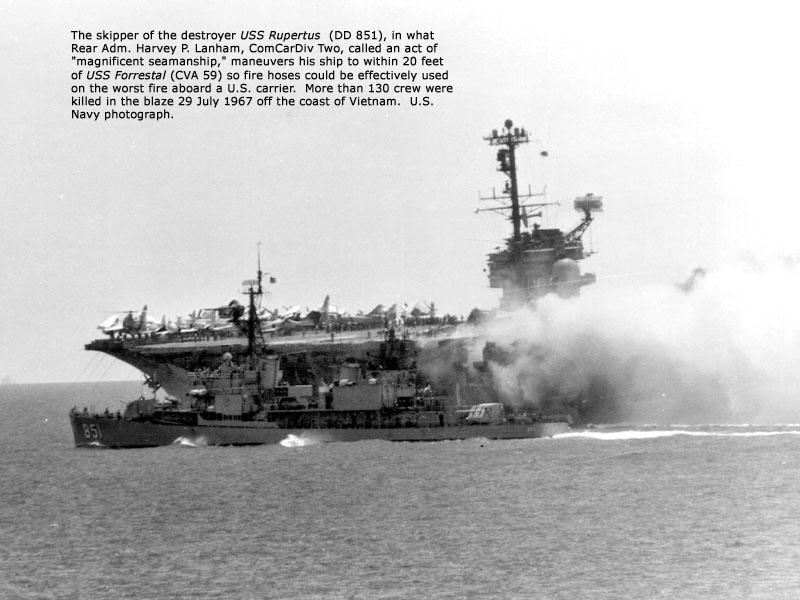
![Figure 8: Listing USS Forrestal with USS Rubertus (DD851)[35]](https://digital.incompliancemag.com/asset/2025/03/the-radar-img08.jpg)
Commander Rowland ordered Sailor Clark to empty the tank overboard, but this contingency was never planned for in the design of the tank. Sailor Clark found a valve on the tank’s lower side. He scrounged up a 1” garden hose, hooked it up, and dragged the end of the hose to the edge of the hanger deck overboard. He then discharged the entire 750-gallon contents of the O2 tank safely overboard, with the angry deck fire only 20 feet away from him!
The final big problem Commander Rowland faces involves the Forrestal’s steering. The USS Forrestal was designed with redundant steering controls on the port and starboard aft end of the ship. Steering controls were normally relayed electronically from the bridge, but the intense fire on the hanger deck aft had cut off the port steering room from the rest of the ship. Three sailors were trapped in port steering, including Sailor James Blakis, who on that day had traded duties with his best friend, Sailor Robert Shelton. Robert was on the bridge recording commands from Captain Belling when he learned of his friend being trapped.
Commander Rowland knew the firefighters wouldn’t reach port steering in time to save the sailors there, but he had to have the controls for port steering transferred to the starboard steering room. Despite injuries and the intense heat, James Blakis and his crew successfully transferred the controls. At this point, Captain Belling allowed Robert Shelton to phone down to port steering to say goodbye to his friend James before the fires overwhelmed the compartment.
Despite overwhelming odds, the deck crews extinguished the topside fires in about 2.5 hours. This is in spite of multiple additional ordinance explosions, including a Shrike missile, multiple 20mm cannon rounds, and belts of 50 caliber machine gun bullets going off in the burning aircraft. Below decks, the fires were more persistent and stubborn, but after 17 hours, the last of the flames were extinguished.
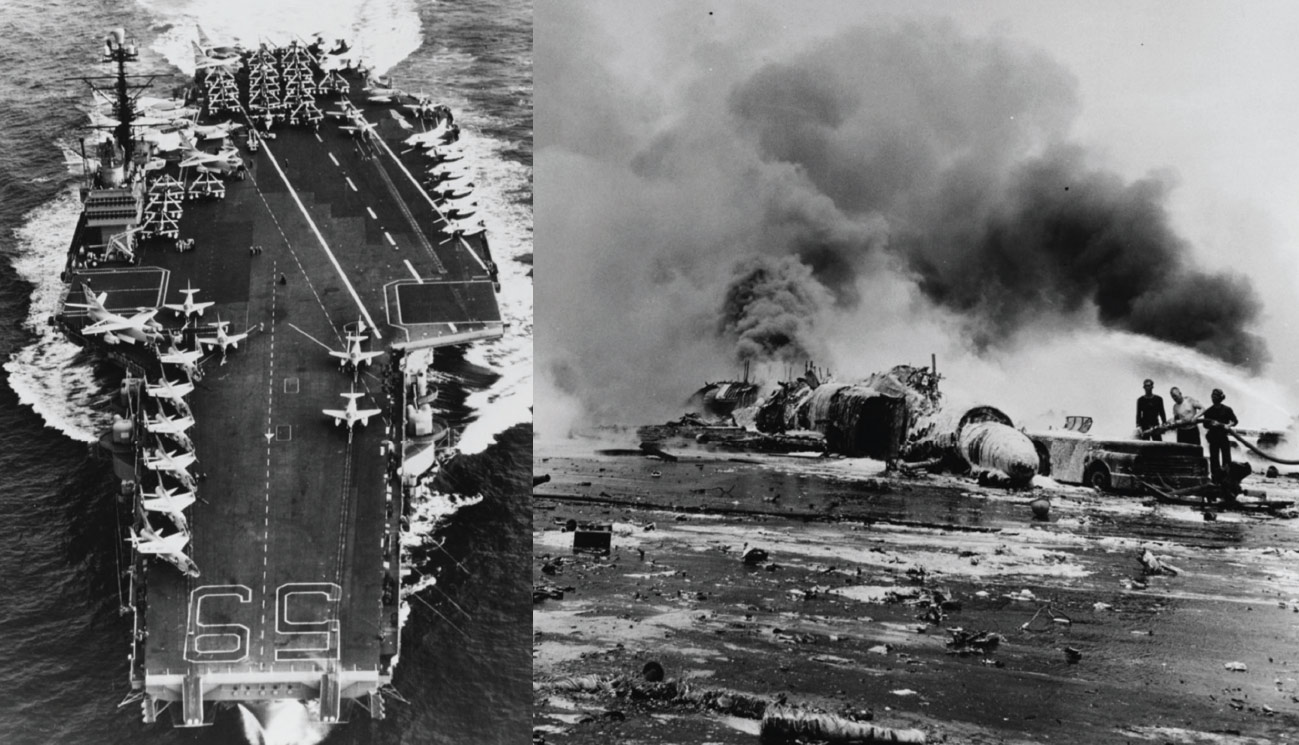
At this point, 134 sailors had perished, and another 161 were severely injured. Only 28 of the fatalities were on deck, the rest were below in the sleeping and working berths beneath the flight deck. Of the 73 aircraft on board, 21 were utterly destroyed, and another 40 were damaged, many permanently. In 2024 dollars, damage to the Forrestal exceeded $644 million dollars, with another $537 million of destroyed aircraft and lost ordinance. The scale of the post-fire devastation is evident in Figure 9.
![Figure 9: Devastation on the Forrestal’s flight deck as the fires are extinguished[36]](https://digital.incompliancemag.com/asset/2025/03/the-radar-img09.jpg)
![Figure 10: Rear Admiral Massey[37]](https://digital.incompliancemag.com/asset/2025/03/the-radar-img10.jpg)
From the pilot and deck crew interviews, many testified seeing a bright flash from the fantail in the vicinity of Bangert’s F-4 #110. As Bangert had miraculously survived, he testified that he felt a Zuni launch the moment he switched over his F-4B from the cart to aircraft power. Looking at other F-4Bs on deck that had survived the fire, Massey ordered that a Zuni Rocket be launched out to sea from an F-4 to see what “safety interlocks” had to be overridden to cause a LAL‑10 paired with a Zuni launcher to “fire its weapon.”
Several of the accident board members also inquired whether the Zuni launch event could have been triggered by the on-board radar. So, Massey checked the Combat Information Center’s electronic records. He found that the AN‑SPS 43 UHF radar main beam was pointed forward and slightly to starboard. He also found that prior to the Zuni launch, an S-3 Sky Warrior aircraft was on Catapult 2, awaiting the launch command. As the aircraft hadn’t launched when the Zuni fired, the SPS-30 radar would have been pointing forward and in standby mode, awaiting the catapult trigger to turn on and measure the departure velocity. Since the SPS‑30 was pointed forward, neither of these radar’s main beams were pointed anywhere close to the location of Bangert’s parked F-4B on the rear starboard side of the ship.
There was never hard evidence presented with data that implicated either of the onboard radar systems with the actual initiation event. The fact that Bangert stated that the Zuni firing was tied precisely to the moment of switching from ground start to aircraft power ruled out this possibility.
In reviewing the PLATS video, Massey had a complete visual record of everything that happened 10 seconds after the Zuni launch because the PLATS operator PO Ignizio had bravely filmed the entire scene. What about the actual initiation event itself? While reviewing the PLATS footage as it focused on the soon-to-be-launched A-3 Sky Warrior, a weird flash appears forward of the A-3 in the video, as shown on the left side of Figure 11. (To see a 17-second film loop of this flash, go to https://youtu.be/0RiQUK89oug.)
![Figure 11: PLATS capture at 10:51:23 from A-3 Sky Warrior (L) Did the PLATS record something aft? (R) [38]](https://digital.incompliancemag.com/asset/2025/03/the-radar-img11.jpg)
To test his thesis, Massey conjured up an experiment on deck. He equipped a crew with a high-powered strobe flash unit and placed the crew at various positions on the aft of the ship. He had them “fire” the strobe while he was watching the PLATS cameras as it was pointed forward at Catapult 2 just as the day of the accident. When the deck crews went to the starboard side aft and positioned their strobe at the very position of Jim Bangert’s F4-B wing root (Figure 12), the flash appeared on the PLATS display exactly as in Figure 11. Not only had Massey proved his thesis, the PLATS system gave him the exact time of the event.
![Figure 12: Strobe flash location at Jim Bangert’s F-4B wing root recreates the flash in PLATS video[39]](https://digital.incompliancemag.com/asset/2025/03/the-radar-img12.jpg)
The Zuni fired precisely when Jim Bangert switched from a ground start cart power to his aircraft generator power. The LAL-10 launcher connector was plugged in, and the TER safety pin was pulled. The accident board noted that LAL-10 pigtails frequently had loose or bent pins, and several post-accident inspections revealed shorted or malfunctioning pins on other LAL-10 launchers. While there were technically six interlocks to prevent the firing command from reaching the LAL-10 launcher, there turned out to be little protection for the LAL-10 power line to jump a voltage surge directly to the firing command wire. F-4B voltage surges down the LAL-10 pigtail during ground cart switchover were reproduced in the field and in the lab on other USN F-4Bs. This was confirmed post-accident, as Bangert’s F4-B was pushed overboard during the fire.
Despite a lack of formal firefighting training, many of Forrestal’s sailors pressed into service fearlessly battled fires and never retreated. Their heroic actions saved the ship from destruction. Furthermore, with all the additional water weight on the port side, Captain Belling’s orders to Commander Rowland to shift oil weight to starboard prevented Forrestal from capsizing.
At this point, a little perspective is important. During World War II, the US Navy at the Battle of Midway sank four Japanese carriers by striking them with dive bombers using a single 1000 lb. bomb each. One 1,000 lb. bombs struck the IJN carrier Akagi, three or four bombs struck IJN carrier Kaga, three struck IJN carrier Hiryu, and three struck IJN carrier Soryu.
The USS Forrestal survived the explosion and fire from no less than seven AN-65A1 1,000 lb. bomb explosions and multiple secondary explosions. In the midst of total disaster, Forrestal’s brave crew saved her from sinking.
Admiral Ephraim Holmes disagreed with Massey’s report only in one area – he held Captain Belling personally responsible for the fire and issued him a career-ending reprimand. When Admiral Moore, the CNO, reviewed the report and Admiral Holmes’s dissent, he decided to rescind Captain Belling’s reprimand. However, Admiral Moore wanted one more look at the root cause. He brought in now-retired Rear Admiral James Russell, his former Vice Chief of Naval Operations, to independently re-review Massey’s report to confirm findings and follow any open leads.
Two months later, Admiral Russel returned to the CNO’s office to provide his “final verdict” of the root cause. Out of courtesy, Captain Belling was invited to attend the half-hour debrief. Russell pulled out of his pocket a TER safety pin with its red “Remove Before Flight” streamer attached and a separate brass multi‑contact slide switch. He stated that the underlying brass slide switch is what the TER pin disengaged. Russel stated that the switch design was flawed, and it regularly shorted out in bench tests, oftentimes regardless of whether or not the TER pin was fully engaged or removed. Ground tests proved beyond a doubt that a power surge could jump directly from the power pin to the firing pin during transients like engine start-up and power switch-over from ground power. “That’s what caused the fire.” Though exonerated by the CNO, Captain Belling never again commanded a ship.
So, how bad was the TER safety pin design? According to USN Systems Command, the “LAL-10 Launcher was ‘impossible’ to launch a weapon when all safety systems engaged and functional.” Upon close inspection and reviewing many LAL-10 field units, multiple design deficiencies were uncovered: 1) the LAL-10 TER and shorting pin had to be fully screwed in to be properly seated. However, pins corroded in the salt air after multiple uses, preventing proper seating of pins and making the safety interlock unreliable; 2) the TER shorting device only needed to be 20% loose to potentially open a pathway from the power to firing pin, thereby effectively leaving the weapon system armed; 3) if the TER shorting device is “sprung” it never makes contact, which fails to “safe the weapon;” and 4) if the LAL10 mounting lugs are not fully seated, there is mechanical interference which prevents the TER pin from seating completely. This is why Russel states, “That’s what caused the fire.”
Over the years, every single US Aircraft carrier was retrofitted with a “Carrier Wash-down Firefighting System.” Basically, this is a giant chemical foam inverted sprinkler system that could wash an entire carrier deck in foam suppressant with the pressing of a button on the bridge in minutes. (To see a three-minute demonstration of a wash-down system on a Royal Navy ship, go to https://youtu.be/Guo4aQq9uSM.)
![Figure 13: Aviation Boatswain Mate Dave Dickerson (1967) (L), and Dave in 2024 with Becky Fischer (R) [40]](https://digital.incompliancemag.com/asset/2025/03/the-radar-img13.jpg)
So, were the radars seriously examined as a possible cause of the USS Forrestal accident? Yes, that thread was explored, and preliminary (not final) findings stated the threat needed to be considered. But a deep dive into the problems with the F4-B power subsystem and the inadequacies of the LAL-10 launcher TER safety pin were clearly identified as the accident’s root cause. Contributing to the accident was the presence of ordinance that never should have been brought on board (AN-M65A1 bombs) and the procedural short-cuts to connect weapons connectors prior to arriving at the catapult.
I am especially grateful for Dickerson’s referral to Kenneth V. Killmeyer’s outstanding book Fire, Fire, Fire on the Flight Deck Aft; This Is Not a Drill, arguably the definitive word on the actions of thousands of sailors and their collective experiences in saving the USS Forrestal on July 29, 1967. This 831-page book shows there were thousands of stories as compelling as Dickerson’s own experience. I am so honored to have learned about these heroes whose stories I never knew but truly appreciated.
- Courtesy USN and National Archives, 12 Aug 1967, Accession #: 330-CFD-DN-SC-04-09140
- Killmeyer, Kenneth V., FIRE FIRE FIRE ON THE FLIGHT DECK AFT; THIS IS NOT A DRILL: Autherhouse Publishing 2018, pp 210‑211
- From US Naval Institute Summary: https://www.usni.org/magazines/naval-history-magazine/2022/august/dissecting-carrier-disaster
- National Geographic History Channel, Single Frame Grab from “Seconds from Disaster Aircraft Carrier Explosion,” Original Broadcast 9-1-2021, Original from US Navy PLATS Camera
- National Geographic History Channel, Single Frame Grab from “Seconds from Disaster Aircraft Carrier Explosion,” Original Broadcast 9-1-2021, Original from US Navy PLATS Camera
- Fire Fire Fire on the Flight Deck, this is No Drill, Kenneth Killmeyer, Artherhouse Publishing, 2018, ISBN 1546248595
- Notes of personal phone interview of Survivor Dave Dickerson conducted by Dr. Brian Kent on 3 October 2024
- National Geographic History Channel, Single Frame Grab from “Seconds from Disaster Aircraft Carrier Explosion,” Original Broadcast 9-1-2021, Original from US Navy PLATS Camera
- Photo courtesy: https://en.wikipedia.org/wiki/1967_USS_Forrestal_fire#/media/File:RADM_John_Beling.jpg
- National Geographic History Channel, Single Frame Grab from “Seconds from Disaster Aircraft Carrier Explosion,” Original Broadcast 9-1-2021
- https://www.navsource.org/archives/02/025916.jpg
- US Naval Heritage Command, Picture 1126644, USS Forrestal Fire
- Courtesy US Naval Institute, Photo 451789jpg
- National Geographic History Channel, Single Frame Grab from “Seconds from Disaster Aircraft Carrier Explosion,” Original Broadcast 9-1-2021, Original PLATS Camera frame from USN
- National Geographic History Channel, Single Frame Grab from “Seconds from Disaster Aircraft Carrier Explosion,” Original Broadcast 9-1-2021
- Personal Photograph taken by Brian Fischer, used by permission, taken in Cincinnati, Ohio, August 2024