


EC 60601 is a family of internationally accepted standards that serve as the primary safety standards for medical electrical equipment, software, and systems used around the world. IEC 60601 standards are prepared and maintained by Technical Committee 62 (TC62) of the International Electrotechnical Commission (IEC ). The General standard and related Collateral standards are prepared and maintained by IEC subcommittee 62A – Common aspects of medical equipment, software, and systems.
The IEC 60601 family is aging. The 3rd edition of IEC 60601‑1 is now 20 years old, with two significant amendments. Released in 2012, Amendment 1 revised the understanding of essential performance. Amendment 2 was released in 2020 and addressed several “safety gaps.” Each of the Collateral standards was updated concurrently with IEC 60601‑1 Amendment 2.
At the time that the Amendment 2 project commenced, an outline for a 4th edition format was discussed, and TC62 established an architecture specification1 for the future edition based on the learnings from the previous editions. TC62 then handed the project lead back to IEC subcommittee 62A, where we prepared a design specification to plan out the work for the new edition.
Further, there are many structural rules that must be followed when developing IEC and ISO international standards. These rules and guidelines are also regularly updated. They are published in the ISO/IEC directive’s part one and two. The second part is where the document structure is defined.
One of the allowances for standards development permits large projects to be developed in fragments. As these rules, tools, and design content were being laid out, it became apparent that we would divide the work of the 4th edition into fragments. We chose to use fragments with the OSD tool to allow for better alignment of work tasks within the design of the 4th edition.
Writing standards requires a strong agreement on terminology and what various terms mean in the context of the work. Once TC62 completed the architecture document, work started to create a new chapter in the freely and publicly available IEV online dictionary. The chapter contains the many terms used in the 4th edition to provide a consistent understanding among the hundreds of writers of the 4th edition and its future particular standards.
“MEE” is defined as a subset of medical devices that are electrical and have an applied part or transfer energy or substances to or from the patient or detecting such energy or substance transfer to or from the patient. (880‑08-26).
“Medical devices” are defined as an instrument, apparatus, implement, machine, appliance, implant, reagent for in vitro use, software, material, or other similar or related article, intended by the manufacturer to be used, alone or in combination, for patients, for one or more of the following specific medical purposes:
- Diagnosis, prevention, monitoring, treatment, or alleviation of disease
- Diagnosis, monitoring, treatment, alleviation of, or compensation for, an injury
- Investigation, replacement, modification, or support of the anatomy or of a physiological process
- Supporting or sustaining life
- Control of conception,
- Disinfection of medical devices
- Providing information by means of in vitro examination of specimens derived from the patient, and which does not achieve its primary intended action by pharmacological, immunological, or metabolic means, in or on the patient, but which can be assisted in its intended function by such means.
“Basic safety” is freedom from unacceptable risk caused by physical hazards in normal use and single-fault conditions. These physical hazards include the risk of shock, mechanical, fire, chemical, and biological hazards. “Essential performance” is the performance of a clinical or diagnostic function of a product where loss of the function or degradation of the performance beyond the limits specified by the manufacturer results in an unacceptable risk other than physical hazards.
These definitions have been clarified in the IEV draft and will have significant implications in the new edition of IEC 60601‑1. We are working to include significant new and additional rationale to clarify the use of these terms as they form the basis of the safety case for medical devices.
Many medical devices impose a degree of risk to the patient in order to provide the intended benefit. This is the risk benefit that is captured from a risk management process during the required hazard analysis of the design and use of the equipment by the manufacturer and clinical user guides. These topics are guided by ISO 14971, Application of Risk Management to Medical Devices.
Establishing evidence that the device is properly designed to limit potential risk associated with its use includes user interface design and the software used in a device, with a device, or supporting a device. The design specification provides guidance to the 4th Edition team in section 11, where we provided an example of how to implement the process requirements to support the conformity assessment process without requiring additional quality system audits of manufacturers’ processes to demonstrate conformity with the standard.
Integrating the Collateral standards is an important goal for TC 62 and the breadth of technology encompassed by the IEC 60601‑1 family of standards. If a general requirement needs modification, the modification can ripple through many Particular standards, and this takes a significant amount of time and manpower to bring all the standards in line with revised requirements. This affects all the users, especially manufacturers and regulatory authorities, on which version of the document is considered to meet the intent of the regulation protecting patients using the devices.
When we completed this task, there were 12 groups of requirements:
- General requirements
- Physical environment hazards
- User interface related hazards (including all labelling and information to be provided) D. Materials hazards
- Programmable electrical medical systems (PEMS), for example, software as a medical device (SaMD), software in a medical device (SiMD), firmware, software, apps, OS, drivers, related hazards
- Electrical hazards
- Mechanical hazards
- Thermal and fire hazards
- Optical radiation (visible, UV, and IR) hazards
- Ionizing radiation hazards
- Electromagnetic exposure (not optical or ionizing but including SAR) hazards
- Electromagnetic disturbances (including coexistence) hazards
This change has also been driven in part by the number of device connections that are now possible with the use of radio technologies. So, the requirements of the Collateral standards of IEC 60601‑1-11 and IEC 60601‑1-12 are being incorporated throughout the 4th edition. The addition of radios to nearly every MEE device has driven a requirement to address RF electromagnetic exposure, specifically, specific absorption rate hazards.
The addition of all these network connections also requires consideration and guidance in the standard to support cybersecurity. This is a new element of IEC 60601‑1, which is being developed by the Software working group. Another item undergoing fast expansion in MEE is the use of artificial intelligence (AI) in its many forms, and guidance will be provided in the software fragment for these aspects, further supporting device safety.
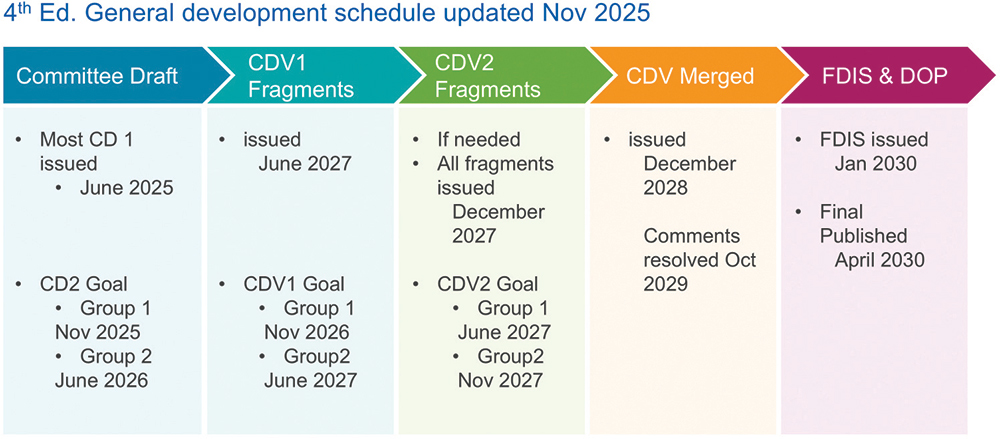
At the time this article was written, all fragments have been published and have received comments on their first CD. A few fragments have issued a second nearly complete CD with the rationale to aid in understanding the risks covered by the requirements and the changes from the previous edition. Once each fragment has been through a CDV, the fragments will begin to be merged so we can create the final layout of the clausal structure for the 4th Edition.
The current schedule from the IEC SC62A meeting in Milan in November 2025 is shown in Figure 1. The first nearly complete assembled version of the CDV is expected to be available in late 2028.
For further information on the IEC 60601‑1 standards development project or to explore potential opportunities to contribute to the standards development effort, contact your national committee. In the U.S., the committee is managed through ANSI by AAMI.
- “Architectural Specification for Safety Standards of Medical Electrical Equipment, Medical Electrical Systems, and Software Used in Healthcare, Version 3.0,” issued May 5, 2020
- “Design Specification Outline for the Fourth Edition of IEC 60601‑1”

Brodie Pedersen is the Chief Regulatory Officer at Borderless MedDev. He is also the Vice Chair of ICE SC62A, and the project leader of IEC 60601‑1
4th Edition. Pederson can be reached at brodiecp@borderlessmd.com.