


of new certification projects fail to comply with the minimum requirements of published medical safety and performance standards. This article explores some of the major challenges faced by medical device designers and manufacturers when asked by local authorities, regulatory bodies, government agencies, or other sources to demonstrate evidence of compliance with applicable medical standards. Whether it’s to support a U.S. FDA 510(k) submission, European Union Regulation (EU) 2017/745, Brazil’s ANVISA, China’s NMPA, sale to hospitals and healthcare professionals, or a device manufacturer’s own internal verification and validation efforts, safety and performance standards come into play.
The majority of issues that third-party test labs and certification agencies encounter stem from:
- Lack of awareness and application of all relevant standards throughout the design process;
- Waiting until “design freeze” to partner with a knowledgeable, accredited third-party test lab or certification agency;
- Being unprepared for standard evaluations without sufficient evidence to demonstrate compliance (including production-equivalent samples, complete user manuals, product labeling/markings, accurate isolation schemes, critical component lists with traceability to component-level approvals, having a compliant quality system, missing or incomplete supporting documentation, etc.);
- Not following established company standard operating procedures (SOPs) on how and when to complete product development steps and risk management activities;
- Incomplete verification and validation (V&V) activities or relying on your third-party test lab certification partner to perform V&V activities during an active evaluation;
- Lastly, siloing design activities between different groups within the larger organization.
By choosing and communicating preemptively and effectively with an accredited third-party test lab and certification partner early in the design process, many of these common and often costly hurdles between your novel, new medical device and its presence on the global market in the diagnosis or treatment of patients can be mitigated as much as possible.
For medical electrical devices, the primary standards are the 60601 and 80601 series (published by a variety of standard writing organizations, e.g., IEC, ISO, ANSI/AAMI, CSA, etc. – IEC or ISO versions will be referred to throughout this paper). At the time of writing, the General standard IEC 60601-1 Ed. 3.2 [1] and its aligned Collateral standards (60601-1-XX) and Particular standards (60601-2-XX or 80601-2-XX) are recognized by most countries of typical interest to manufacturers.
Often, Particular standard publications may not align with the General or Collateral standards due to specialization and the rate of technology advancement for the type of product covered. For example, active implantable devices have their own requirements within the ISO 14708 [2] series of standards. Biocompatibility is addressed in the ISO 10993 [3] series. ISO 13485 [4] compliance is also required for medical device design and production companies. Standards can be purchased directly or viewed through subscription services from many vendor options online. Reviewing the titles, scopes, and terms and definitions in these standards determines their applicability.
To better understand and anticipate the testing requirements of the General standard that will be applied to the equipment under test (EUT), IEC/TR 62354 (2014) is an underutilized resource that outlines testing procedures for medical electrical equipment aligned with the IEC 60601-1 ED 3.1 version of the General standard.
Partnering with an external resource can be costly, so it’s best to begin preparing necessary materials to support standard evaluations early to ensure that quoted time is used as efficiently as possible. Digitized and searchable copies of all referenced supporting documents and the completed vendor checklists should ideally be provided before the scheduled starting date of the project with the assessing lab or agency. Most often, the cost of evaluating and testing to standards is determined based on engineering time estimates to complete the scope of work for the specific EUT. The more complex or novel the design, the more standards may apply, the more intricate and detailed risk management becomes, the longer the time, and the higher the cost for an external resource to evaluate it all.
Depending on the scope of the project, “readiness” may include preparing and delivering the following:
- EUT samples
- Accessories (including optional items, mounting kits, mobile stands, carrying cases, etc.)
- Support equipment (to properly “run” the equipment and load any outputs, computers/phones/tablets with user interface software, custom fixturing, etc.)
- Ample consumables or single use/sterile parts
- Instructions for Use (IFU), Service, and Installation Manuals
- Internal and external product labeling and markings, warnings, cautions
- Isolation or insulation diagrams
- Critical components list or bill of materials (with technical specs and traceability to component-level standard certifications by accredited agencies)
- Schematics, wiring diagrams, board layouts
- Completed checklists, questionnaires, templates provided by the partnered lab or agency
- Quality system, risk management, software, and usability-related documentation (SOPs, Failure Modes and Effects Analysis, V&V reports, etc.)
Some of the most common construction or sample related issues are tied to: unsecured (or temporarily secured, i.e. taped) parts or mountings, lack of cable routings and fasteners, use of copper tape for quick EMC fixes instead of permanent solutions, 3D-printed “stand-in” enclosures or parts instead of final casts or moldings, printed circuit boards without final layouts (ex. jumpers instead of solder, impacts spacings), temporary labeling vs. final versions (materials, ink, and adhesives as well as content), software not being finalized (troubleshooting, bugs), and use of temporary components for feasibility studies instead of final selections.
Complex medical electrical devices or systems often require on-site assistance from technicians or manufacturers to operate the equipment. EUTs with hazardous outputs or materials may require the full-time presence of knowledgeable staff or training for test lab or agency staff before any testing occurs. If safety equipment or specialized tools are required to operate or service the EUT (e.g., eye, ear, respiratory, laser dumps, radiation shielding, dosimetry monitoring, etc.), they must be provided to the test lab. If an EUT requires installation or assembly, or configuration prior to operation, technicians or manufacturer representatives are often required to be on‑site to support.
Products with essential performance claims require clearly defined quantitative and qualitative characteristics that can be monitored to ensure that performance is maintained throughout testing or that appropriate mitigation options are in place to ensure that an unsafe situation does not occur. Test labs need ways to monitor and measure that performance. Particular standards define test requirements that may already cover these methods. Accredited test labs with adequate scopes to cover those Particular standards will have calibrated equipment capable of measuring some parameters, but custom or unique essential performance criteria that aren’t covered by existing standards may need to be developed with the test lab to support an evaluation. This is increasingly becoming a challenge as technology advances ahead of published safety standards and the regulatory world.
The base medical electrical EMC standard (IEC 60601‑1‑2, latest ED 4.1) [5] is written in a way to cover all possible medical products in the field. Due to design variations, a third-party test lab may not be immediately familiar with the technologies involved. Labs will need technical specifications and operational guidance about the EUT to perform a proper evaluation.
Documentation is a very essential step for an EMC test lab to properly evaluate any EUT. The standard therefore dictates that the manufacturer is responsible for providing the necessary documentation prior to performing any testing (e.g., EMC test plan, user manual, risk management, and related accompanying documents). Per 60601-1-2, the test plan is a vital document, and testing shall not start until a test plan has been submitted for a given project (see “test plan” in Cl. 4.3.1, 6.2, 7.1.2, 7.1.9, 8.1, 8.7, 8.9, 8.11, and Annex G) [5]. The standard provides some guidelines for the minimum EUT information needed to be included in the test plan (Cl. G.1, Annex G) [5].
Be aware that this is a generic guideline for all devices that may need information to be added to cover more complex EUTs. Clearly defining your essential performance or essential requirements with observable and testable acceptance criteria within your test plan is critical for complete and repeatable EMC testing. Having all documentation ready for the start of a project is a crucial obstacle every manufacturer will have to face when applying for certification.
Another major obstacle facing manufacturers is EUT sample preparation. Setting up the EUT in its worst‑case configurations and providing all relevant support equipment, accessories, disposables, etc., is a critical step in ensuring accurate testing and compliance with medical electrical standards. The worst-case configuration (Cl. 4.3.1 “Configurations,” Cl. 8.9 “Immunity Test Levels”) [5] involves configuring the EUT to its maximum or most demanding operational parameters that would be encountered during intended use. If the EUT can meet the testing criterion of applicable standards (including EMC test deviations that may exist in Collateral and Particular standards) under the identified worst-case parameters, the EUT is covered for all other combinations of regular function per the 60601-1-2 standard. Depending on the EUT, there may be more than one mode of operation to consider for evaluation.
All of this is achieved through engineering analysis and familiarity with the given EUT. Typically, test labs will provide a questionnaire or quoting form to assess the characteristics of your EUT. Some general questions to determine worst-case modes are:
- What parameters make the EUT work the hardest?
- Which modes are needed to cover all included hardware?
- How can the end user push the EUT to its limits?
The final major obstacle manufacturers may face is failure during the EMC evaluation. Unexpected failures can put a tight strain on any project timeline or budget. If an EUT fails a given test, modification to the existing EUT may be necessary for the EUT to comply with the tests of the standard. Depending on the complexity or degree of sample modification needed to pass a specific test, retesting other clauses previously found to be compliant may also be necessary to ensure the changes do not introduce any unexpected new vulnerabilities. This adds time and cost to schedule additional resources with the test lab.
The best way to mitigate this issue if you’re uncertain of how your product will perform is to dedicate time for engineering analysis and testing or “pre‑scans” internally or with a knowledgeable test lab before attempting full certification. The tests with the highest failure rates in IEC 60601-1-2 Ed. 4.1 are: radiated emissions, electrical fast transients (EFT), electrostatic discharge (ESD), and radiated radio frequency immunity.
The isolation diagram is used by test labs to confirm that adequate isolation is provided between areas in the end-product, which also informs their testing strategy. If third-party components are used to provide isolation, use of these components is evaluated based on their approvals to component standards and implementation of their conditions of use/acceptability.
Common issues with isolation diagrams include:
- Medical device manufacturers using appropriately certified, recognized critical components but not considering the conditions of acceptability (or use) for such components when installing such components as part of their end-system. (For more information, see the section “Critical Components” later in this article.)
-
The working voltage is taken as the highest voltage appearing across the insulation in normal use, including earthing of any accessible part or applied part.
However, between F-Type applied parts and all other accessible parts (as defined by Cl. 5.9.2) [1] and other patient connections, the working voltage is not only the normal operating voltage (e.g., 24 Vdc) but also the maximum mains voltage (e.g., 240 Vac, see Cl. 8.5.2.1) [1]. Specifically, this clause states a minimum of 1 MOPP based on the maximum mains voltage must be considered for these areas. This considers a worst-case scenario of an external voltage source being present on the floating patient. As this is outside of your control as the manufacturer, this is considered a normal condition.
- To summarize, for F-type applied parts, you’re required to meet 2 MOPP based on your nominal operating voltage and 1 MOPP based on maximum mains voltage.
- Compliance is checked by leakage current tests of Cl. 8.7.4 [1], the dielectric strength test of Cl. 8.8.3 [1], and by measurement of relevant creepage and clearance distances per Cl. 8.9.3 [1].
As shown in Table 1, for a secondary circuit operating at 24 Vdc, when F-type applied part requirements are introduced, the worst-case spacing is based on the maximum mains operating voltage. It is important to consider both requirements and ensure that the worst-case construction (the largest spacings requirements) is met.
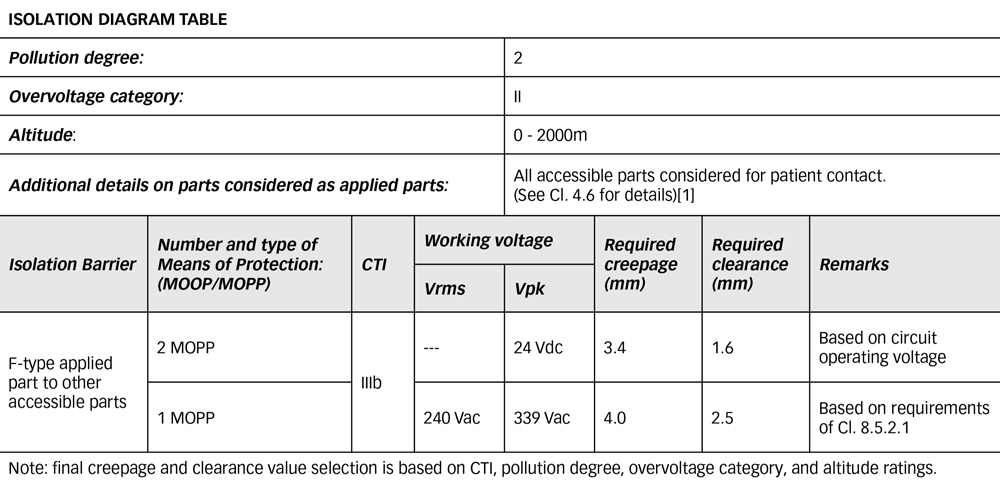
-
When determining creepage and clearance values, adjustments to limits may change when factoring in these criteria:
- CTI rating (see Cl. 8.9.1.7)[1]
- Pollution degree (see Cl. 8.9.1.8)[1]
- Overvoltage category (see Cl. 8.9.1.9)[1]
- Altitude (see Table 8)[1]
For example, a power supply is certified for 2000m but is used within an end-system with a rated operating altitude of 5000m. This can lead to a possible failure of air clearance since the multiplication factor for MOPP of 1.29x at 5000m.
- If the applied part is defibrillation proof, Cl. 8.9.1.15 [1] requires a minimum creepage and clearance distance of not less than 4.0mm (see additional Cl. 8.5.5.1) [1].
- Per Cl. 4.6 [1], to support your isolation barrier selection, the risk management file (RMF) needs to indicate any parts of the product the patient might contact, in addition to the identified applied part(s). The RMF shall also specify which applied part types these areas should be treated as type B, BF, or CF. These areas are any part of the equipment that may contact the patient during normal/accidental use of the equipment, but isn’t an applied part. These areas will be treated as an applied part for the sake of testing. Generally, when selecting these areas, the patient environment is considered 1.5 m around the normal patient position. However, the RMF should take into account the typical use environment, the intended operator, and reasonably foreseeable patient positioning when considering this. It is also important to consider parts that the operator can contact at the same time as they are touching the patient.
- Improper use of conductive coating material can also lead to isolation breakdown. When using a conductive coating, it is important to select one that is certified for use on the plastic you are spraying. If the plastic and coating combination isn’t properly certified, coatings could flake off, leading to bridged isolation barriers. It is also important to ensure that the placement of this coating doesn’t bypass your creepage and clearance spacings. The most common issue is due to overspray that bypasses isolation from mains/secondary circuity out to enclosure parts.
- Be wary of running traces beneath isolating components, as this can violate the spacings achieved by the components bridging the isolation barrier. Ensure that components are mounted appropriately per their installation instructions on both sides of the board.
It’s important to identify relevant technical specifications for each critical component that may impact standards compliance. Typical characteristics for safety-critical components include electrical ratings, operating temperature limits, insulation class, gauge or conductor size, insulation voltage or dielectric strength, material type, flammability rating, component type, and key dimensions.
A typical medical evaluation assumes all critical components are approved by a Nationally Recognized Testing Laboratory (NRTL) recognized by the Occupational Safety and Health Administration (OSHA) in the U.S. and the Standards Council of Canada (SCC) to appropriate standards (IEC, U.S., and Canadian component standards). A NRTL mark of conformity demonstrates that a product has been tested and approved by an authorized NRTL and that it is under their annual follow-up program. This follow-up program ensures continued compliance throughout the life of the NRTL mark.
Use of unapproved components generally warrants additional testing not covered by the initial quotation. This leads to costly testing, scheduling delays, and additional continued follow-up testing for these components in the end-product as part of an unapproved component evaluation program.
(Note: currently, for the Medical category, OSHA only recognizes the General standard. Collaterals and Particulars are considered supporting standards for NRTL listings.)
For International Electrotechnical Equipment and Components (IECEE) Certification Body (CB) scheme evaluations, all power supplies and batteries are also required to be CB certified for compliance with the requirements of appropriate standards. (For more information on battery requirements, see the section on “Batteries” later in this article.) The CB scheme is an international system for mutual recognition of test results and certificates that promotes uniformity in testing and reporting among participating countries and certification organizations. CB testing can only be performed by qualified CB engineers and test labs with ISO 17025-calibrated equipment. CB scheme reports are universally accepted; however, some countries have published their own deviations to specific standards that may also need to be considered.
If you are uncertain of the COAs for your chosen component, the manufacturer or vendor of that component is responsible for maintaining and providing this information to end‑users.
Common issues related to COAs include:
- Consideration of rated ambient conditions (temperature, relative humidity, and altitude restrictions) of the component vs. the end-system environment;
- Use of additional protective measures that must be implemented in the end-system, such as overcurrent protection or adding an enclosure to open-frame modules or subassemblies;
- Routing of wiring and securement of components in the end-system; and
- Adequate mounting considerations. To maintain the basic safety and insulating characteristics of a component, it is important to ensure creepage and clearance distances aren’t violated when installed in the end-system.
Medical equipment manufacturers are constantly shrinking the physical dimensions of products as technologies advance, which is challenging for maintaining creepage and clearance.
Other examples are raw material certifications vs. molded enclosure material certifications. The COAs for the majority of moldable plastics with UL 94 [6] flammability ratings state that materials must meet applicable requirements concerning the molding and fabricating of finished parts as described in ANSI/UL 746D [7]. This makes this requirement relevant for any product where the enclosure material is considered a critical component. When insufficient NRTL approvals are found, flammability testing is required to be conducted in addition to the typical mechanical testing of the IEC 60601-1 evaluation. This unapproved molded part is then added to the end‑product NRTL’s unapproved component program.
NRTL and/or CB scheme approvals for batteries are key to a successful end-product evaluation. Battery cells and packs shall comply with the battery standard specified in the end-product standard. For IEC 60601-1 ED 3.2 [1], this is IEC 60086-4 for primary lithium batteries and IEC 62133 or IEC 62133-2 for secondary lithium batteries. If the end-product standard does not specifically require compliance of a battery and the end-product standard does not contain specific tests for batteries, the cells and packs shall comply with the requirements of the battery standard relevant to the end‑product certification scheme.
Please be aware that, due to the safety concerns with batteries, the latest published version of IEC 60086-4, IEC 62133-1, and IEC 62133-2 are recommended to maximize safety and universal acceptance.
- NRTL listing to the applicable UL/CSA battery standard
- NRTL listing to the applicable IEC battery standard
- UL 1642 Lithium Cell
- UL 2054 Nickel Cell or Lithium/Nickel Packs
- IEC 60086-4 Non-rechargeable Lithium
- IEC 60086-5 Non-rechargeable Alkaline
- IEC 61951-2 and IEC 61951-2 Performance of Rechargeable Ni-Cd or Ni-MH
- IEC/UL 62133-1 for nickel systems
- IEC/UL 62133-2 for lithium systems
- Certification to the UL/CSA end-product standard using the test methods of UL or IEC battery standards
ISO 14971 compliance for the application of risk management (RM) to medical devices is required for all medical electrical devices or systems seeking compliance with the 60601 series of standards. Depending on the versions of the standards with which you’re looking to comply (IEC 60601-1 ED 3.0 or ED 3.1 or ED 3.2), the 2007 [9] or 2019 [10] version of ISO 14971 is required. For certification projects, evaluations to this standard are performed by accredited test labs in a “desktop audit” style. Checklists that align with the standard clauses are typically provided by the evaluating test lab to help the product manufacturer demonstrate compliance for both their company-wide RM process as well as implementation of that process for the specific product being evaluated. The results of the ISO 14971 review are documented in Table 4.2.2 [1] of the IEC 60601-1 test report and are referred to throughout the rest of the evaluation to IEC 60601-1 specific RM clauses.
The most common failure discovered during this review is typically tied to the implementation of the company’s RM process for a specific product. Establishing templates or mapping documents to tie separate product-specific files back to your RM process within your quality system helps ensure steps aren’t missed.
ISO/TR 24971 [11] is a separate publication that provides guidance for applying ISO 14971, including explanations and examples on how to implement an RM system. IECEE provides additional guidance through published operational documents that are applicable to CB scheme projects (OD 2044 [12], OD 2044-1 [13], and OD 2055 [14]).
IEC 60601-1 (ED 3.0 and later), Collateral, and Particular standards integrate risk management considerations throughout their clauses. Searching for the keyword “risk” within the standards themselves, using the checklists provided by your partner test lab, and referencing the published IECEE guidance materials are great first steps to ensure you cover the minimums. There will always be additional risks specific to your device design, user interface, software, and other aspects to consider in addition to those defined by the standards.
The most common RM failures are tied to the lack of documented considerations of the minimum hazards outlined by the 60601-1 standard. For example, take Cl. 9.5.1 [1] for expelled parts hazards. Most often, this clause is mitigated through inherently safe design (Cl. 7.1a) [10] by providing a suitable enclosure around any parts that could become expelled during a fault event (moving parts becoming dislodged, capacitors or batteries exploding, insulation melting, etc.). For a test lab to evaluate RM, written evidence must be provided for each clause that’s traceable to the risk management file for the product under test. Oftentimes, clauses like this one aren’t considered in RM as they’re deemed “obvious.” However, without clear documentation, a third party is unable to verify if the hazard was considered during your design process.
The main challenges with Cl. 14 “Programmable Electrical Medical Systems” (PEMS) [1] and IEC 62304 [15] software evaluations are similar to those encountered during RM evaluations. This includes that ensuring company SOPs defining the software lifecycle processes are followed, evidence is appropriately documented, and V&V activities are completed. Having an ISO 14971-compliant RM process is required to comply with IEC 62304.
Table A.1 [15] provides a summary table of clause applicability based on software safety class (A, B, C)
to help focus the assessment of relevant clauses.
Annex B [15] additionally provides guidance on the provisions of the standard with deeper explanations and examples on how clause requirements may be addressed. If the product uses legacy software (“medical device software legally … still marketed today but for which there is insufficient objective evidence that it was developed in compliance with the current version of the standard”), subclause 4.4 [15] establishes a process for applying IEC 62304.
A common issue assessors see with PEMS is documenting processes and hazards related to software of unknown provenance (SOUP). SOUP is commonly used in place of new, manufacturer‑developed software. Per IEC 62304 [15], SOUP is defined as a “software item that is already developed and generally available and that has not been developed for the purpose of being incorporated into the medical device (also known as “off-the-shelf software”) or software item previously developed for which adequate records of the development processes are not available.”
For the end-product specific files, the full PEMS architecture document will demonstrate how SOUP is to be incorporated into the full design. The architecture needs to detail functional and performance requirements of SOUP (Cl. 5.3.3) [15], as well as hardware and software specifications required by SOUP (Cl. 5.3.4) [15]. End product documentation must also demonstrate that SOUP items have been adequately configured and integrated into the end software as defined by your process. The risk management process as defined by ISO 14971 must also take into account specific hazards related to the use and failure of SOUP items.
Clauses 6 and 7 of IEC 60601-1 [1] contain the majority of product classification, internal and external marking, warnings and cautions, and manual requirements in the standard. Similarly, Collateral and Particular standard clause numbering is aligned with the General standard. Clauses 6 and 7 in Collaterals and 201.6 and 201.7 in Particulars contain amendments or additions to the General standard requirements.
Clause 5 of IEC 60601-1-2 [5] contains all identification, marking, and instructions for use requirements related to EMC. These are frequently provided late during the test lab evaluation process and prevent the issuance of final certification reports after testing has completed and data and reports are compiled.
When assessing the completeness and compliance of your labeling artwork and user manual content, ensure you’re factoring in applicable standards as well. The requirements in the medical standards are very prescriptive and help establish your minimum labeling and manual content.
- Medical Electrical Equipment – Part 1: General requirements for basic safety and essential performance, IEC 60601-1 Edition 3.2, 2020-08
- Active implantable medical devices – Part 1: General requirements for safety, marking and for information to be provided by the manufacturer, ISO 14708-1 Edition 2.0, 2014‑08
- Biological evaluation of medical devices – Part 1: Evaluation and testing within a risk management process, ISO 10993-1 Edition 5.0, 2018-08
- Medical devices – Quality management systems – Requirements for regulatory purposes, ISO 13485 Edition 3.0, 2016-03
- Medical Electrical Equipment – Part 1-2: General requirements for basic safety and essential performance – Collateral Standard: Electromagnetic disturbances – Requirements and tests, IEC 60601-1-2 Edition 4.1, 2020-09
- Standard for Safety – Tests for Flammability of Plastic Materials for Parts in Devices and Appliances, UL 94 Edition 7, 2023-02-28
- Polymeric Materials – Fabricated Parts, UL 746D Edition 8, 2018-01-26
- Acceptance of Components within the IECEE, IECEE OD 2039 Edition 2.2, 2023‑06-28
- Medical Devices – Application of risk management to medical devices, ISO 14971 Edition 2, 2007-10‑01
- Medical Devices – Application of risk management to medical devices, ISO 14971 Edition 3, 2019-12
- Medical Devices – Guidance on the application of ISO 14971, ISO/TR 24971 Edition 2, 2020‑06
- Evaluation of Risk Management in medical electrical equipment according to the IEC 60601‑1 and ISO/IEC 806-1-1 Series of Standards, IECEE OD 2044 Edition 2.4, 2021-06‑01
- Evaluation of Risk Management in medical electrical equipment according to the IEC 60601‑1:2005 + A1:2012 + A2:2020 and related ISO/IEC 80601‑1 Series of Standards, IECEE OD 2044-1 Edition 1.0, 2023-06-28
- Operational Document on Medical Electrical Equipment in the CB Scheme according to the IEC 60601 and ISO/IEC 80601 Series of Standards, IECEE OD 2055 Edition 2.3, 2021-06-01
- Medical device software – Software life cycle processes, IEC 62304 Edition 1.1, 2015-06

Elizabeth Casey is a Medical Safety Test Engineer Principal at TÜV Rheinland of North America and can be reached at elizabeth.casey@us.tuv.com.