

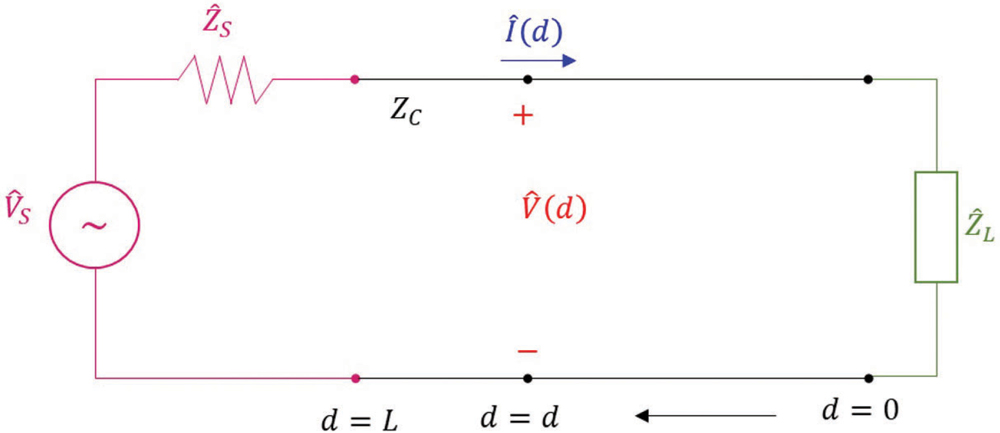
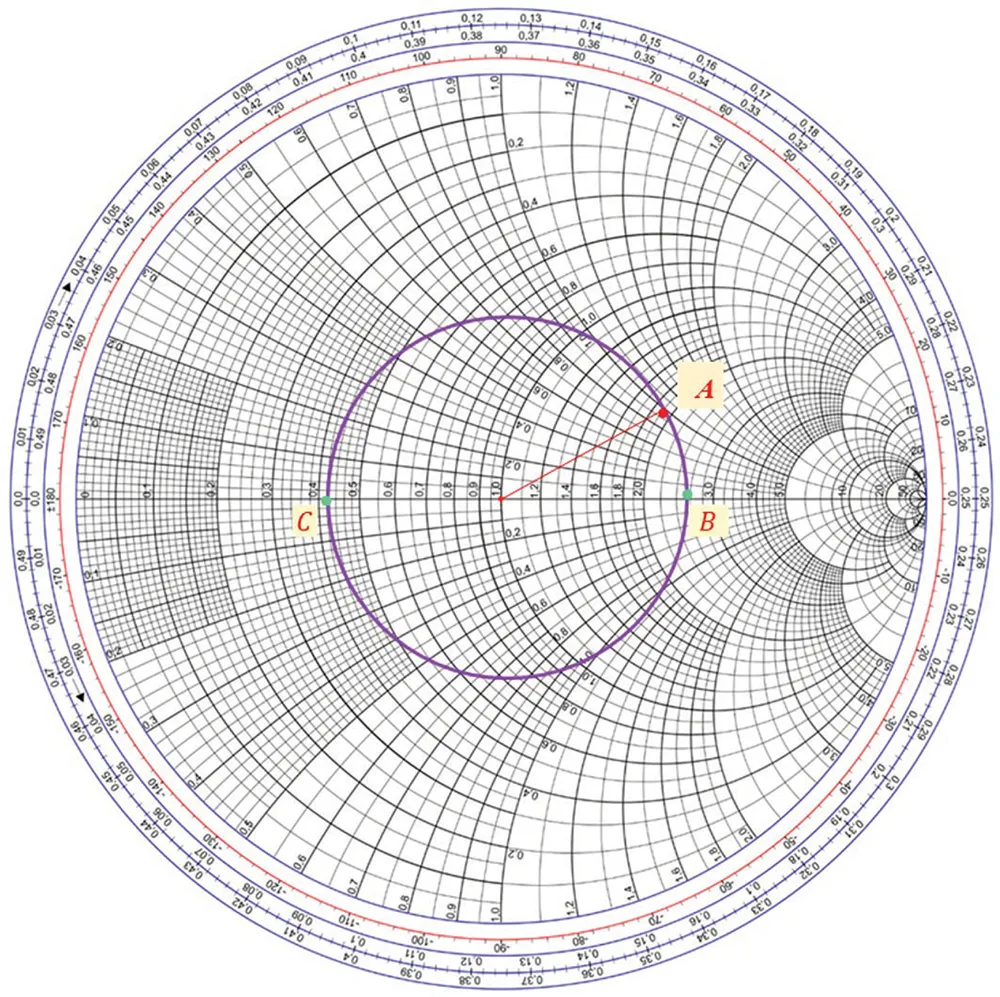
his is the third and final article discussing four different circuit models of transmission lines in sinusoidal steady state. In [1], Model 1 and Model 2 were presented. Model 1 was used to present the solution of the transmission line equations. Model 2 introduced the standing waves. Model 3 discussed in [2] led to the evaluation of the values of the minima and maxima of standing waves. This article uses Model 4 to determine the locations of the minima and maxima of standing waves. This determination is first done analytically, followed by the graphical method using the Smith chart.



 = 2π/
= 2π/ , Eq. (2.2) becomes


 /4. The first minimum can be obtained from the first maximum as


 (d), that is, (
 – 2d), is zero, or -2nπ, (n being a positive integer).
As stated earlier, the maximum magnitude of the voltage occurs when the cosine function in Eq. (1.3) equals 1 or its argument satisfies the condition
 (d), that is ( – 2d), equals -π or – (2n + 1)π (n being a positive integer).
As stated earlier, the minimum magnitude of the voltage occurs when the cosine function in Eq. (1.3) equals -1 or its argument satisfies the condition

The corresponding minima and maxima are /4 apart.
- Adamczyk, B., “Analysis of Transmission Lines in Sinusoidal Steady State – Different Circuit Models and Their Applications – Part I,” In Compliance Magazine, October 2024.
- Adamczyk, B., “Analysis of Transmission Lines in Sinusoidal Steady State – Different Circuit Models and Their Applications – Part II,” In Compliance Magazine, November 2024.
- Adamczyk, B., “Smith Chart and Standing Wave Ratio,” In Compliance Magazine, September 2024.
- Adamczyk, B., “Smith Chart and Input Impedance to Transmission Line – Part 3: Input Impedance to the Line,” In Compliance Magazine, June 2023.