
lectricity meters and other similar devices have their own set of unique standards and requirements. The following describes these requirements, the challenges involved, and the status of some requirements.

For meters going to Mexico, Comisión Federal de Electricidad (CFE) standard G0000-48-2010 is required for stand-alone meters. G0000-48-2010 derives its requirements from the IEC meter standards. In 2025, an entirely new standard for meters sold into Mexico will take effect. This standard is NOM-001-CRE and brings with it an entirely new set of requirements for meters and requires meters to have the capability for easy replacement via some type of extractable case.
Meters sold into Australia and New Zealand require certification by the Australian National Measurement Institute in accordance with NMI M6-1, which follows the Australian versions of the LEC meter standards.
IEC 61000-4-30, Power Quality Measurement Methods specifies two different classes of meters, Class A and Class S. Class A and Class S are determined by performing IEC 62586-2:2017, Power quality measurement in power supply systems – Part 2: Functional tests and uncertainty requirements on the meter. Class A pertains to highly accurate meters, whereas Class S is not as rigorous and is applied to less accurate meters.
IEC 61557-12, Performance measuring and monitoring devices (PMD) requires testing to IEC 61326-1 for EMC and IEC 61010-1, IEC 61010-2-030, and IEC 61010-2-201 for product safety.
ANSI standards are applied to devices sold into the United States, Canada, and some Latin American countries. Entities such as the New York State Department of Public Service Commission require all meters used at their facilities to comply with ANSI standards.
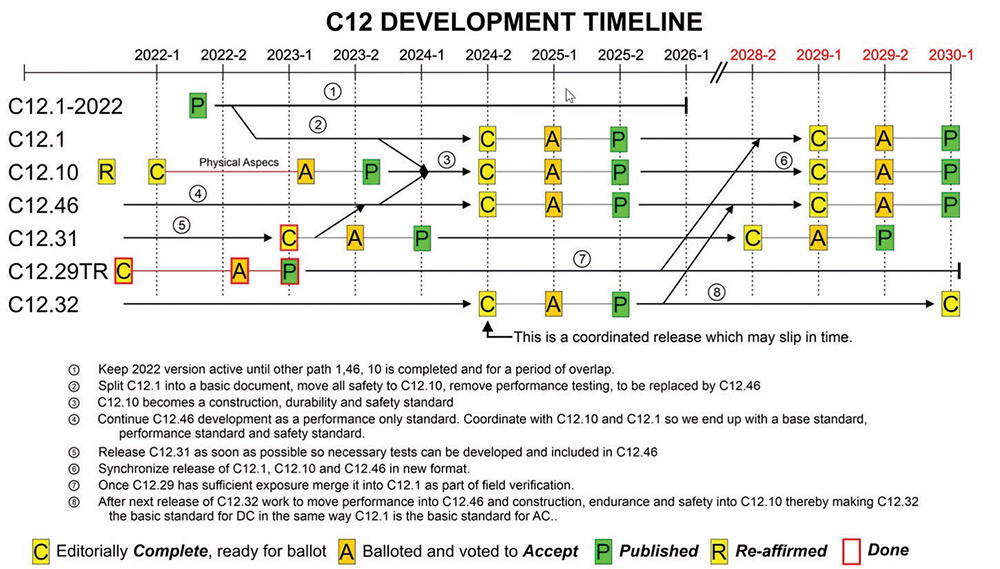
Many of the ANSI meters standards are currently under revision, new standards are in progress, and a few are slated for replacement by newer versions.
- ANSI C12.31-202x establishes standard definitions of AC electrical power (active, reactive, and apparent), AC electrical energy (active, reactive, and apparent), and power factor in terms of sampled voltage and current measurements.
- ANSI C12.32-202x (2nd Edition) covers DC Metering.
- ANSI C12.46-20xx, based on OIML R46:2012 and many IEC standards, is a performance standard for the measurement of active, apparent, and reactive energy that is intended to replace ANSI C12.1.
- A new ANSI demand metering standard is also in the work, the number of which has yet to be defined.
- ANSI C12.1 requires that voltage and current inputs to the meter pass a surge test of 6 kV and a 2 Ohm source impedance. This is a much tougher test than what is required by IEC standards.
- ANSI C12.1 requires the meter to pass Class B emissions.
- ANSI and IEC standards are not yet fully aligned, and keeping track of the differences is burdensome.
- ANSI standards are currently in a state of change, and the update process is lengthy.
- Depending on the requirement, meters must maintain accuracy during and after they are subjected to EMC immunity and other environmental influence quantities.