

his column is the second in a three-part series on testing small form factor products for CDM. Part 1 highlighted the issues of CDM testing with the current field-induced CDM (FICDM) testers. The main problems are the pogo pin size vs package or ball bump size and that small form factor products may have very low withstand voltages, where the FICDM testers are known to be unreliable. In Part 2, the first set of possible solutions is presented. These solutions are air discharge techniques just like FICDM. Part 3 will focus on contact-first methods to address these same issues.
Air Discharge Options for Bare Die and Interface Die Testing
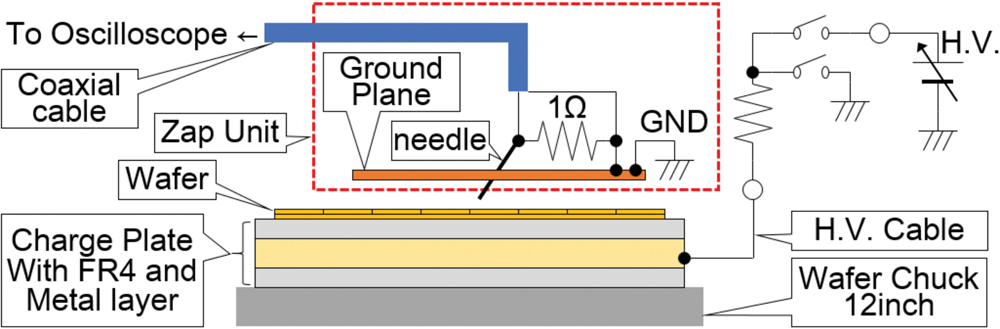

- A sharp tip degrades the arc’s properties in air discharge. This method removes that degradation because the discharge is in the chamber, not at the sharp-tip pogo pin.
- Air discharge quality and repeatability depend on air quality, such as humidity.
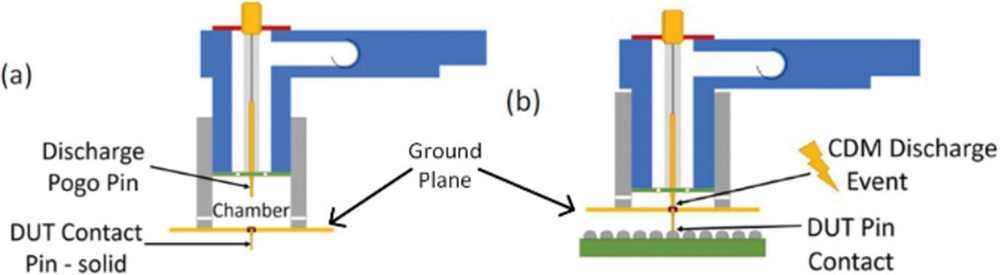
- M. Sawada et al., “Study of FI-CDM Discharge Waveforms,” EOS/ESD Symposium 2010.
- ANSI/ESDA/JEDEC JS-002, Charged Device Model (CDM) – Device Level, EOS/ESD Association.
- Grund et al., “A New CDM Discharge Head for Increased Repeatability and Testing Small Pitch Packages”, EOS/ESD Symposium 2018.
- Kathleen Muhonen, “Small Form Factor CDM Testing, Part 1: Problems with FICDM Testing for Small Form Factor and Interface Die,” In Compliance Magazine, January 2026.


Founded in 1982, EOS/ESD Association, Inc. is a not for profit, professional organization, dedicated to education and furthering the technology Electrostatic Discharge (ESD) control and prevention. EOS/ESD Association, Inc. sponsors educational programs, develops ESD control and measurement standards, holds international technical symposiums, workshops, tutorials, and foster the exchange of technical information among its members and others.