
EMC concepts explained
Shielding to Prevent Radiation
Part 7: Effect of the Apertures
T

his is the final article in a series [1-7] devoted to the topic of shielding to prevent electromagnetic wave radiation. All the previous articles assumed a solid shield with no apertures. This article addresses the impact of slots or apertures in the shield on radiation. It is shown that apertures can be as effective radiators as antennas of the same dimensions.
Apertures and Shielding Effectiveness
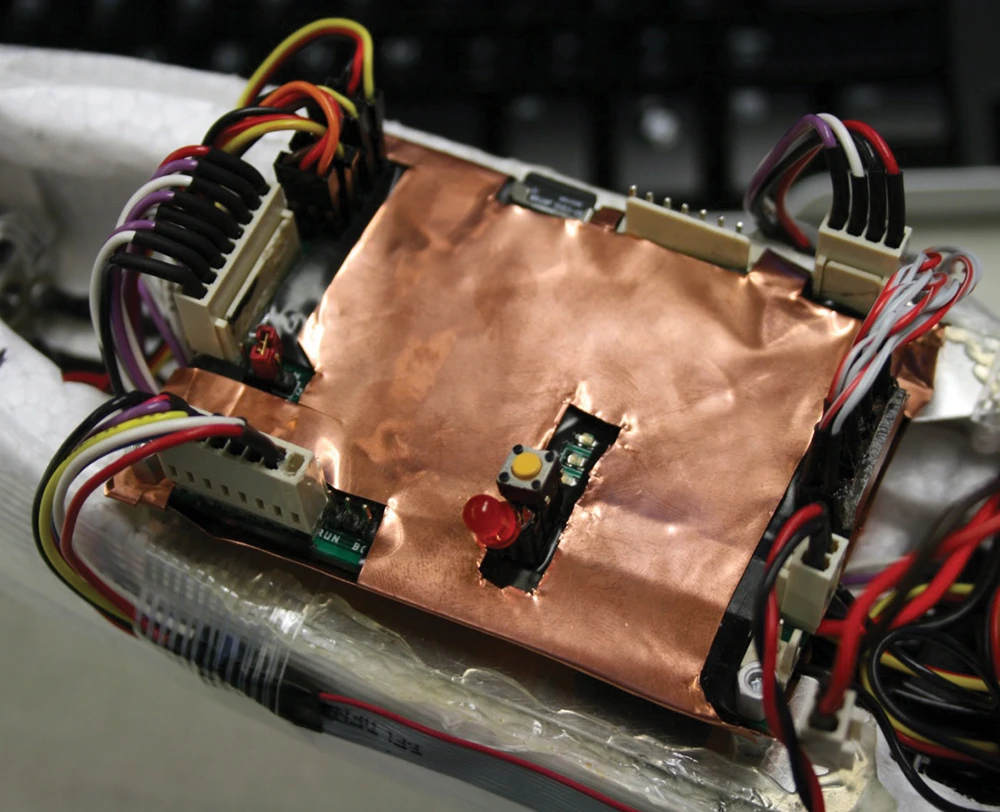
In practice, most shields are not solid, since there must be access covers, doors, holes for cables, ventilation, and displays, like the ones shown in Figure 1.
Metallic shield with apertures
Figure 1: Metallic shield with apertures
In practice, most shields are not solid, since there must be access covers, doors, holes for cables, ventilation, and displays.
All of these apertures reduce the effectiveness of the shield. Consider a solid shield shown in Figure 2.
Incident wave induces current in the shield
Figure 2: Incident wave induces current in the shield
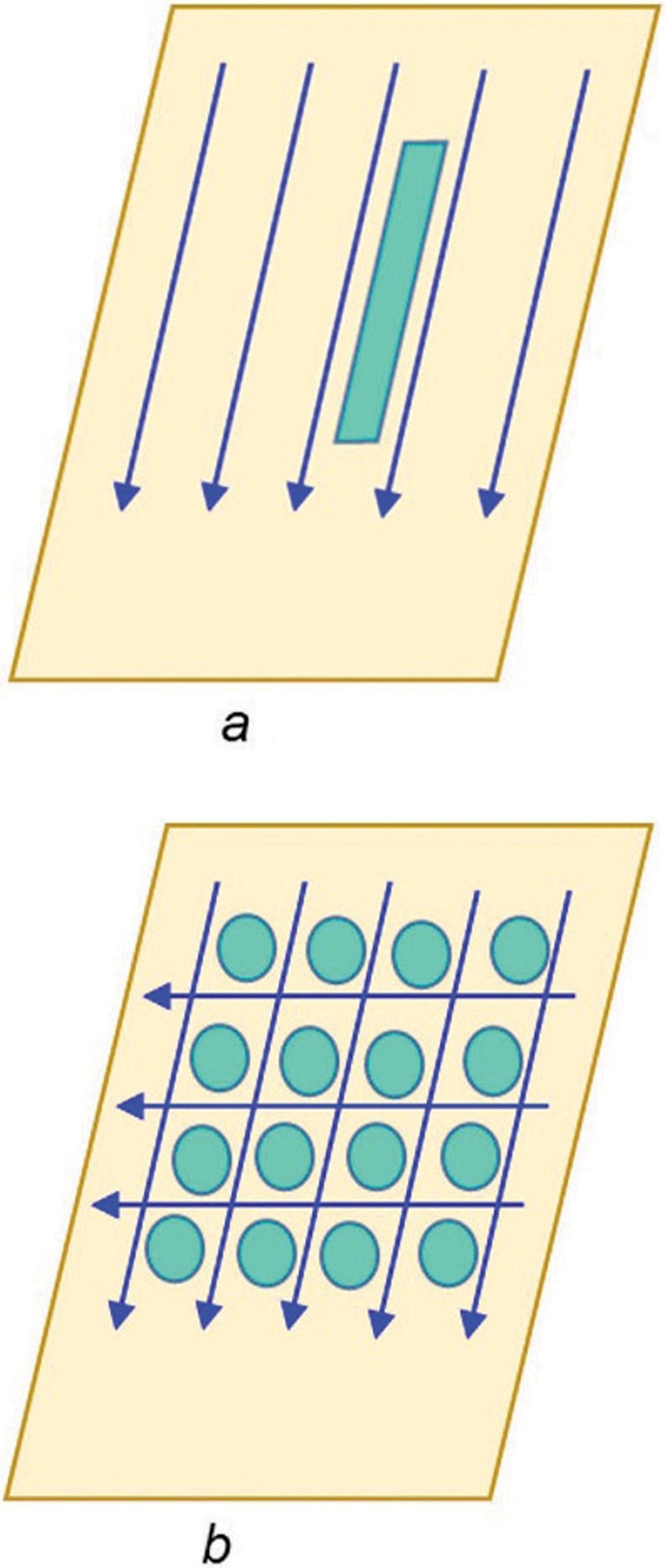
The incident field induces a surface current in the shield, which may be thought of as producing the reflected field that tends to cancel the incident field [8]. In order for the shield to perform this cancellation, the induced currents must be allowed to flow unimpeded, as shown in Figure 3a.

The slot will impede the current flow. Figures 3b and 3c illustrate that the thickness of the slot is not critical, but the length of it is. An obvious solution might be to place the slot parallel to the current flow, as shown in Figure 4a, to minimize its adverse effect.

Effect of slots on induced currents
Figure 3: Effect of slots on induced currents
Effect of slots on induced currents
Figure 4: Effect of slots on induced currents
The problem with this solution is that it is not feasible to predict the direction of the induced current. A reasonable solution is to use a large number of small holes (Figure 4b), as these small holes disturb the induced current to a much lesser degree.
The incident field induces a surface current in the shield, which may be thought of as producing the reflected field that tends to cancel the incident field. In order for the shield to perform this cancellation, the induced currents must be allowed to flow unimpeded.
Electric Dipole and its Fields
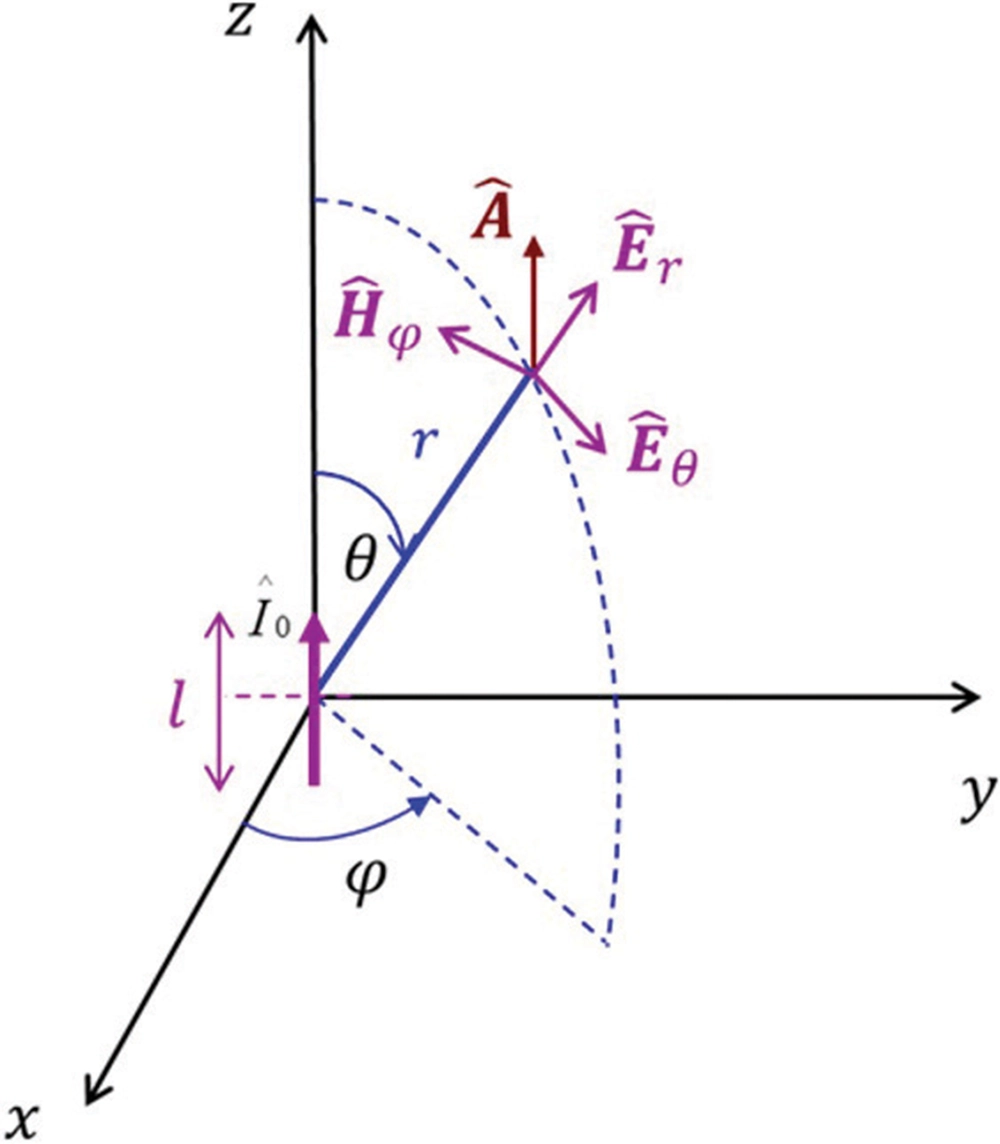
The electric (Hertzian) dipole and its complete fields are shown in Figure 5.
Hertzian dipole antenna and its fields
Figure 5: Hertzian dipole antenna and its fields
The far fields of the electric dipole are
Equation 1
Equation 2
Equation 3
The simplified far-field model of the dipole (oriented along the z axis), and the fields at an observation point P at the location (θ = 90°, = ϕ = 90°) are shown in Figure 6.
Far fields of the electric dipole antenna
Figure 6: Far fields of the electric dipole antenna
Electric source, J, produces the fields electric field vector component and magnetic field vector component at an observation point P in the far field of the antenna. The medium with intrinsic impedance ηO is infinite with no other objects present.
Babinet’s principle, modified by Brooker for antennas, provides a way to analyze the radiation from slot antennas by treating a conducting strip (of the same dimensions as the slot) like a complementary antenna to shield with a slot.
Babinet’s Principle Applied to a Slot Antenna
Babinet’s principle, modified by Brooker for antennas [9], provides a way to analyze the radiation from slot antennas by treating a conducting strip (of the same dimensions as the slot) like a complementary antenna to shield with a slot.

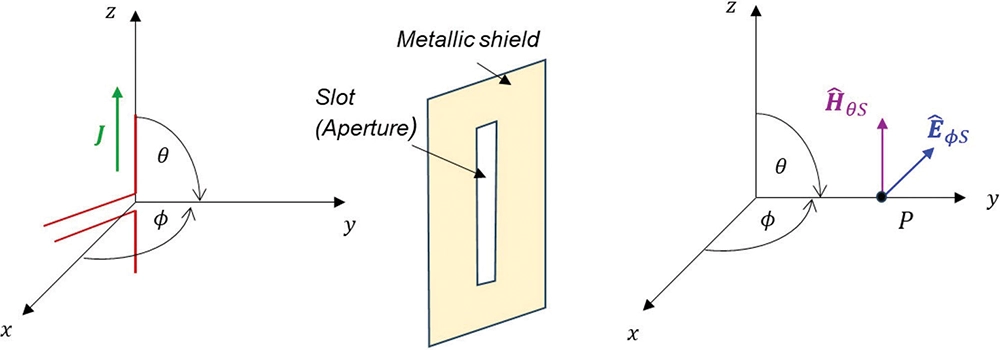
Figure 7 shows an infinite thin flat metallic shield with a slot cut out, placed between the source and the observation point in the far field.

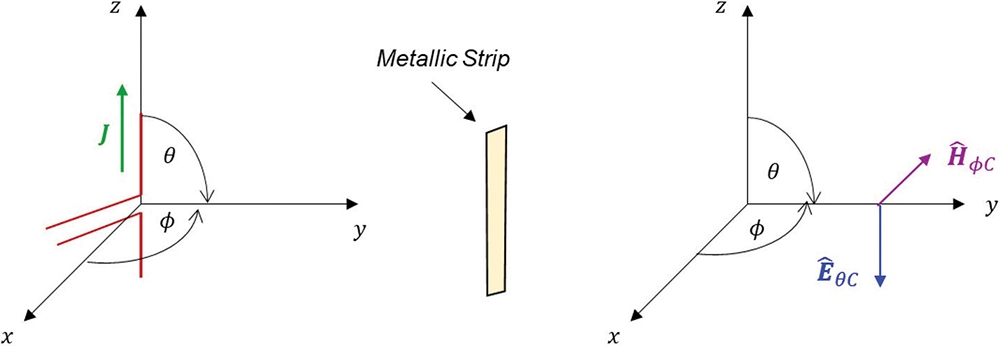
Now, the fields at an observation point P are electric field vector component and electric field vector component, as shown in Figure 7. Next, the shield is replaced by a complementary thin metallic strip of the same dimensions as the slot, as shown in Figure 8.

Now, the fields at an observation point P are electric field vector component and electric field vector component.

Far fields in presence of a shield with a slot cut out
Figure 7: Far fields in presence of a shield with a slot cut out
Far fields in presence of a metallic strip
Figure 8: Far fields in presence of a metallic strip
The fields in Figure 7 and Figure 8 are related by [9]:
Equation 4a
Equation 4b
Next, consider the situation shown in Figure 9a where the electric dipole is rotated and oriented along the x-axis.

Figure 9b shows the fields at the observation point in far fields with the shield containing a slot cut out, placed between the source and the observation point. Figure 9c shows the fields with a metallic strip of the same size as the slot placed between the source and the observation point.

Far fields in the presence of a shield with a slot cut out and the metallic strip
Figure 9: Far fields in the presence of a shield with a slot cut out and the metallic strip
Figure 9 leads to the two additional relations [9]:
Equation 5a
Equation 5b
Equations (4) and (5) lead to the conclusion that apertures can be as effective radiators as antennas of the same dimensions.
References
  1. Bogdan Adamczyk, “Shielding to Prevent Radiation – Part 1: Uniform Plane Wave Reflection and Transmission at a Normal Boundary,” In Compliance Magazine, June 2025.
  2. Bogdan Adamczyk, “Shielding to Prevent Radiation – Part 2: Uniform Plane Wave Normal Incidence on a Conducting Shield,” In Compliance Magazine, July 2025.
  3. Bogdan Adamczyk, “Shielding to Prevent Radiation – Part 3: Far-Field Shielding Effectiveness of a Solid Conducting Shield – Exact Solution,” In Compliance Magazine, August 2025.
  4. Bogdan Adamczyk, “Shielding to Prevent Radiation – Part 4A: Far-Field Shielding Effectiveness of a Solid Conducting Shield – Approximate Solutions,” In Compliance Magazine, September 2025.
  5. Bogdan Adamczyk, “Shielding to Prevent Radiation – Part 4B: Far-Field Shielding Effectiveness of a Solid Conducting Shield – Approximate Solutions,” In Compliance Magazine, October 2025.
  6. Bogdan Adamczyk, “Shielding to Prevent Radiation – Part 5: Near-Field Wave Impedance of Electric and Magnetic Dipoles,” In Compliance Magazine, November 2025.
  7. Bogdan Adamczyk, “Shielding to Prevent Radiation – Part 6: Near-Field Shielding Effectiveness of a Solid Conducting Shield,” In Compliance Magazine, December 2025.
  8. Clayton R. Paul, Introduction to Electromagnetic Compatibility, Wiley, 2006.
  9. C. A. Balanis, Antenna Theory Analysis and Design, Harper & Row, New York, 1982.

Share this story:
Bogdan Adamczyk headshot
Dr. Bogdan Adamczyk is professor and director of the EMC Center at Grand Valley State University (http://www.gvsu.edu/emccenter) where he performs EMC educational research and regularly teaches EM/EMC courses and EMC certificate courses for industry. He is an iNARTE-certified EMC Master Design Engineer. He is the author of two textbooks, “Foundations of Electromagnetic Compatibility with Practical Applications” (Wiley, 2017) and “Principles of Electromagnetic Compatibility: Laboratory Exercises and Lectures” (Wiley, 2024). He has been writing “EMC Concepts Explained” monthly since January 2017. He can be reached at adamczyb@gvsu.edu.