



ISO 17025 Accreditation from a Test Lab’s Perspective
EMC Concepts Explained
Hot Topics in ESD
ISO 17025 Accreditation from a Test Lab’s Perspective
EMC Concepts Explained
Hot Topics in ESD






In Product Insights, Don MacArthur dives deep into practical EMI mitigation challenges, offering solutions for capacitor behavior, ferrite selection, differential probes, and more to optimize designs and advance engineering careers.
Ken Wyatt’s EMC Bench Notes helps engineers identify and resolve EMC issues early in the design cycle using in-house pre-compliance testing tools, enhancing troubleshooting skills and reducing costly testing failures.
Patrick Andre’s Military and Aerospace EMC shares valuable insights into EMC challenges in high-stakes environments like defense, aerospace, and military systems, offering engineers practical solutions and expertise.
Karen Burnham’s Standards Practice explores immunity standards and advanced testing methods, helping engineers navigate compliance challenges in industries like defense, aerospace, and automotive with techniques like reverberation chamber testing.
Kimball Williams’ Signals and Solutions connects the foundational techniques of amateur radio, such as Morse code, to modern EMC engineering, offering fresh perspectives on troubleshooting, testing, and innovation.
https://incompliancemag.com/expert-insights

ISSN 1948-8254 (print)
ISSN 1948-8262 (online)
is published by
Same Page Publishing Inc.
451 King Street, #458
Littleton, MA 01460
tel: (978) 486-4684
fax: (978) 486-4691
© Copyright 2026 Same Page Publishing, Inc. all rights reserved
Contents may not be reproduced in any form without the prior consent of the publisher. While every attempt is made to provide accurate information, neither the publisher nor the authors accept any liability for errors or omissions.
editor-in-chief
Please contact our circulation department at circulation@incompliancemag.com
According to an Order on Reconsideration, the Commission called a January 2025 Declaratory Ruling by the Commission “based in part on the Declaratory Ruling’s flawed legal analysis,” thereby making it “unlawful and ineffective.” At the same time, the Commission also withdrew a Notice of Proposed…
That’s the key takeaway in a recent report issued by consulting firm Future Market Insights (FMI), titled “EMC Electromagnetic Compatibility Test Laboratory Market Forecast and Outlook 2025 to 2035.” According to FMI’s research and data analysis, the global market for EMC testing is expected to reach $2.9 billion by the year 2035, nearly double the $1.6 billion projected for 2025. That’s a compound annual growth rate (CAGR) of 6.5% per year over the next 10 years…



raining in any of the scientific or technical disciplines is rarely linked to the faith-based philosophies that abound in our societies. Yet, upon reflection, the virtues of faith, hope, and charity—so often discussed in spiritual contexts—are deeply embedded in the daily work of engineers.
A well-known quote from the Christian Bible, 1 Corinthians 13:13, states: “And now these three remain: faith, hope, and love; but the greatest of these is love.” The Greek language offers multiple words for love, and in some translations, “charity” is used instead—emphasizing generosity and selflessness. While the Quran may not present these three virtues in a single verse, its teachings consistently highlight their importance: “Allah loves the doers of good.” Similarly, Hindu texts like the Bhagavad Gita and the Upanishads recount stories of those who extend help and are rewarded for their efforts.
ompliance engineering is a critical field that ensures products and systems meet regulatory standards, safeguarding public health and safety while promoting environmental sustainability. The training of compliance engineers, however, presents significant challenges, particularly in keeping up with constantly evolving regulations and balancing theoretical knowledge with practical application. This article explores these challenges and offers insights into effective training strategies for compliance engineers.

elcome to 2026! Regardless of where you are in your career, your ongoing efforts to refresh or expand your technical knowledge and skills are essential to your continued professional and personal growth and success. So, as the new year begins, we’ve once again queried training resources throughout our industry to provide you with an overview of free or affordable solutions to meet your training goals and to help you on your journey to becoming your best self in the new year.
In this article, you’ll find sources of compliance‑related seminars, workshops, and other types of training offered live, including both virtual and in‑person options, as well as pre-recorded webinars and on-demand training offerings. We’ve also included a list of industry symposia, conferences, and exhibitions to be held in both the U.S. and around the world.




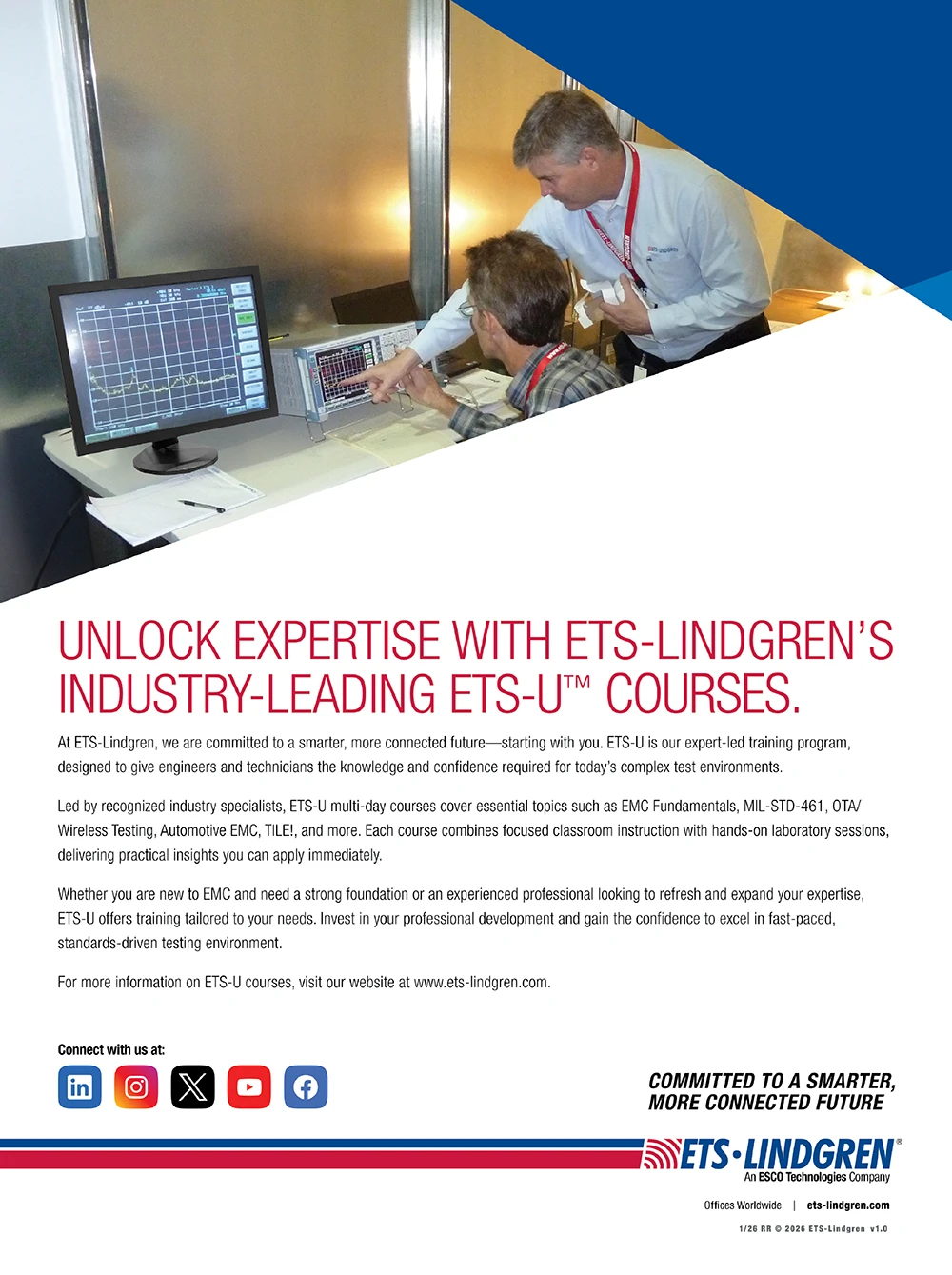
Through webinars, workshops, and ETS-U immersive courses, we equip professionals with the insight, confidence, and mastery to meet today’s demands—and tomorrow’s.

TCB Council

From breaking standards updates to proven troubleshooting methods, expert analysis to can’t‑miss educational opportunities—get the essential compliance intelligence that keeps you ahead of the curve.
Join thousands of engineers who rely on their weekly briefing.


lectromagnetic compatibility (EMC) has always been one of the most challenging topics to teach. Although every electrical engineer recognizes its importance, the underlying physical mechanisms – coupling, radiation, resonance, and reciprocity – are often difficult to visualize. Traditional lectures and circuit models rarely succeed in making the invisible visible.
As the Chinese philosopher Confucius said more than two thousand years ago: “I hear and I forget. I see and I remember. I do and I understand” (Figure 1). This insight forms the educational philosophy behind the EMC Demo Box, which allows students to observe and interact directly with real electromagnetic phenomena.

ndependent testing laboratories become accredited under International Standards Organization ISO 17025, just as most manufacturers today accredit their organizations using ISO 9000-9001 or other applicable standards.
The third-party test lab accreditation program requires that a testing lab be evaluated by compliance auditors, a process that can take days, or even weeks, as auditors scrutinize every detail of every standard for which the test lab is seeking accreditation. The audit process involves observing every step of the testing and reporting process, and includes reviewing documentation, inspecting the test equipment and its calibration, questioning the test engineers, evaluating the facility itself, checking the current version of the software, as well as reading through minutes of managers’ meetings, training manuals and responses to customers inquiries. This rigorous review and inspection provide a thorough evaluation of the test lab’s systems and processes and helps to ensure that the quality of its evaluations meets the requirements of the applicable standards.

his is the final article in a series [1-7] devoted to the topic of shielding to prevent electromagnetic wave radiation. All the previous articles assumed a solid shield with no apertures. This article addresses the impact of slots or apertures in the shield on radiation. It is shown that apertures can be as effective radiators as antennas of the same dimensions.
NSI/ESDA/JEDEC JS-002 [1] specifies how to test and qualify a product for a factory CDM event. The document is intended for the testing of packaged devices. Thus, CDM testers in the industry have mechanical stages and contact pins that are oriented towards products in packages with pin pitches typical of today’s package sizes. With shrinking footprints and increasing integration (for example, flip chip or wafer level chip scale packaging), bare die are being sold to original equipment manufacturers (OEMs). OEMs are asking the IC manufacturers to give a CDM rating for these packageless products. However, the existing CDM testers introduce issues when considering the testing of small form factor die. Additionally, there are products that have very low withstand voltages for CDM, and the traditional CDM testers do not produce reliable waveforms for voltages below 100V. This column discusses some of the issues with Field-Induced CDM (FICDM) testing, which is troublesome for small form factor and interface die.




View Index
You can do that here.