




Minimizing Risk When Buying or Selling a Company
Expert Insights
EMC Concepts Explained
Hot Topics in ESD
Minimizing Risk When Buying or Selling a Company
Expert Insights
EMC Concepts Explained
Hot Topics in ESD

solid-state amplifiers


- Superior Linear Performance for precision output.
- Improved Harmonic Performance with up to -20 dBc (compared to -3 dBc in TWT systems).
- Enhanced Reliability thanks to solid-state technology with no critical failure points.
- Swift Maintenance enabled by modular construction.
- Lower Cost of Ownership through reduced downtime and the elimination of backup unit expenses.
With intuitive touch-screen interfaces and multiple remote-control options, these amplifiers are as user-friendly as they are powerful.
Contact us at ari-sales@ametek.com or telephone 215.723.8181
To learn more about the S6G18C Series and what sets it apart from other amplifiers, Download the Brochure Now.







ISSN 1948-8254 (print)
ISSN 1948-8262 (online)
is published by
Same Page Publishing Inc.
451 King Street, #458
Littleton, MA 01460
tel: (978) 486-4684
fax: (978) 486-4691
© Copyright 2025 Same Page Publishing, Inc. all rights reserved
Contents may not be reproduced in any form without the prior consent of the publisher. While every attempt is made to provide accurate information, neither the publisher nor the authors accept any liability for errors or omissions.
editor-in-chief
Please contact our circulation department at circulation@incompliancemag.com
According to the Commission’s report, entitled Internet Access Services: Status as of June 30, 2024, approximately 97% of residential fixed Internet connections had a speed of at least 10 megabits per second (Mbps) downstream and 1 Mbps upstream by the end of the reporting period, with 94% of residential connections having a speed of at least 25 Mbps downstream and 3 Mbps upstream. These results easily surpass the target set in the National Broadband Plan of 3 Mbps downstream and 768 kilobits per second (kbps) upstream…
Detailed in a press release, the FDA’s Center for Devices and Radiological Health (CDRH) has issued General Correspondence Letters to Mid-Link Technology Testing Company, based in Tianjin, China, and the Sanitation & Environment Technology Institute of Soochow University in Suzhou, China. The FDA’s communications inform the testing laboratories that it has been unable to “ensure the reliability and validity of biocompatibility testing and animal safety and performance testing studies” conducted at their respective laboratories…






ast month, we introduced you to radiated emissions pre-compliance testing and what equipment is required. This month, we’ll show you how to actually make the measurement for commercial, industrial, and medical products, including all the system gains and losses. Once we complete the calculation for each dominant harmonic, you can directly compare it to the appropriate test limit. Next month, we’ll cover some details for automotive modules and military pre‑compliance testing.
The generalized test setup for pre‑compliance testing is shown in Figure 1. The unit under test (EUT) is placed on an 80 cm high non‑conductive table, which ideally should be able to rotate. However, a good estimate with fixed tables is to measure at least every face of the EUT in order to maximize the dominant harmonics. The preamplifier may not be required, as most modern analyzers have a 20-dB broadband preamp built in, if needed, to boost signal levels. The attenuator (usually 3 or 6 dB) is fixed to the antenna port to level out the impedance closer to 50Ω.
nder the heading of radiated susceptibility (RS) testing is the category of High Intensity Radiated Fields, or HIRF. What is HIRF and why does anyone need to test to these high levels?
NASA/TP-2001-210831, In-Flight Characterization of the Electromagnetic Environment Inside an Airliner[1], has this definition (emphasis mine):

ithin the IEEE, the EMC Society “punches above its weight class” in terms of standards development. We’re a small‑to-mid-sized society (< 4000 members) with a fairly large portfolio of standards (> 25). That’s not too surprising, since most readers of this magazine know that EMC engineers live and die by the requirements imposed by different standards documents.
In this article, I hope to do three things: 1) describe the standards development process within the IEEE EMC Society and encourage you to get involved; 2) provide updates on areas of active development; and 3) provide a list of currently available EMC standards.


Discover the proven strategies and essential practices that leading organizations use to navigate complex regulatory requirements successfully.
For more information, visit https://www.element.com/connected-technologies.
Visit us at https://www.staticworx.com.
hen ESD flooring audits fail, it’s often for a simple reason: the footwear used during qualification testing isn’t the footwear worn on the production floor. ANSI/ESD STM 97.1 (system resistance) and STM 97.2 (body voltage) treat the operator, footwear, and floor as a single conductive system. Change any part of the chain and performance changes.
ESD tile dissipates static through carbon granules or veins, which vary significantly in density – by as much as a factor of 10 between brands. Floors with sparse carbon paths require a larger conductive footprint, in which case ESD shoes may be necessary.

This article is brought to you by:
s the use of smart, “connected devices” across our homes, workplaces, and cities increases, the cybersecurity risks tied to these products continue to grow. In response, the UK’s Product Security and Telecommunications Infrastructure (PSTI) regime, updates to the EU’s Radio Equipment Directive (RED), and the upcoming EU Cyber Resilience Act (CRA) have emerged to ensure connected products are secure and remain secure throughout their lifecycle.
This article outlines the key requirements, scope, and timelines of each framework and offers guidance for manufacturers preparing to meet their obligations.

ISPR is the International Special Committee on Radio Interference which was founded in 1934. The International Standard for electromagnetic emissions (disturbances) from industrial, scientific, and medical (ISM) equipment is CISPR 11. The official title of the standard is “Industrial, Scientific, and Medical Equipment – Radio-Frequency (RF) Disturbance Characteristics – Limits and Methods of Measurement.”
The premiere edition of the standard was released in 1975, and the current edition (seventh edition) was released in 2024. The standard includes both limits and methods of measurement for conducted emissions and radiated phenomena. This article details the most recent Edition and retroactively traces the history and development of the content of the standard over the last 50 years.



ver the years, I have been involved in a number of situations involving product liability issues arising out of the purchase or sale of a business or product line. In my experience, either the buying company (“buyer”) or the selling company (“seller”) does not perform adequate due diligence when analyzing risks. They always use experienced merger and acquisition counsel who can advise on how to structure the deal and generally the kind of due diligence that should be performed. But they rarely retain a product liability and product safety lawyer to help evaluate certain pre-transaction and post-transaction risks and make recommendations on the specifics of the sales contract.
This article will discuss this subject from the perspective of the buying company, as well as the selling company.

his is the second of seven articles devoted to the topic of shielding to prevent electromagnetic wave radiation. The first article, [1], discussed the reflection and transmission of uniform plane waves at a normal boundary. This article discusses the normal incidence of a uniform plane wave on a solid conducting shield with no apertures.





Testing of single bare dies using the field-induced CDM (FICDM) setup according to JS002 [3] standard is not possible. One issue is the difficulty of touching bare die pads with the pogo‐pin, whose diameter can exceed the pad size. Moreover, FICDM testing at voltages below 20 V leads to unstable waveforms. The standardized testing setup does not reflect the real capacitance and peak current relationship due to the small dimensions and thickness of the dies, which affect CDM peak currents, rise times, and pulse widths. There are arguments for using alternative testing methods, such as CCTLP, to enable the testing of bare dies [4].

At home.
on the go.
You can do that here.
 Visit In Compliance’s booth at these events!
2025 IEEE International Symposium on Antennas and Propagation & ITNC-USNC-URSI Radio Science Meeting
July 14-15
Understanding ISO/IEC 17025:2017 for Testing & Calibration Labs
July 15
Digital Twin of EMI Source – Source Reconstruction Method
July 16-17
Auditing Your Laboratory to ISO/IEC 17025: 2017
July 30
A Practical Simulation Approach for RF Desense Mitigation of Consumer Electronics
July 31
Internet of Things: Testing and Protections for Devices and Systems
August 5-6
ESD Best Practices for Technology Change!
Auditing Your Laboratory to ISO/IEC 17025: 2017
August 11-14
Understanding ISO/IEC 17025: 2017 for Testing & Calibration Labs
August 18-22
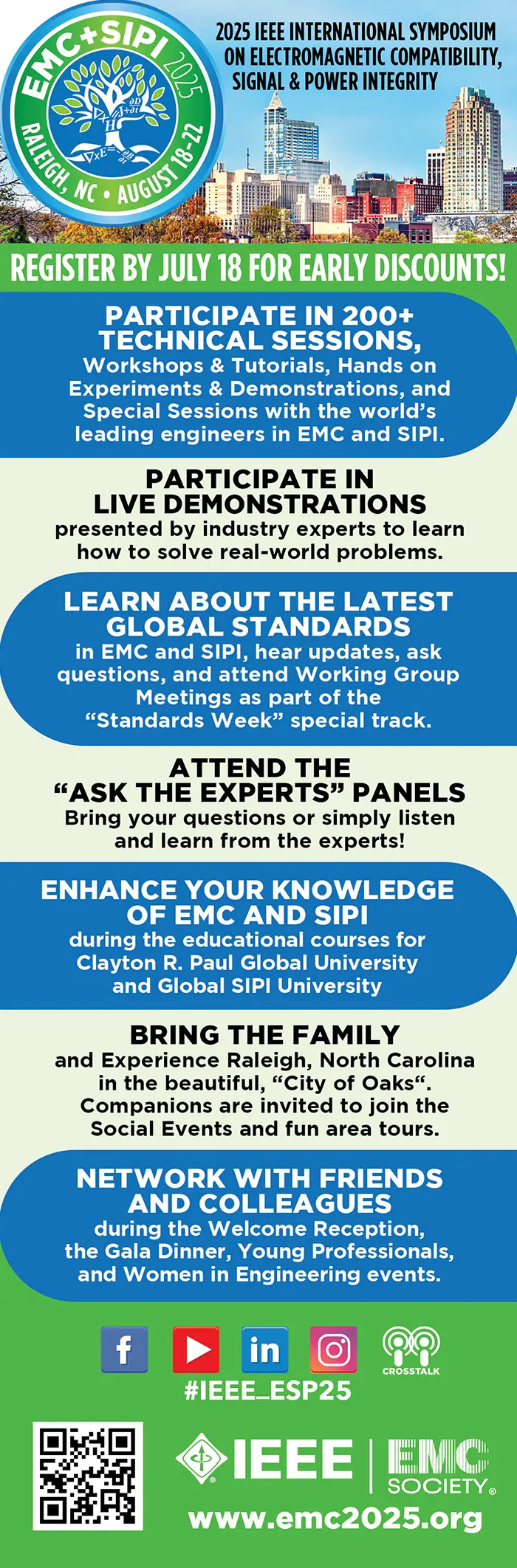
2025 IEEE International Symposium on Electromagnetic Compatibility, Signal & Power Integrity (EMC+SIPI)
Visit In Compliance at Booth 515!
August 27
Reverberation Chambers: Introduction, Basic Theory, Uses and Applications
August 28
Radio Regulations for Module Integrators
View Index

