


luetooth® technology is the dominant technology for short-range, low-power wireless communication widely used in consumer products. As a radio (or an intentional radiator, a wireless device), a Bluetooth device must comply with regulatory requirements prior to being placed on the market.
Global market access (GMA) involves navigating international laws, regulations, standards, and equipment authorization procedures (e.g., certification, registration, declaration of conformity (DoC), supplier’s declaration of conformity (SDoC)).
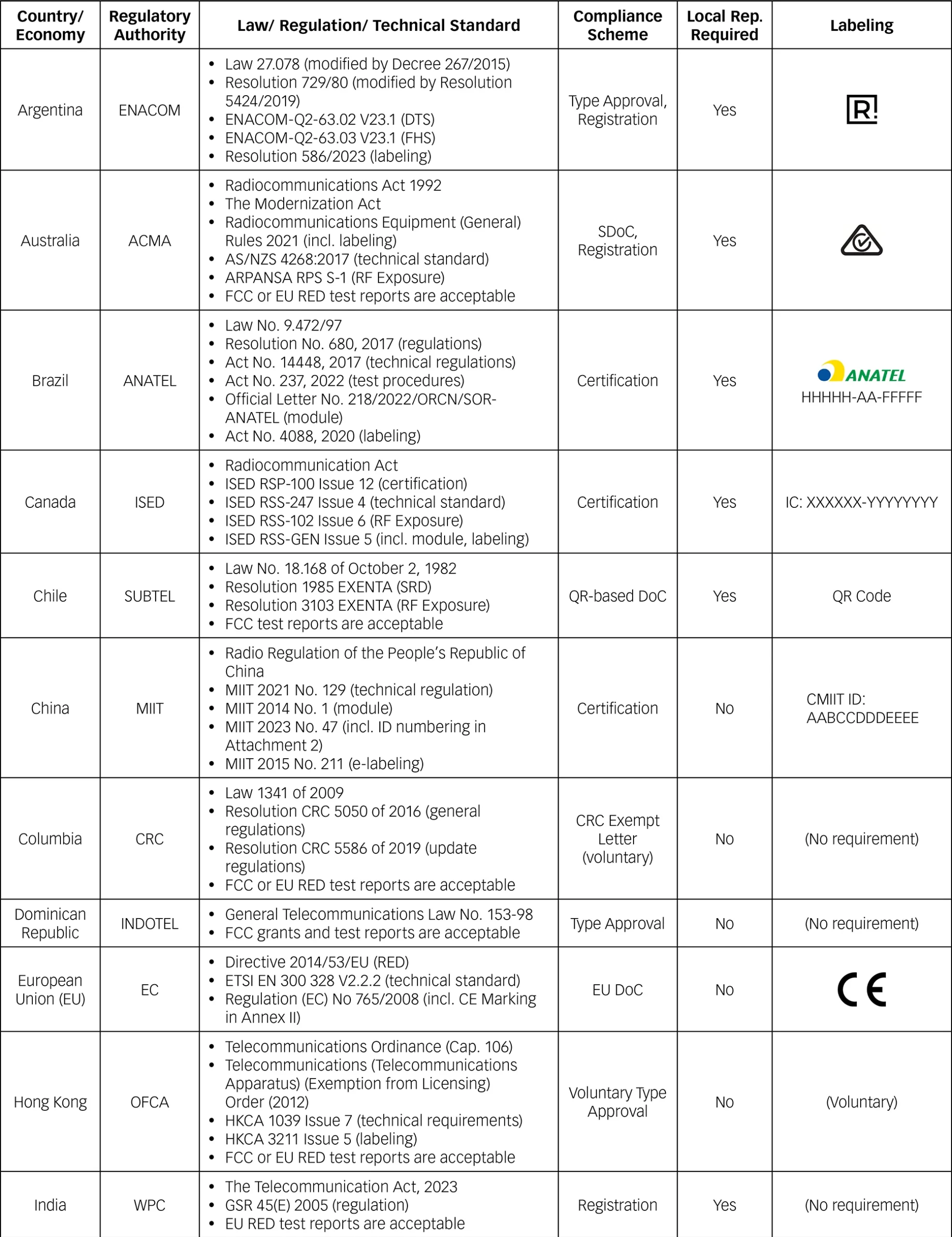
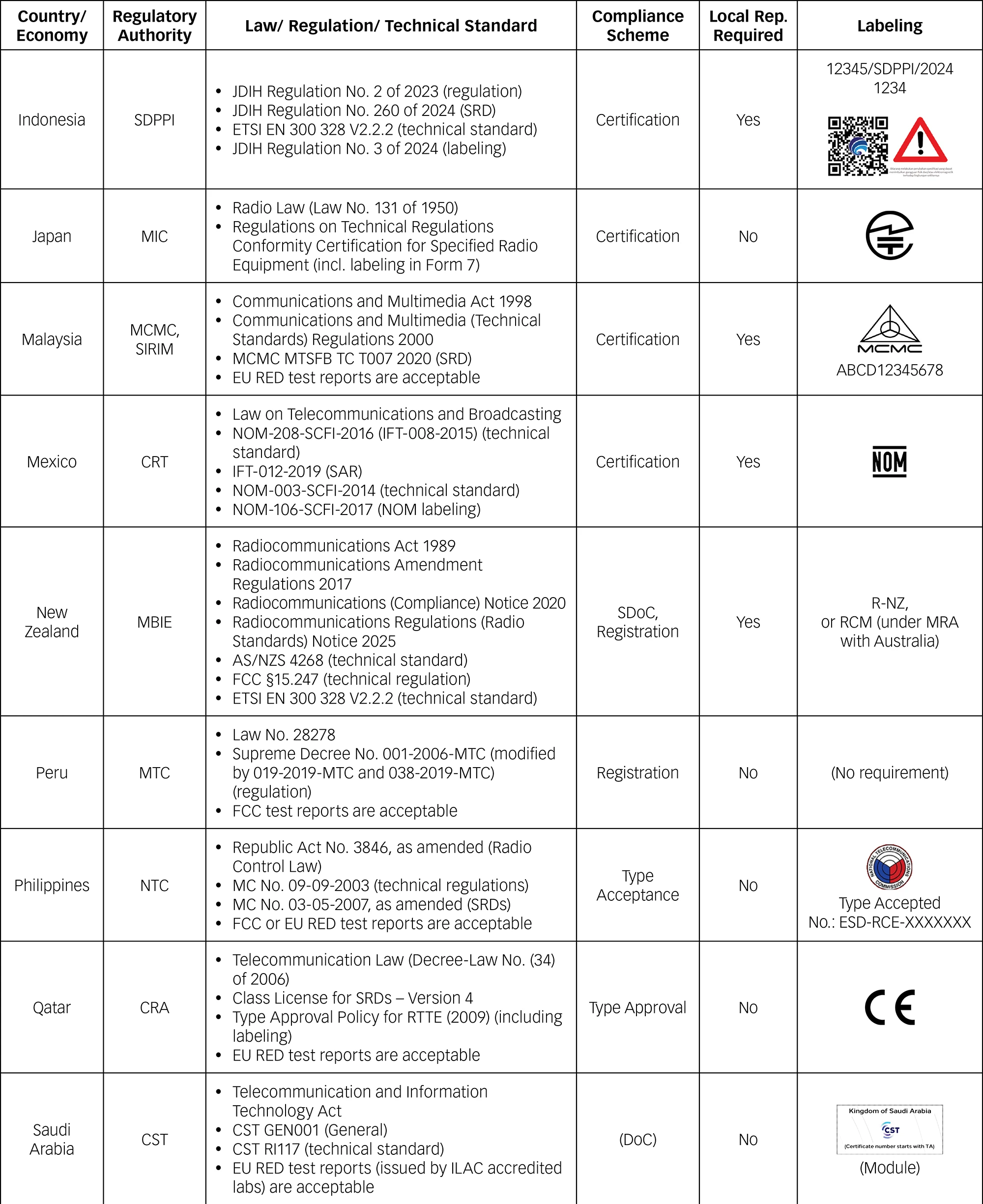
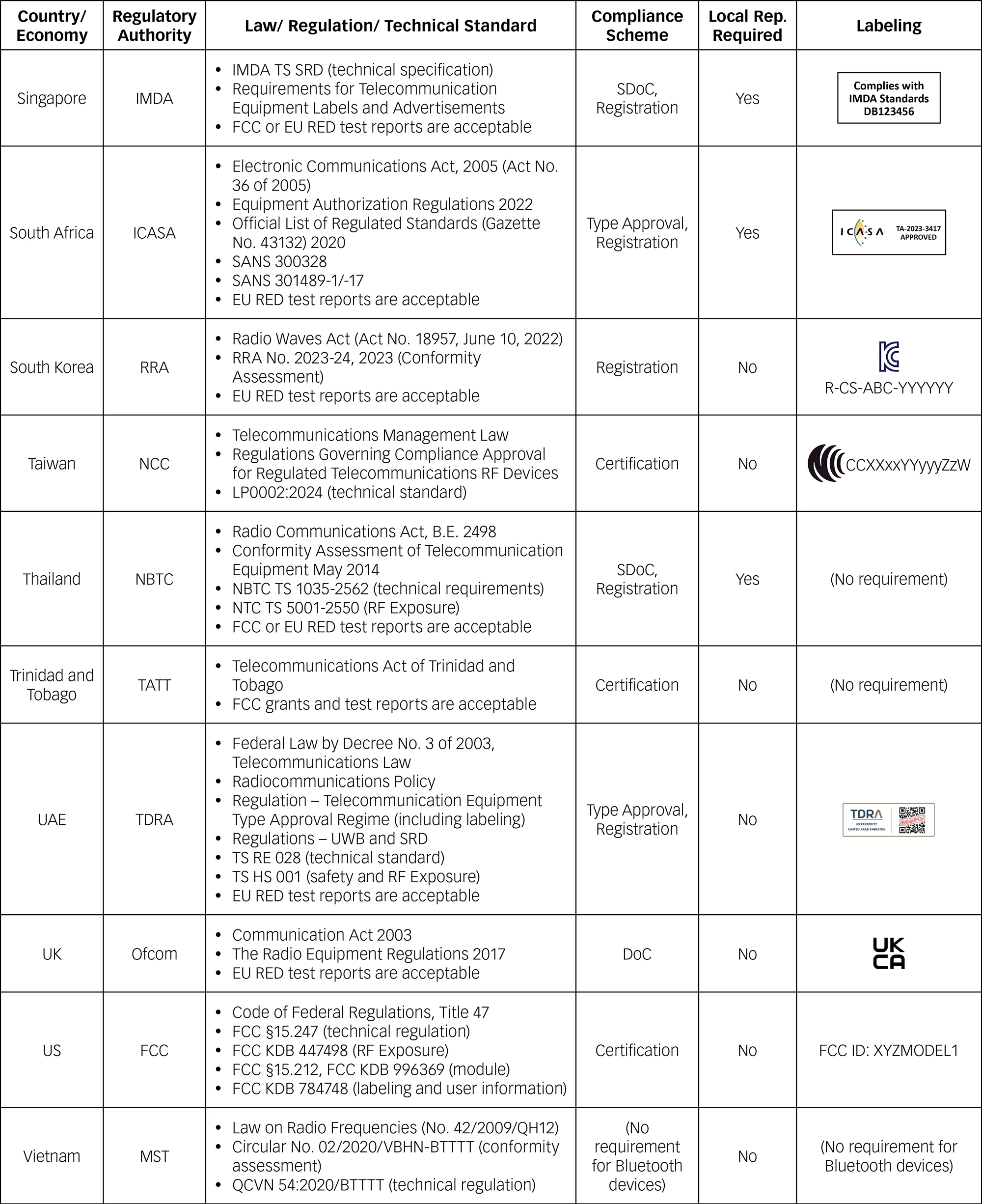
This article focuses on the radio transmitter portion of Bluetooth device regulations, providing an overview of global regulatory requirements. Table 1 lists regulatory authorities, laws, regulations, technical standards, regulatory schemes, local representative requirements, and labeling for 30 countries/economies.
Online free translation of laws and regulations can provide a basic understanding of regulations. However, it is important to seek professional translation services on critical compliance issues. For example, a sentence in English including “shall” was translated to Chinese using an online translator. When this translated sentence, in Chinese, was translated back to English, “shall” was translated as “should.” The difference is that “shall” refers to a mandatory requirement, while “should” refers to a recommendation.
Information regarding regulated devices and equipment is typically published explicitly or implicitly. In the United States (U.S.), the Federal Communications Commission (FCC) publishes a general guide, titled Knowledge Database (KDB) Publication 997198 (Importation Guide), to identify goods that require an FCC equipment authorization. All intentional radiators shall be certified except those devices that are exempted.
It is important to note that equipment listed on the FCC’s Covered List is prohibited from obtaining an FCC equipment authorization under FCC §2.903.
In Canada, all radio apparatus is subject to Canadian regulations, requiring certification (Category I equipment) or a supplier’s declaration of conformity (SDoC, Category II equipment).
The Government of Canada’s Innovation, Science and Economic Development Canada (ISED) publishes lists of regulatory standards on its website at “Radio equipment standards.”
Brazil has published Act No. 7280 (Telecommunications Product Reference List), listing regulated equipment. A compliance scheme for each type of equipment is also included in the Act.
China’s Ministry of Industry and Information Technology (MIIT) published Radio Equipment Type Approval and Licensing Service Guide in 2018. A complete version of the Guide, including all the attachments, can be downloaded online. Attachment 3 of the Guide lists types of regulated equipment and test sample requirements.
Goods subject to compliance with Mexican official NOM standards are classified in Annex 2.4.1, published by the Ministry of Economy in November 2022, based on harmonized system (HS) codes. An HS code is listed on the NOM certificates. It is important to accurately identify an HS code that maps a given device to the applicable NOM standard(s). Although HS codes vary by country, the first 6-digit HS codes are typically harmonized.
FCC, ISED, and NIST government officials, as well as EU experts, present regulation updates at the TCB Council workshops on a regular basis. The workshops are open to the public and are held biannually.
Bluetooth Classic radios are categorized as frequency hopping systems (FHS). BLE radios are categorized as digital transmission systems (DTS). Applicable technical standards and requirements are different between FHS and DTS. They are often aligned with international standards, i.e., FCC §15.247, ISED RSS-247, or ETSI EN 300 328. FCC §15.247 and ISED RSS-247 refer to the same measurement standard of ANSI C63.10. The only difference is that ISED requires 99% bandwidth measurement in addition to 6 dB (DTS) or 20 dB (FHS) bandwidth. ETSI EN 300 328 includes technical requirements and measurement procedures, which are not equivalent to those of the FCC or the ISED.
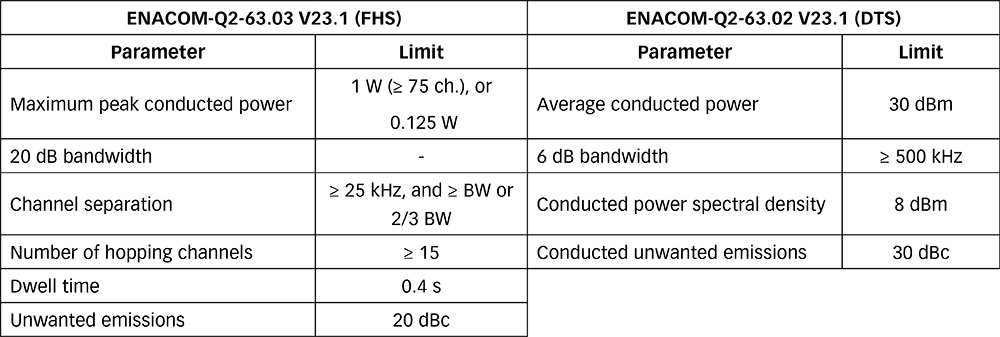
Technical standards for Argentina are ENACOM-Q2-63.03 V23.1 (FHS) and ENACOM-Q2-63.02 V23.1 (DTS). Technical parameters and limits are listed in Table 2. They are similar to the FCC’s. Only the lowest and highest frequency channels are required to be evaluated. Brazil’s technical requirements are similar to those of the FCC.
Mexico certification requires complying with both radio (NOM-208-SCFI-2016, IFT‑012-2019) and safety (NOM-003-SCFI-2014) standards. Though NOM‑208-SCFI-2016 is within the scope of the U.S.-Mexico Mutual Recognition Agreement (MRA), in-country testing may still be needed due to the absence of an MRA for NOM‑003‑SCFI-2014.
MRAs enable conformity assessment bodies (CABs, testing laboratories, or certification bodies) to accept the conformity assessment results of other CABs for regulatory purposes. The National Institute of Standards and Technology (NIST), the U.S. Designating Authority for MRAs, maintains a webpage for MRAs, including lists of recognized U.S. CABs. The International Laboratory Accreditation Cooperation (ILAC) MRA signatories accept the results of each other’s accredited CABs under the ILAC MRA. A list of ILAC MRA signatories is available at the ILAC website.
There are regulatory authorities that only recognize domestic testing laboratories, making in-country testing a requirement. State Radio Regulation of China (China SRRC) is an example.
Test reports issued in connection with the European Union (EU) Radio Equipment Directive 2014/53/EU (RED) are widely accepted. However, some regulatory authorities accept only FCC/ISED test reports.
Test reports shall be kept on file for a certain period of time based on agency requirements. Test laboratories issue test reports after testing is completed and fees are paid. China labs do not issue test reports for radio applications.
In Canada, ISED RSS-102 is the main standard by which RF exposure compliance is assessed. There is a series of companion standards that need to be used in conjunction with RSS-102. ISED-recognized RF exposure measurement procedures are included in IEC/IEEE 62209-1528 and accepted FCC KDB publications. Normative references and accepted FCC KDB publications are listed on ISED’s webpage, titled “Acceptable Knowledge Database, Other Supplementary Procedures and Notices.”
RF exposure requirements differ between the FCC and ISED. Neither government agency accepts an RF exposure assessment report that covers both FCC and ISED requirements.
In the EU, harmonized RF exposure standards are listed under the Low Voltage Directive (LVD, Directive 2014/35/EU), or Radio Equipment Directive (RED, 2014/53/EU). Examples are:
- Under LVD (dated November 4, 2024): EN 50364:2010, EN 50445:2008, EN 62233:2008 + AC:2008, EN 62311:2008, EN 62479:2010, EN 62493:2010;
- Under RED (dated January 30, 2025): EN 50360:2017 and EN 50566:2017 (and their amendments)
In Mexico, technical standard IFT-012-2019 applies to devices designed to be used in such a way that the RF source’s radiating structure(s) is/are within 20 centimeters of the body of the user, in the frequency range of 30 MHz to 6 GHz.
To be approved as a (single, full, or complete) modular transmitter, the radio elements of the modular transmitter must have their own shielding. The modular transmitter must have buffered modulation/data inputs and its own power supply regulation, comply with the antenna requirements, be tested in a stand‑alone configuration, and comply with any applicable RF exposure requirements in its final configuration.
A certified transmitter module can be installed in various host products without any additional certification if used within its grant restrictions. When applying for the host device approval, a modular declaration letter must accompany the host device application, identifying the module(s) used. Section 3.0 of FCC KDB Publication 996369 D04 provides host device testing guidance, as does Section 5 of EU REDCA Technical Guidance Note 01 (TGN 01).
To change antennas of a certified transmitter module, an equivalent antenna must be used to avoid permissive change filings with regulatory authorities. Specifically:
[FCC KDB 178919 D01 v06, II. A. 3)].
Seeking agents’ assistance is a common practice. Well-known testing laboratories have their dedicated teams providing GMA services. The key advantage is their track record regarding the acceptance of their test reports by regulatory authorities. There are companies providing GMA services at a relatively affordable cost. The services may be limited, for example, to certain countries or certain types of products, and do not include handling test sample import clearance. Using several agents overcomes the limitation.
Unfortunately, there is no one-stop shopping due to local requirements and/or language barriers. Well-known testing laboratories and agents use subcontractors in each country/economy to cover global markets.
For Indonesia, the label contains a certification number, a warning logo, and a QR code issued by SDPPI. The QR code opens the certificate. An application for labeling must be submitted within 30 days of approval. For South Africa, an application for labeling must be submitted right after the radio application has been approved.
For composite devices that include both radio transmitter(s) and digital circuitry, labeling for the digital circuitry portion and for the transmitter portion is required. For devices incorporated in a certified transmitter module, the modular certification number must be visible. If it is not, the modular certification number preceded by the word “Contains” must be displayed, for example, “Contains FCC ID: XYZMODEL1.”
Electronic labeling (e-labeling) is an alternative labeling method for devices with a built-in display or only operating in conjunction with another product that has an electronic display. In addition to e-labeling, some regulatory authorities require a temporary label either on the device or its packaging that permits the device to be identified at the time of importation, marketing, and sale.
For products containing dangerous goods (such as Li‑ion batteries) and where in-country testing is required, IATA dangerous goods regulations (DGR) must be consulted to ensure the timely delivery of test samples.
Alpha Liu, Claudia Cordon, Eric Chan and his Team, John Grinager, Kantha Shree, Larissa Klein, Nate Grinager, Pete Baughman and his team, Praveen Rao, and Suresh Kumar.
Finally, a special thanks to Wayne Owens of HYTORC for his full support.

Grace Lin is a Regulatory Compliance Engineer at HYTORC. Lin can be reached at glin@hytorc.com.