



In Compliance: The Compliance Information Resource for Electrical Engineers logo
Global Market Access for
Bluetooth Devices
Including
MIL-STD-461H: A Review

Host Integration of Pre‑Certified Radio Modules

Expert Insights

EMC Concepts Explained

Hot Topics in ESD

June 2026
Or continue scrolling for full digital issue
In Compliance logo
In Compliance Magazine
ISSN 1948-8254 (print)
ISSN 1948-8262 (online)
is published by

Same Page Publishing Inc.
451 King Street, #458
Littleton, MA 01460
tel: (978) 486-4684
fax: (978) 486-4691

© Copyright 2026 Same Page Publishing, Inc. all rights reserved

Contents may not be reproduced in any form without the prior consent of the publisher. While every attempt is made to provide accurate information, neither the publisher nor the authors accept any liability for errors or omissions.

publisher/
editor-in-chief
Lorie Nichols
lorie.nichols@incompliancemag.com
(978) 873-7777
business development director
Sharon Smith
sharon.smith@incompliancemag.com
(978) 873-7722
production director
Erin C. Feeney
erin.feeney@incompliancemag.com
(978) 873-7756
marketing director
Ashleigh O’Connor
ashleigh.oconnor@incompliancemag.com
(978) 873-7788
circulation director
Alexis Evangelous
alexis.evangelous@incompliancemag.com
(978) 486-4684
features editor
William von Achen
bill.vonachen@incompliancemag.com
(978) 486-4684
senior contributors
Bogdan Adamczyk
Keith Armstrong
Ken Javor
Kenneth Ross
Christopher Semanson
Min Zhang
columns contributors
Bogdan Adamczyk
Erin Earley
Min Zhang
EOS/ESD Association, Inc.
advertising
For information about advertising, contact Sharon Smith at sharon.smith@incompliancemag.com.
subscriptions
In Compliance Magazine subscriptions are free to qualified subscribers in North America. Subscriptions outside North America are $149 for 12 issues. The digital edition is free.

Please contact our circulation department at circulation@incompliancemag.com
June 2026
Volume 18 l Number 6
Contents
Feature Articles
Global Market Access for Bluetooth Devices

Successfully Navigating the Regulatory Landscape for Radio Transmitter Devices
By Grace Lin
MIL-STD-461H: A Review

Everything You Need to Know About the Latest Version of this Important EMC Standard
By Ken Javor
Host Integration of Pre-Certified Radio Modules

Keeping Your EMI/Wireless Testing to a Minimum
By Cory Bradshaw and Craig Brandt
Columns
By Bogdan Adamczyk, Peter Reiser, and Scott Mee
By David E. Swenson for EOS/ESD Association, Inc.
Departments
Thank you to our Premium Digital Partners
A.H. Systems logo
Albatross Projects logo
Advanced Test Equipment Rentals logo
SIGLENT Technologies logo
Compliance News
FCC Adopts Rules Prohibiting the Use of Testing Labs in Non-MRA Countries
As expected, the U.S. Federal Communications Commission (FCC) has approved new rules that it says will support the integrity and security of electronic device testing laboratories and services.

The Commission voted to enact a rulemaking detailed in a draft Second Report and Order and Second Further Notice of Proposed Rulemaking that will ban recognition of testing labs, testing certification bodies, and laboratory accreditation bodies located in or operating within countries that do not have a Mutual…

China Pushes Back on FCC Restrictions on Testing, Certification
China has quickly voiced its ardent opposition to the U.S. Federal Communications Commission’s (FCC’s) latest efforts to disqualify China-based testing labs from the testing or certification of electronic devices sold or marketed in the U.S.

In a statement issued the day after the FCC’s vote to approve restrictions on testing labs, China’s Ministry of Commerce said that “the FCC has abandoned the principle of technology neutrality, overstretched the concept of national security, and repeatedly imposed restrictive measures without factual basis…

Expert Insights
Practical Engineering
Basics of Grounding and Bonding for EMC Compliance
By Don MacArthur
I

n the realm of electromagnetic compatibility (EMC), grounding and bonding are fundamental practices that ensure the safe and effective operation of electrical systems. Proper grounding and bonding minimize electromagnetic interference (EMI) and enhance the performance, reliability, and safety of electronic devices. This article delves into the principles of grounding and bonding in EMC, explores common practices across various industries, and highlights successful implementations through case studies.

Principles of Grounding and Bonding in EMC
Grounding and bonding are interrelated concepts crucial for EMC. Grounding refers to creating a reference point, typically the earth, for electrical systems. Bonding involves connecting different metal parts to create a low-impedance path for electric currents. These practices serve several purposes:
Military and Aerospace EMC
Tailoring Test Standards
By Patrick André
N

ew equipment is being developed for a new or updated aircraft. The concept looks promising until the EMC requirements are given. Then it appears the laws of physics must be broken to achieve the requirements. What do you do?

This is not as uncommon as you may think. Two requirements conflict, making it impossible to meet both at the same time. A promise is made that ensures a sale, but may be unrealistic and unnecessary for the aircraft. An overcautious manager may redraw a limit line to ensure the margin will always be adequate, with notches so deep that they cannot be measured at room temperature because the thermal noise floor exceeds the limit even using a 1 Hz bandwidth.1

EMC Bench Notes
Measuring Common Mode Versus Differential Mode Conducted Emissions
By Kenneth Wyatt
W

hen faced with excessive conducted emissions from switching power supplies, one of the first things to investigate is the adequacy of the power line filter. Line-powered switching supplies generally have both common mode (CM) and differential mode (DM) sections of the filter, as shown in the generalized schematic in Figure 1.
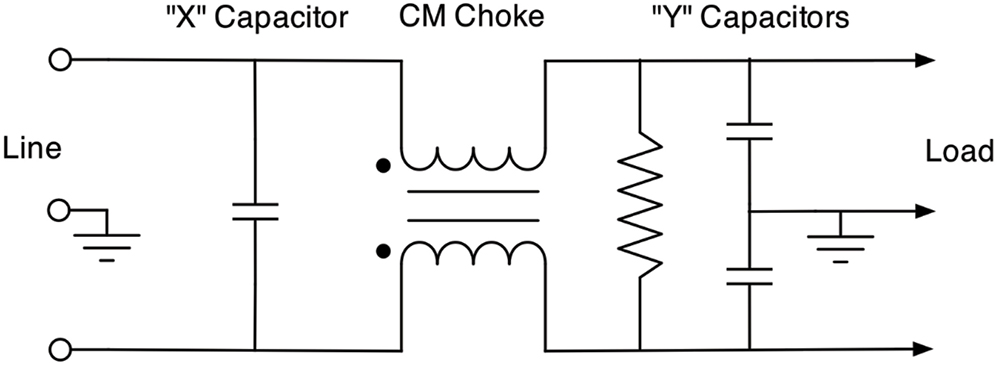
Figure 1: A common form of power line filter. The common mode inductance of the choke and “Y” capacitors form the common mode filter and the “X” capacitor in conjunction with the differential mode inductance of the choke filter differential mode. The purpose of the resistor shown is to bleed off any stored charge and is unrelated to the discussion.
Figure 2 shows the flow of differential mode (DM) and common mode (CM) currents through the filter network. The DM current is the current supplied to the switching circuit, so it is sourced by the Line and returned via the Neutral (shown in blue). The CM current is generated by switching transients or “ground bounce”, coupled with parasitic capacitance to chassis structure, and flows into the Line/Neutral wires and returns via the chassis ground (shown in red). This current loop is fairly uncontrolled and can result in unwanted emissions. In order to design an effective filter, we need to measure the two currents versus frequency.
Standards Practice
Transfer Impedance vs. Shielding Effectiveness
By Karen Burnham
S

ince 2019, I’ve been part of a fantastic standards working group helping draft the standard IEEE P2855 “Recommended Practices for the Electromagnetic Characterization of Cable/Connector Assembly Shielding Effectiveness in Frequency Range of Direct Current (DC) to 40 GHz.” This group has consistently been meeting monthly, and we’re just getting ready to submit a draft for balloting—which gives you an idea of the speed of standards development, even when everything goes very well and you have a very conscientious working group chair, secretary, and membership.

Reviewing the draft got me thinking about transfer impedance (Zt) and shielding effectiveness (SE). When I was just starting out, someone told me they’re reciprocals of each other, that SE was just 1/Zt. That’s directionally true—when you have a very good shield, Zt will tend to be very small and SE will tend to be very large. However, it isn’t technically true, since Zt and SE are measured in quite different ways.


Unlock the arcane arts of EMC
A bearded wizard in red robes reading an open book while a bolt of magical lightning glows behind him in a modern laboratory.
In Compliance: The Compliance Information Resource for Electrical Engineers logo
View the Archive
harness the magic
A stylized digital world map showing continents connected by an intricate web of glowing lines and light points.
Global Market Access for Bluetooth Devices
Successfully Navigating the Regulatory Landscape for Radio Transmitter Devices
By Grace Lin
B

luetooth® technology is the dominant technology for short-range, low-power wireless communication widely used in consumer products. As a radio (or an intentional radiator, a wireless device), a Bluetooth device must comply with regulatory requirements prior to being placed on the market.

Global market access (GMA) involves navigating international laws, regulations, standards, and equipment authorization procedures (e.g., certification, registration, declaration of conformity (DoC), supplier’s declaration of conformity (SDoC)).

This article focuses on the radio transmitter portion of Bluetooth device regulations, providing an overview of global regulatory requirements. Table 1 lists regulatory authorities, laws, regulations, technical standards, regulatory schemes, local representative requirements, and labeling for 30 countries/economies.
Futuristic digital illustration of a fighter jet as a glowing blue 3D wireframe hologram on a dark circuit-patterned background. Neon blue and pink streaks of light flow backward, simulating high-speed aerodynamic data streams.
MIL-STD-461H: A Review
Everything You Need to Know About the Latest Version of this Important EMC Standard
By Ken Javor
M

IL-STD-461H was released on April 17, 2026, and became effective on programs initiated after that date.1

As background, MIL-STD-461 is officially prepared by the U.S. Air Force, but it is the product of a Tri-Service Working Group (TSWG) made up (not surprisingly!) of representatives from the Army and Navy as well. In addition to service members, there are industry representatives (of which the author of this article is one).

Since 1993, MIL-STD-461 has been on a five-year review cycle to ensure that it remains current and useful. This does not mean a new revision has to be released every five years, but just that a review must be performed on that cycle. It would be entirely acceptable to simply reaffirm the old version with no changes, or to entirely sunset the standard. To date, neither of these alternatives has been selected.
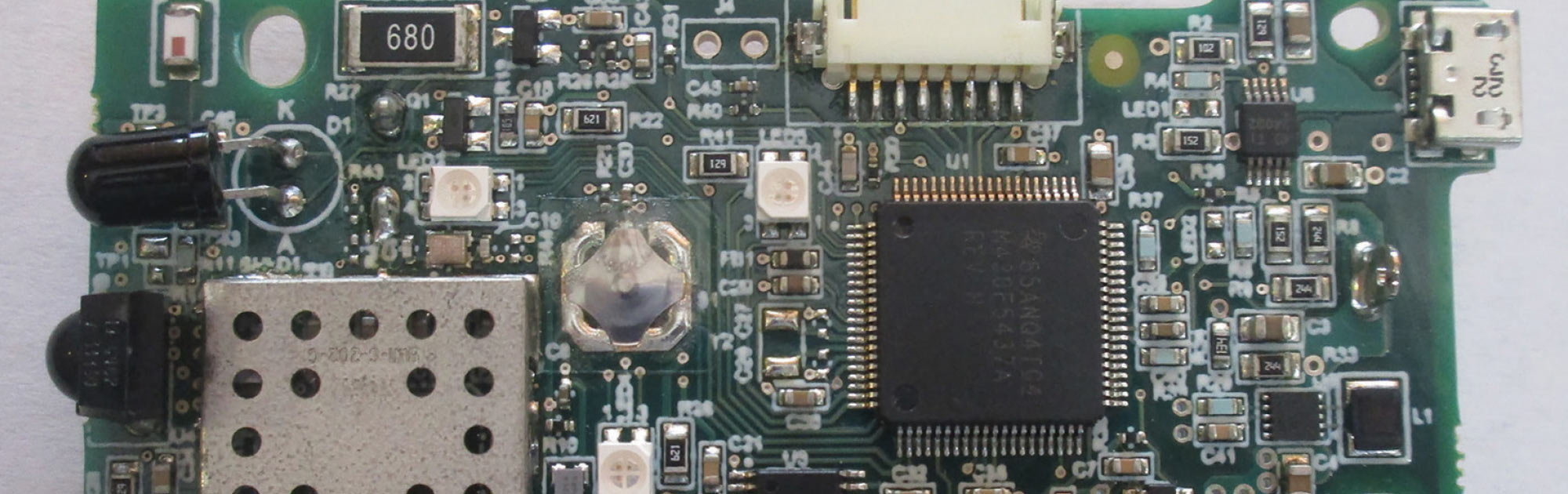
A close-up photograph of a green printed circuit board featuring a large central processor chip, various surface-mount components, and a metal shield.
Host Integration of Pre-Certified Radio Modules
Keeping Your EMI/Wireless Testing to a Minimum
By Cory Bradshaw and Craig Brandt
T

he use of pre-certified radio modules by product manufacturers has been growing in popularity. The process of designing a radio transceiver and meeting all the “Country Specific” regulatory requirements through extensive testing and documentation can be a long process. One of the many benefits of using a pre-certified radio module is that it significantly reduces both the cost of development and the time to market.

If used in accordance with the module’s Grant of Certification and integration instructions, it can limit the EMI/wireless testing to a minimal “spot-check” verification of the radiated emissions with the module installed in the host product. When performing this spot check, a certified test lab will only need to focus on the worst-case conditions from the original certification. Test engineers will be checking the band edges to ensure the product is not operating out of band and verifying that the harmonics from the transmitter are still compliant.

 
EMC Concepts Explained
Shielding Effectiveness: The Impact of Loss Tangent on the Reflection and Absorption Losses
By Bogdan Adamczyk, Peter Reiser, and Scott Mee
T

his article presents a concept of the loss tangent of the medium, which is often used to determine if a medium is a good conductor. A good conductor is defined as a medium in which the conduction current density is much greater than the displacement current density, or equivalently, the loss tangent of a medium (σ ⁄ ωε >> 1). The loss tangent of the medium is used to obtain an approximate solution for the shielding effectiveness in the far field, which in turn leads to the formulas for the shielding effectiveness in the near field [1].

Uniform Plane Wave Propagation in a Lossy Medium
To define the loss tangent of a medium, we begin with the uniform plane wave propagation in a lossy medium. The solution of the plane wave equations leads to the definition of the intrinsic impedance of the medium, which in turn leads to the concept of the loss tangent of the medium.
 
Hot Topics in ESD
Ground and Grounding in Electrostatic Control Programs
Understanding ANSI/ESD S20.20 Requirements
By David E. Swenson on behalf of EOS/ESD Association, Inc.
Introduction
Electrostatic discharge (ESD) is a significant concern in environments where sensitive electronic components or energetic materials are handled. Effective ESD control programs are essential for protecting products, equipment, and personnel from the harmful effects of static electricity. ANSI/ESD S20.20 (S20.20) is the American National Standard that outlines requirements for establishing, implementing, and maintaining an ESD control program. One of the core requirements in this standard is “ground” and “grounding.”
Definition of Ground and Grounding
In the context of S20.20, ground refers to a conducting connection, whether intentional or accidental, between an electrical circuit or equipment and the earth, or to some conducting body that serves in place of the earth. Grounding is the act of creating this connection, typically to control or dissipate unwanted electrical charges. The term “bonding” is also used to describe this activity where one conducting body is purposely attached to ground.
Technical
Library
Whitepaper
Demystifying IEC 60601: A Practical Guide For Understanding The Standards
offered by
This whitepaper demystifies the IEC 60601 family of medical electrical safety standards, explaining general, collateral, and particular requirements and how they impact global market access. It offers practical guidance on integrating compliance, risk management, and testing strategies early to streamline regulatory approval and accelerate time to market.
Whitepaper
Enabling Intelligent, Automation-Ready Electrical Safety Testing in Modern Production
offered by
Learn how electrical safety testing must adapt to Industry 4.0 production environments with automated, high‑speed hipot testing. This application note explains how programmable tests, seamless PLC/robot integration, and traceable data capture with Vitrek testers help manufacturers boost throughput, improve quality, and maintain compliance in smart, automated production lines.
Upcoming Events
June 1-2
Introduction to Leaky Waves and Leaky‑Wave Antennas
June 4
From MET to Market: MET Laboratories New England Grand Opening and Open House
June 7-12
2026 IEEE International MTT Symposia (IMS)
June 9-11
The Battery Show Europe
June 29 – July 3
Global Electromagnetics 2026 Symposium
July 12-17
IEEE AP-S/URSI 2026
July 13-16
2026 International ESD Workshop (IEW)Asia
August 3-7
2026 IEEE International Symposium on EMC and SIPI
Stay Current, Stay Compliant… Don’t Let Your Compliance Coverage Expire
Ensure you never miss an update. Renew your In Compliance subscription—or start a new one—and keep expert insights coming all year long.
Is it time to renew your subscription to In Compliance?
Was this issue of In Compliance forwarded to you?
Do you only want to receive the In Compliance enewsletters?

You can do that here.

In Compliance: The Compliance information Resource for Electrical Engineers logo
Thanks for reading our June 2026 issue!