

his article presents the derivation of the radiated far fields from a Hertzian dipole antenna above the ground plane using image theory.
 positioned symmetrically at the origin of the coordinate system and oriented along the z-axis.
 /50 ( = wavelength) can be considered a Hertzian dipole.
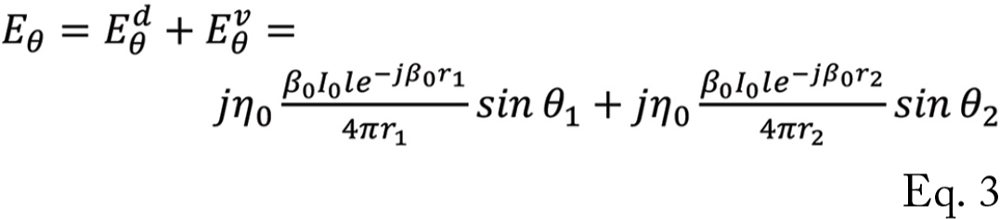
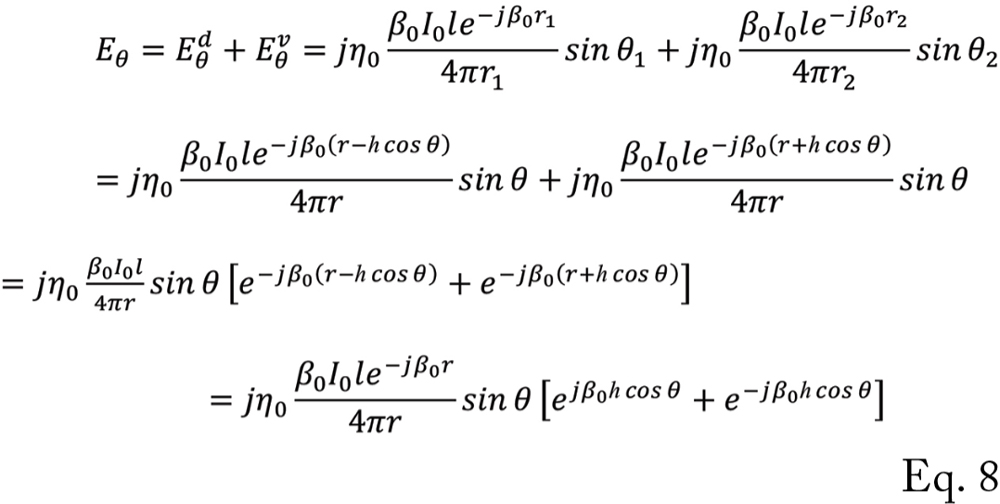
The far field of a Hertzian dipole has only a θ component (in a spherical coordinate system) and is given by [1].

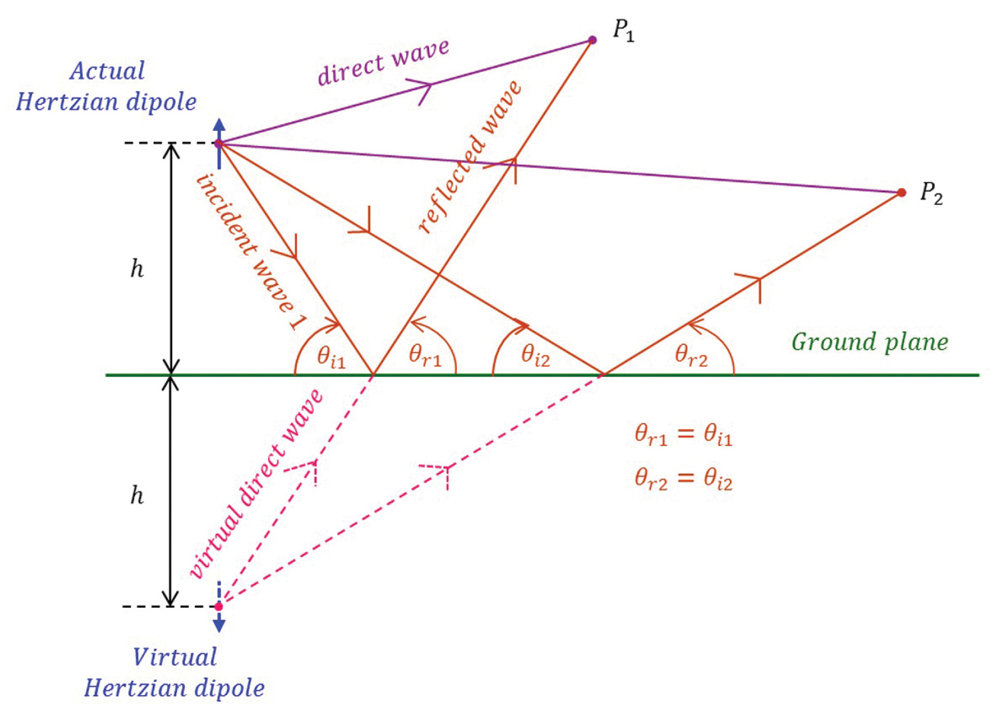
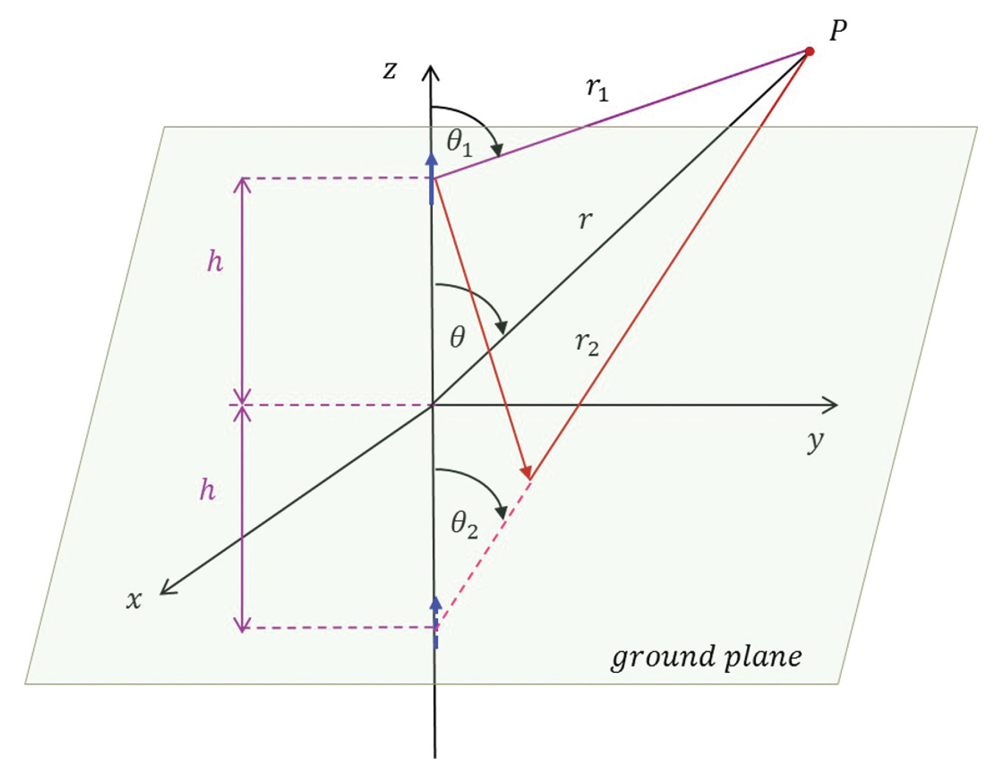
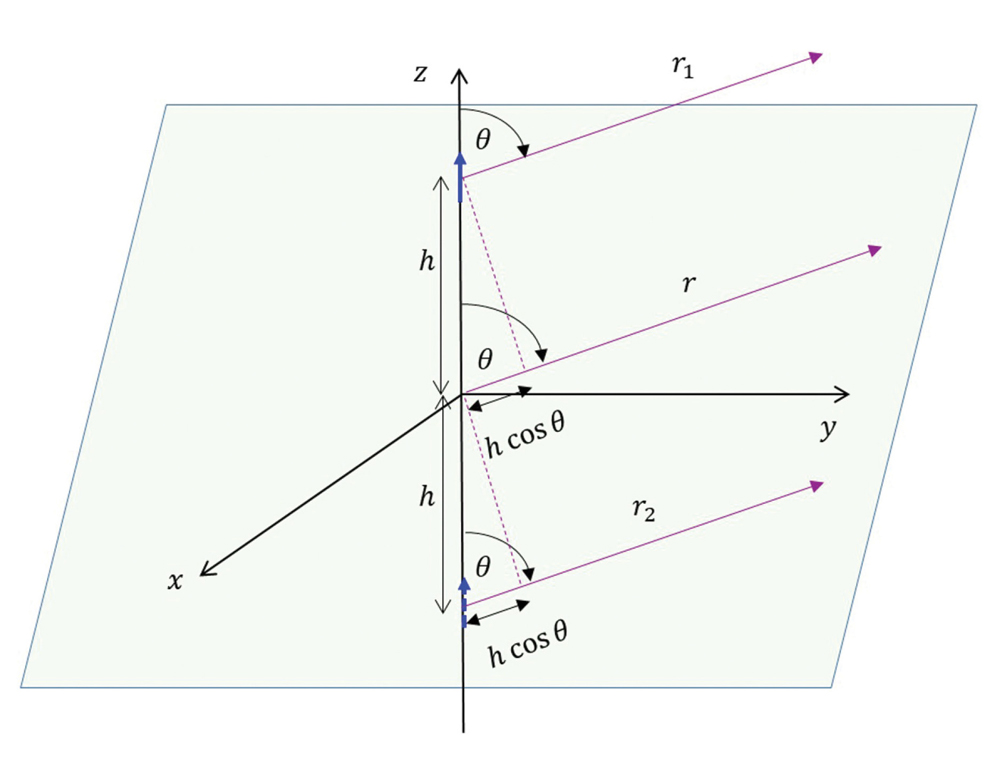
Instead of obtaining the total field by summing the actual direct and reflected waves, we add the direct wave from the actual source and the direct wave from its image (virtual source) to obtain the same result (above the ground plane). When considering the virtual direct wave, we pretend that the ground plane does not exist and, therefore, the virtual wave has a direct, unobstructed path to the observation point.
Why are we using this approach? Because the calculation of the fields using the actual waves is quite complicated, whereas the calculations using image theory are quite simple, as we shall see.











- Paul, C. R., Introduction to Electromagnetic Compatibility, 2nd Edition, John Wiley and Sons, New York, 2006.
- Bogdan Adamczyk, Foundations of Electromagnetic Compatibility with Practical Applications, Wiley, 2017.
- Balanis, C. A., Antenna Theory Analysis and Design, 3rd Edition, Wiley Interscience, Hoboken, New Jersey, 2005.