

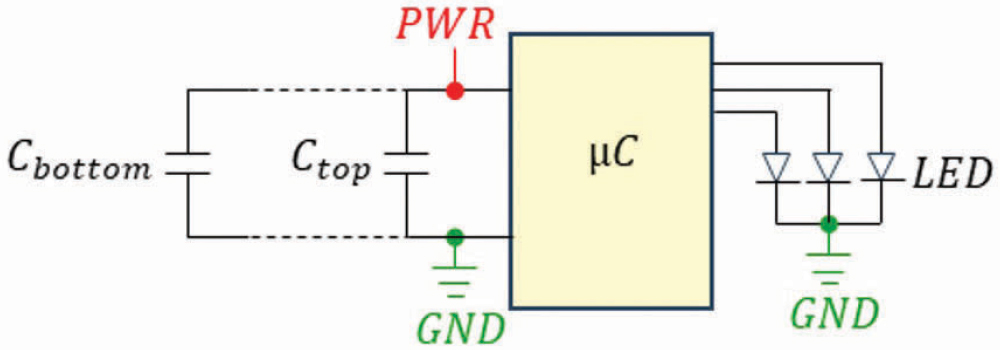
his is the third and final article in the series investigating the effectiveness of decoupling capacitors while varying the topology of vias, trace length between the decoupling capacitor and the IC power/ground pins, and distance from the internal power-ground plane pair. The first article [1] introduced the electrical schematic, via and trace topologies, as well as PCB topology. The second article [2] addressed the impact of the distance of the capacitor from the IC VCC and GND pins on the conducted emissions. This article investigates the impact of conducted emissions due to the distance of the capacitor from the internal power-ground plane pair and the impact of the capacitor via topology. The conducted emissions are measured using the CISPR25 standard, as shown in the second article [2] in the series.
Six PCBs were tested, each with a different via topology, as shown in Figure 4.
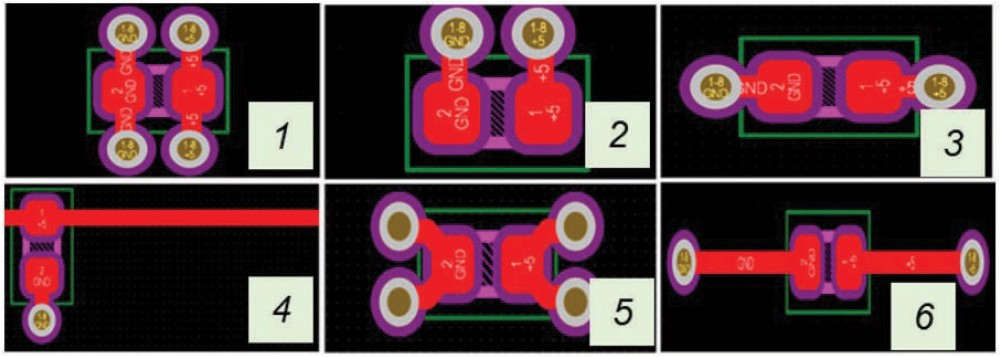
Board 2 was similar to Board 1 but had only two vias connected to the capacitor instead of four. The via connected to the internal power plane on layer 3 was placed 0.03 inches above the capacitor’s power pin, while the via connected to the internal ground plane on layer 2 was placed 0.03 inches above the capacitor’s ground pin. Again, there was 0.03 inches of separation between the power via and the ground via.
Board 3 had two vias connected to the capacitor, where one was approximately 0.026 inches to the left of the capacitor’s ground pin, and the other was 0.025 inches to the right of the capacitor’s power pin. 0.085 inches separated the vias from each other and connected to their respective internal planes on layers 2 and 3.
Board 4 used only one via, which connected to the board’s internal ground plane on layer 2 and was placed approximately 0.026 inches away from the center of the capacitor’s ground pin. A long trace ran from the capacitor’s power pin to the IC’s power pin.
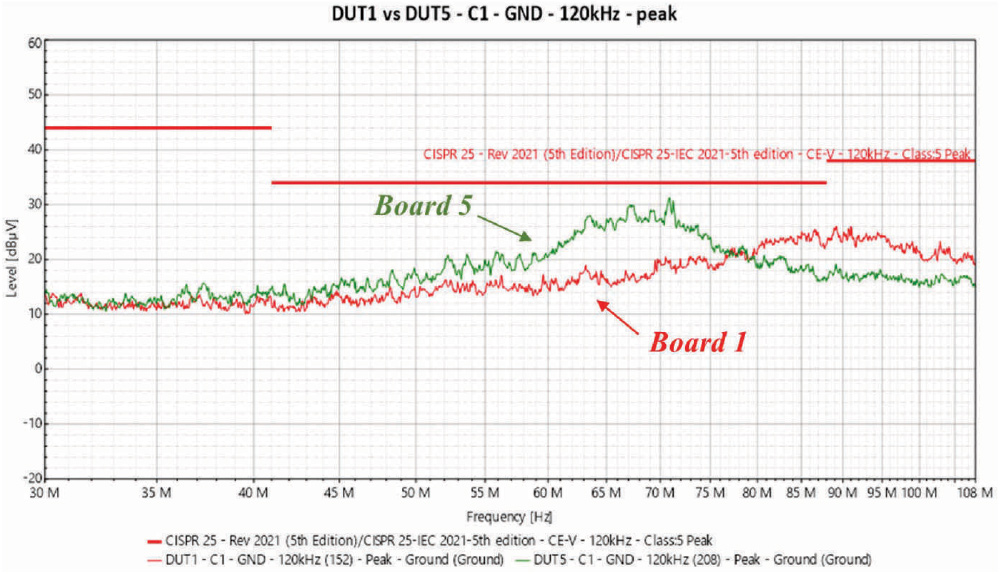
Board 5 had four vias connected to the capacitor. Each via was placed at a vertical distance of approximately 0.015 inches and a horizontal distance of approximately 0.026 inches from the center of the respective capacitor pin. This left 0.086 inches of distance between each power and ground via pair and connected to their respective internal planes on layers 3 and 2. The traces connecting the vias to the capacitor pin pads were also curved.
Board 6 was similar to Board 3 but had a longer trace between each via and the capacitor. Each via was approximately 0.1 inches from the center of its respective capacitor pin pad and connected to its respective internal planes on layers 2 and 3, making the distance between the vias 0.234 inches.
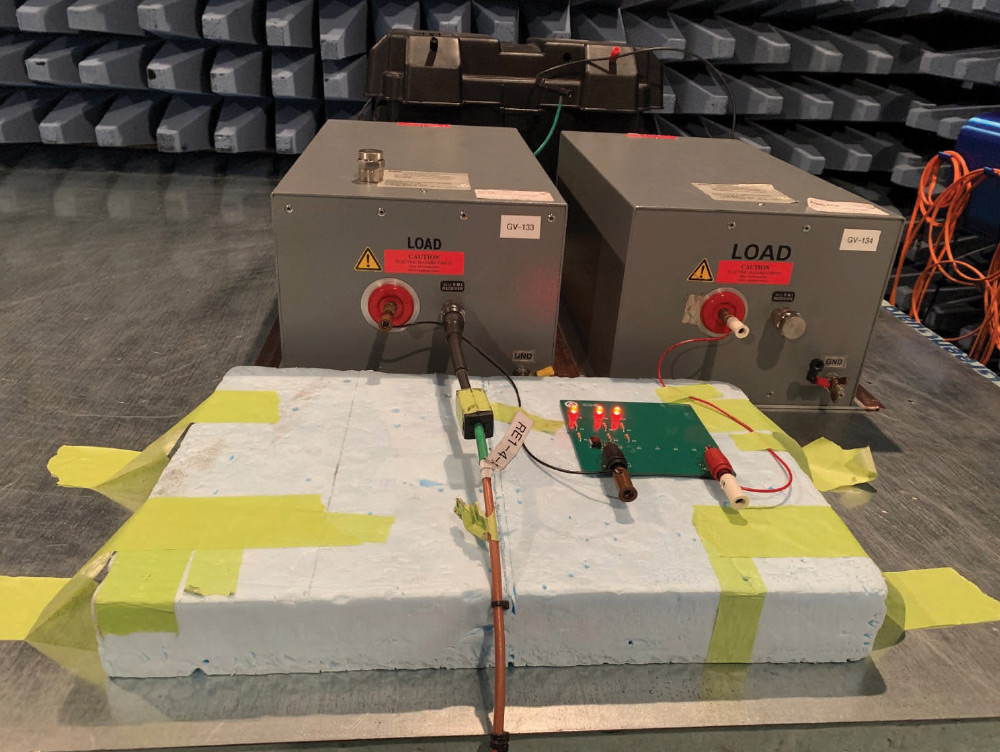
Measurements in the frequency range 0.15 – 30 MHz were performed with 9 kHz resolution bandwidth (RBW), while the range 30 – 108 MHz used 120 kHz RBW. Emissions were evaluated against Class 5 limits using the peak, average, and quasi-peak detectors. For clarity, the results for the peak detector are shown in this study.
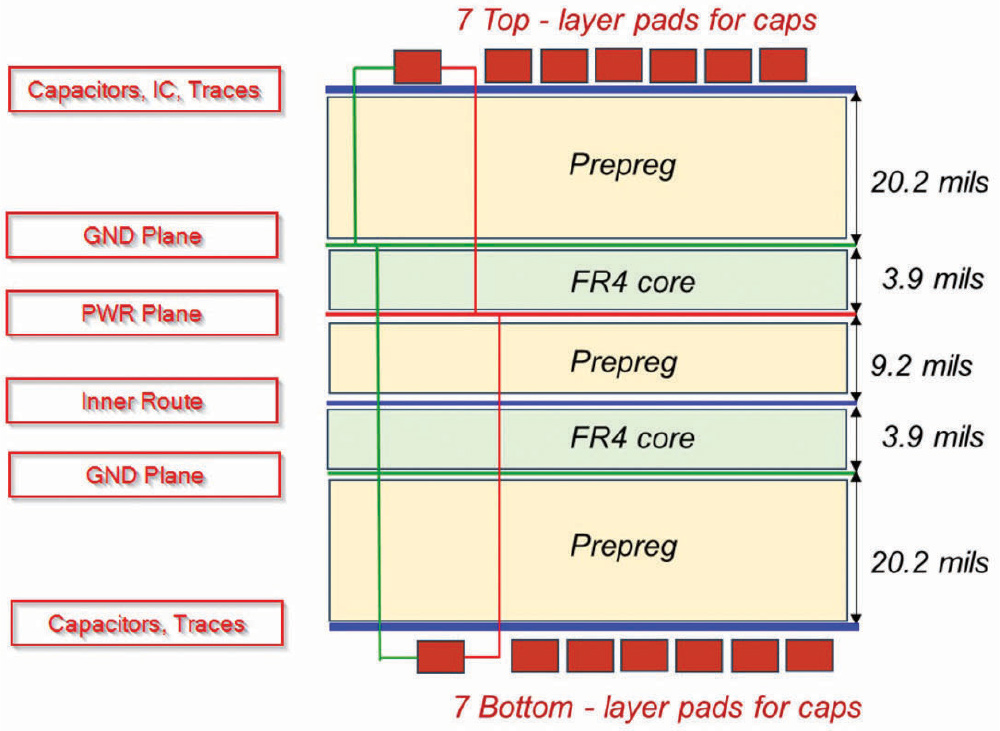
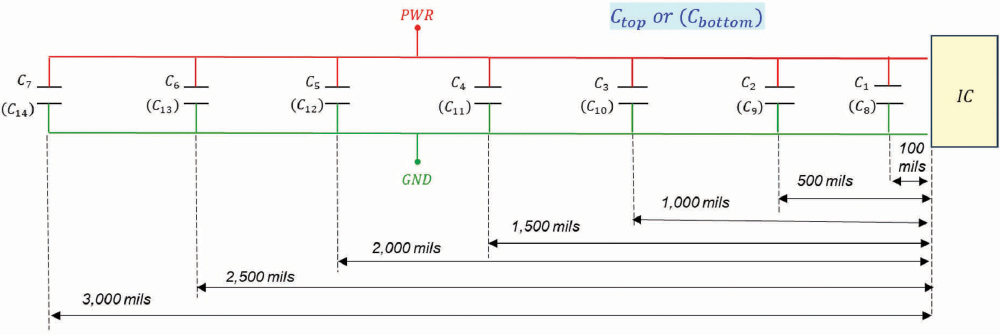
Figure 6b shows the results for Board 6 with the capacitor placed furthest away from the IC (C7 and C14). The C7 location corresponds to the capacitor placed on the top layer close to the power-ground plane pair. The C14 location corresponds to the capacitor placed on the bottom layer, further away from the power-ground plane pair. Thus, the C8 location creates a smaller current loop during switching than the C14 location. Therefore, we would expect the emissions from the C8 loop to be smaller than those from the C14 loop. This indeed is the case, as Figure 6b shows, in the frequency range 30 – 40 MHz.
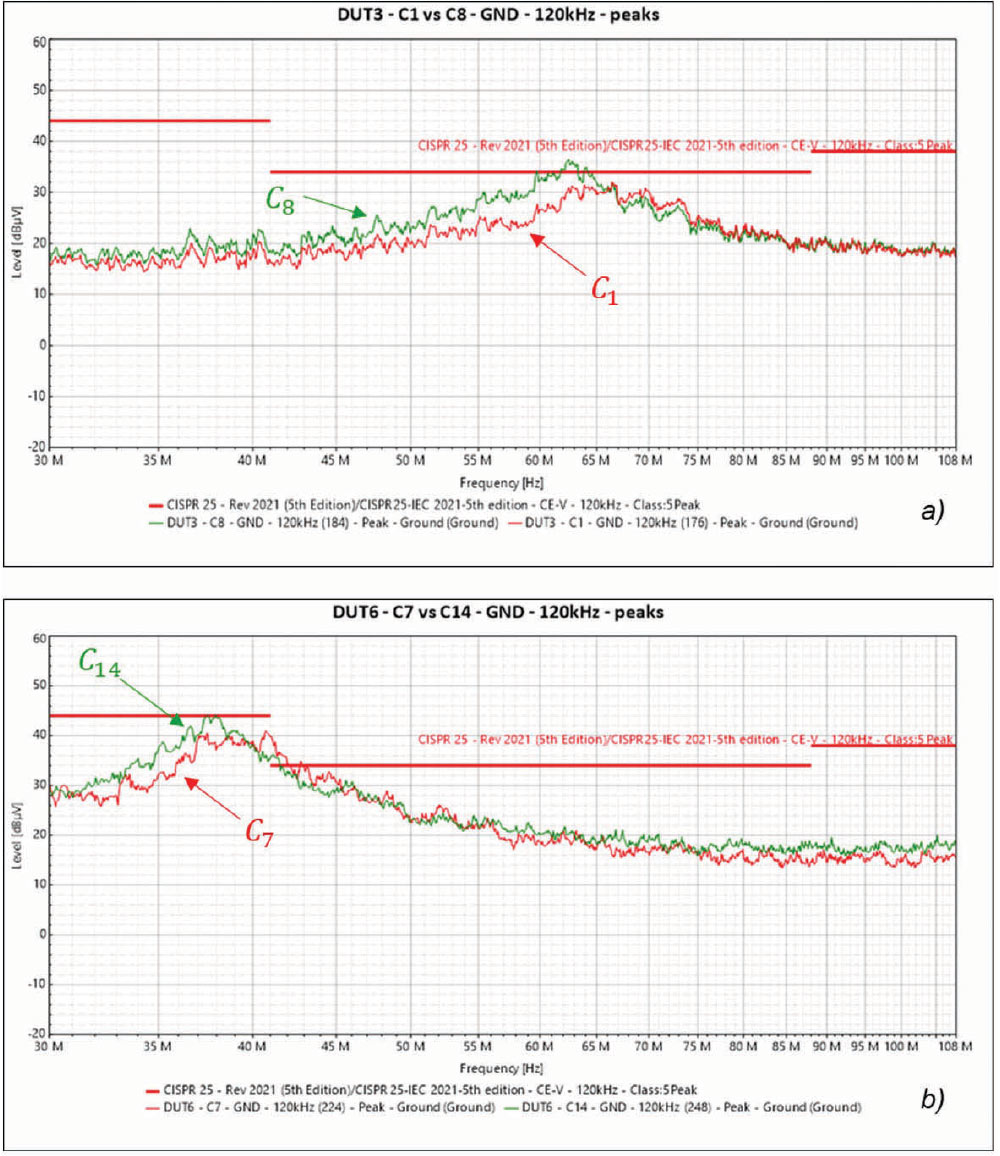
Figure 7a shows that the BAT line emissions of both boards are somewhat similar up to 15 MHz. Beyond that frequency, emissions from Board 6 become higher than emissions from Board 3, with the difference of about 15 dB at the upper frequency of 30 MHz.
Figure 7b shows the GND line results for Board 3 versus Board 6 in the frequency range 30 – 108 MHz. In the range 30 – 53 MHz, Board 6’s emissions are higher with the maximum difference of about 25 dB at 42 MHz. Past the frequency of about 55 MHz, Board 3’s emissions are higher, with the maximum difference of about 17 dB at 67 MHz. As one would expect, since via spacing in Board 6 is larger than via spacing in Board 3, the emissions at higher frequencies increase.
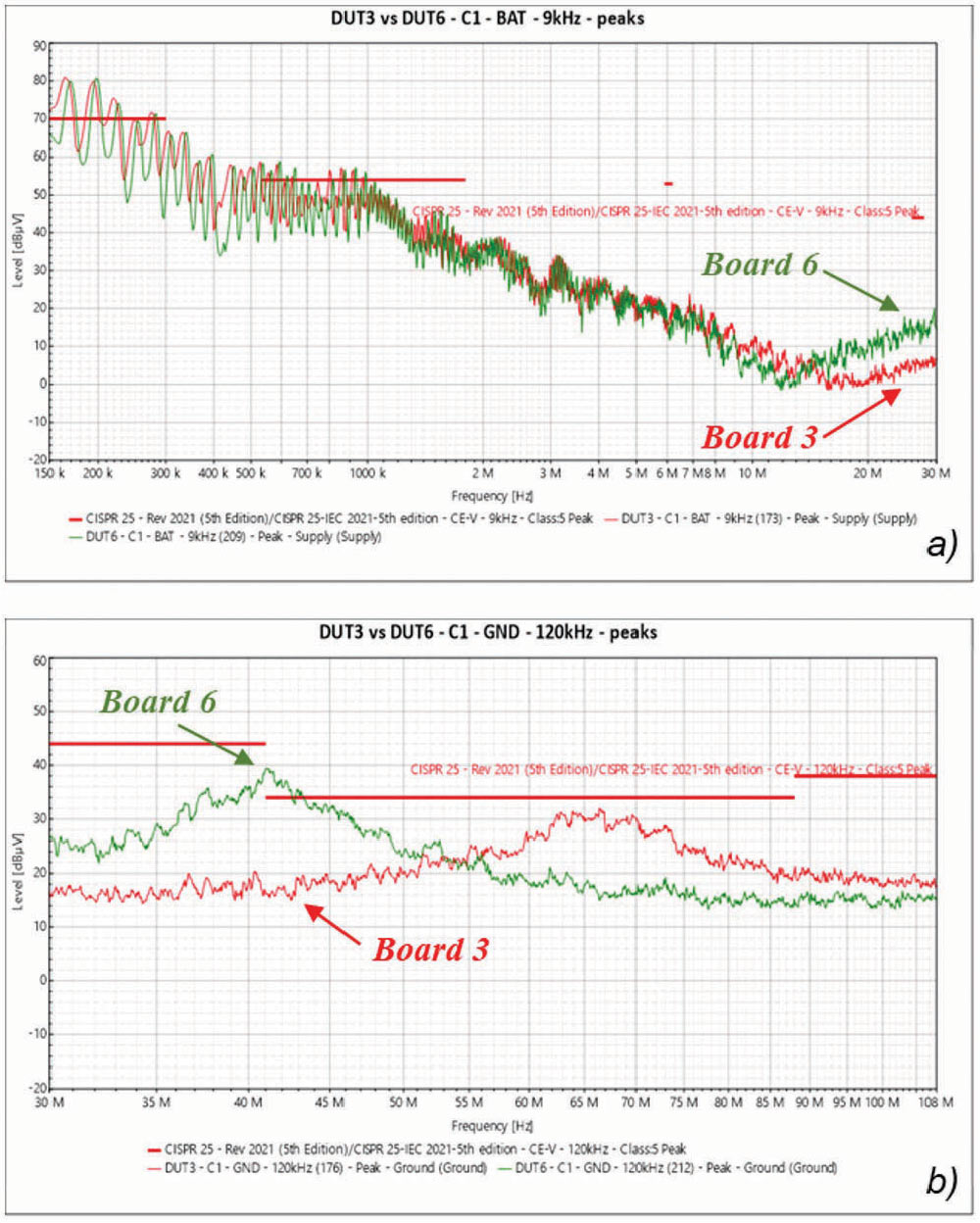
Figure 8 shows the GND line results for Board 1 versus Board 2 in the frequency range 30 – 108 MHz.
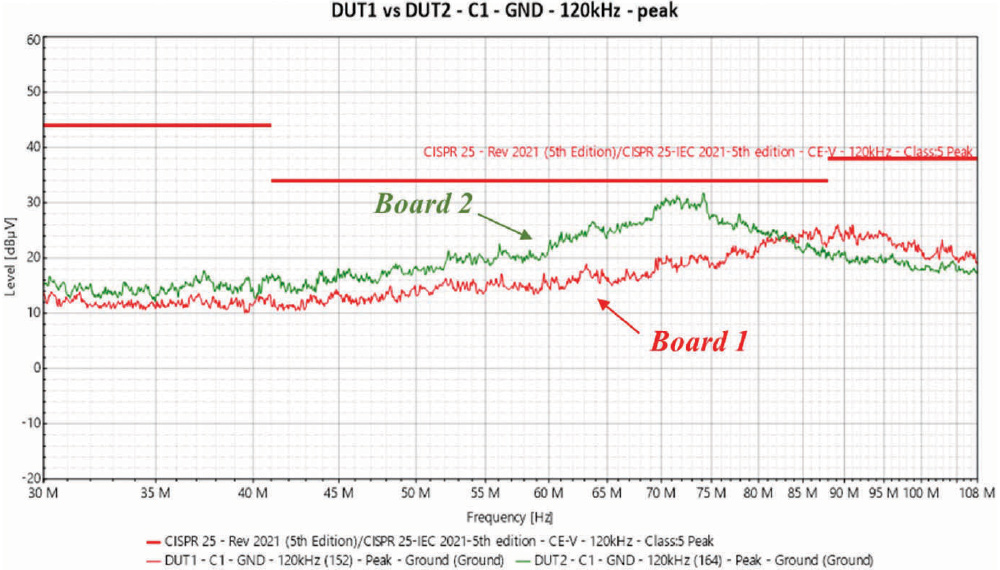
Figure 9 shows the GND line results for Board 1 versus Board 5 in the frequency range 30 – 108 MHz.
The best results were obtained by placing 2 vias per pad, locating the vias with close spacing, and placing the capacitor on the side of the board that is closest to the internal power and ground plane pair in the PCB structure. This last aspect is true when the embedded capacitor layers are closely spaced. In this study, the spacing used between the PWR and GND plane pair was 3.9 mils. As this spacing increases beyond 8-10 mils, the embedded capacitance exhibits a higher inductance, making the plane pair less effective for decoupling. These conclusions are consistent with the extensive studies described in [3] and [4].
The authors attempted to extend this study by also measuring radiated emissions. However, due to the limited technology, speed, and current draw of the selected microcontroller and loads, the results showed insufficient radiated noise to draw meaningful conclusions. Therefore, this is the third and final article on the subject.
- Bogdan Adamczyk, Allyson Telck, and Scott Mee, “Impact of PCB Via and Trace Geometry on the Effectiveness of Decoupling Capacitors – Part 1: Board Topologies and the PCB Circuitry,” In Compliance Magazine, February 2026.
- Bogdan Adamczyk, Allyson Telck, and Scott Mee, “Impact of PCB Via and Trace Geometry on the Effectiveness of Decoupling Capacitors – Part 2: Conducted Emissions Results – Impact of the Distance between the capacitor and IC,” In Compliance Magazine, March 2026.
- T. Hubing, “Effective strategies for choosing and locating printed circuit board decoupling capacitors,” 2005 International Symposium on Electromagnetic Compatibility, Chicago, IL, USA, 2005, pp. 632-637.
- Juan Chen, Minjia Xu, T. H. Hubing, J. L. Drewniak, T. P. Van Doren, and R. E. DuBroff, “Experimental evaluation of power bus decoupling on a 4-layer printed circuit board,” IEEE International Symposium on Electromagnetic Compatibility. Symposium Record (Cat. No.00CH37016), Washington, DC, USA, 2000, pp. 335-338 vol. 1.

Dr. Bogdan Adamczyk is professor and director of the EMC Center at Grand Valley State University where he performs EMC educational research and regularly teaches EM/EMC courses and EMC certificate courses for industry. He is an iNARTE-certified EMC Master Design Engineer. He is the author of two textbooks, “Foundations of Electromagnetic Compatibility with Practical Applications” (Wiley, 2017) and “Principles of Electromagnetic Compatibility: Laboratory Exercises and Lectures” (Wiley, 2024). He has been writing “EMC Concepts Explained” monthly since January 2017. He can be reached at adamczyb@gvsu.edu.