

n our “On Your Mark” columns, we often discuss the importance of American National Standards Institute (ANSI) Z535. This family of U.S. standards was created to enhance safety communication and promote consistent hazard recognition and understanding – making it critical for manufacturers and workplaces across the country. The six (soon to be seven) Z535 standards create a guide for the design, application, and use of signs, colors, and symbols intended to identify and warn against hazards and for other accident prevention purposes. Our theme of exploring one of these standards in depth continues, this month focusing on ANSI Z535.3 – Criteria for Safety Symbols.
The ANSI Z535.3 standard focuses solely on guidelines for the design and use of safety symbols. It establishes criteria for creating symbols that effectively convey safety information across different languages and cultures. The goal: to promote the adoption of effective safety symbols for safety communication and to supply a procedure to do just that.
ANSI defines safety symbols as a configuration made up of an image, with or without a surround shape, that conveys a message without the use of words; the symbol may represent a hazard, a hazardous situation, a precaution to avoid a hazard, a result of not avoiding a hazard – or a combination of these.
According to the introduction of ANSI Z535.3, “Effective safety symbols have demonstrated their ability to provide critical information for accident prevention and personal protection. Signs with safety symbols can promote greater and more rapid communication of the safety message, and therefore greater safety for the general public.”
Labels and signs that use safety symbols, instead of words alone, can help to achieve more rapid communication of the safety message and, ultimately, greater safety for those using, cleaning, or maintaining machinery. Also key in that is consistency. Effective symbols are consistent in their design, providing the ability to quickly glean important safety information across different languages, reading comprehension levels, and learning backgrounds. A consistent design allows for familiarity with images, making it easier to notice differences during potentially hazardous situations.
In 1914, the Worker’s Compensation Bureau published a booklet on best safety practices that included safety signs. While it advocated for safety signs – including those in the languages of workers – it didn’t provide guidelines or formats for symbols. In 1941, the first U.S. standard for safety signs, ASA Z351.1 was published, outlining specifications for safety sign design and standard formats.
ANSI Z535.3 was published for the first time in 1991, offering extensive details about designing, evaluating, and using symbols. It was revised in 1998, when more substance was added to it, including providing well-tested procedures for evaluating symbols. Following that, revisions were made periodically, according to ANSI’s cycle, including a 2011 update to delete a separate annex (C) with safety symbol examples, moving relevant parts to Annex A – essentially showcasing these not as examples (since they may be out of date or out of synch with updates to ISO 7010) but to illustrate principles and guidelines for graphic designs.
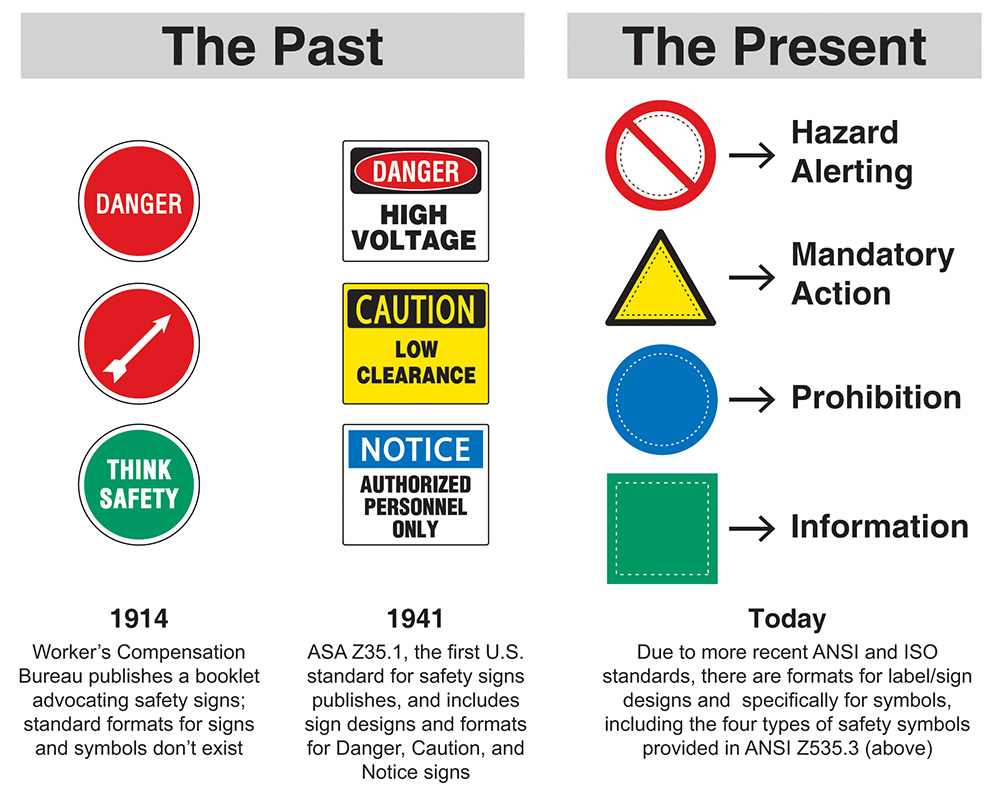
For example, helpful, specific areas from the standard that create important foundational elements for developing and using safety symbols include:
- “Individual safety symbols should be designed, wherever possible, as elements of a consistent visual system.”
- “There are four types of safety symbols that communicate different messages: hazard alerting, mandatory action, prohibition, and information.”
- “Safety symbols used on safety signs should be placed within the normal field of view, and near the hazard or area for which action is required…they should be legible at the intended viewing distance.”
- “Attention should be paid to environmental factors such as dirt, degradation, light level, and light quality that can impair the effectiveness of a safety symbol.”
- “A safety symbol should have demonstrated understandability as verified by acceptable selection procedures involving an appropriate test group…a symbol training/recognition procedure is recommended to familiarize intended users with symbols and their meanings.”
However, when it comes to the practical application of the standard, there are many nuances and gray areas. That’s because the standards aren’t prescriptive in nature; they’re meant to be guidelines.
According to Angela Lambert, head of standards compliance at Clarion Safety Systems and ANSI Z535 committee member, particular areas with question marks for equipment manufacturers charged with product safety are often:
- Safety alert symbol variations
- Symbol comprehension testing
- Abstract vs. representational symbols
- Use of only symbols vs. symbols and text
- Standardized symbols vs. your own creation