


ur ability to measure the charge accumulated by a human being is a critical part of managing electrostatic discharge (ESD) in industrial environments. Unfortunately, these measurements require that the person involved is connected by wire to a high-impedance or electrostatic voltmeter. This is fine in the laboratory but severely limits our possibilities on the factory floor. In this article, we describe how wireless measurements of human body voltage can be made, and why they are important for ESD managers.
Controlling human body potential and static charge is a key part of any ESD control program, and actually measuring body voltage is how we validate these programs. For example, the ANSI/ESD STM 97.2, Floor Materials And Footwear – Voltage Measurement in Combination With A Person, requires a “walking test” in which an operator walks on the floor while holding an electrode connected to a charge plate monitor (effectively, a very high impedance voltmeter). The operator’s voltage is recorded while they walk, and the limits of body voltage determine whether the floor is compliant or not.
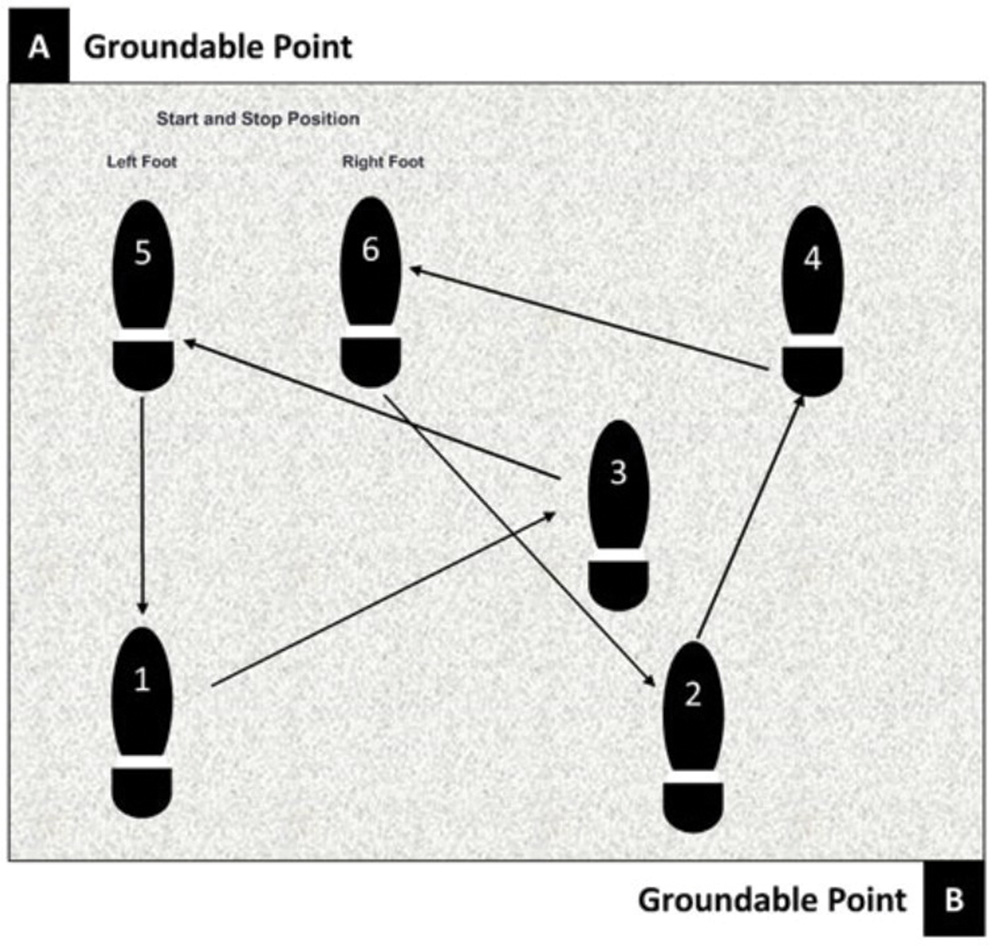
The ANSI/ESD standard itself illustrates why wired measurement is a problem here. The operator can’t actually walk because they’re wired to a fixed instrument. Instead, they perform a statutory set of steps in place (colloquially known as the “ESD Shuffle”) which look exactly like a 1950s dance class, right down to the numbered foot movements (Figure 1). To be fair, the test is also designed to qualify small areas of flooring, but many ESD managers would much rather have a method and hardware that would allow them to properly qualify large areas of floor by walking around.
The key to this type of wireless voltage measurement lies in understanding the relationship between charge, capacitance, electric fields, and voltage. We remember from basic electrostatics that all conductors have an intrinsic self-capacitance. For example, a conducting sphere has C = 4πrε, where r is the sphere radius and ε the permittivity of the surrounding insulator (usually air, for which we approximate ε0, or the permittivity of free space). Human beings have a self-capacitance. The standards use 100 pF as a generic value, but most people’s self-capacitances are significantly larger (we’ve measured 231 and 205 pF, respectively).
When a conductive object or person acquires charge q (by shuffling feet on a carpet, for example), their voltage changes accordingly: V = q/C. This charge distributes itself across the surface of the conductive object, with some dependency of charge density on geometry. The surface charge induces an electric field that is perpendicular to the surface and proportional in strength to the charge density, as follows:
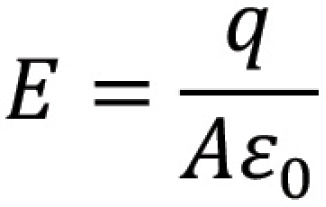
So, if we can measure the electric field E at the surface, and we can estimate the area A and self-capacitance C, then we can approximate the voltage as follows:
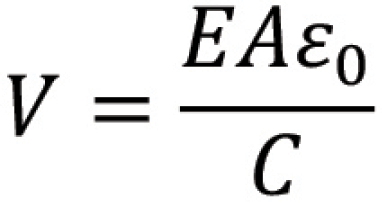
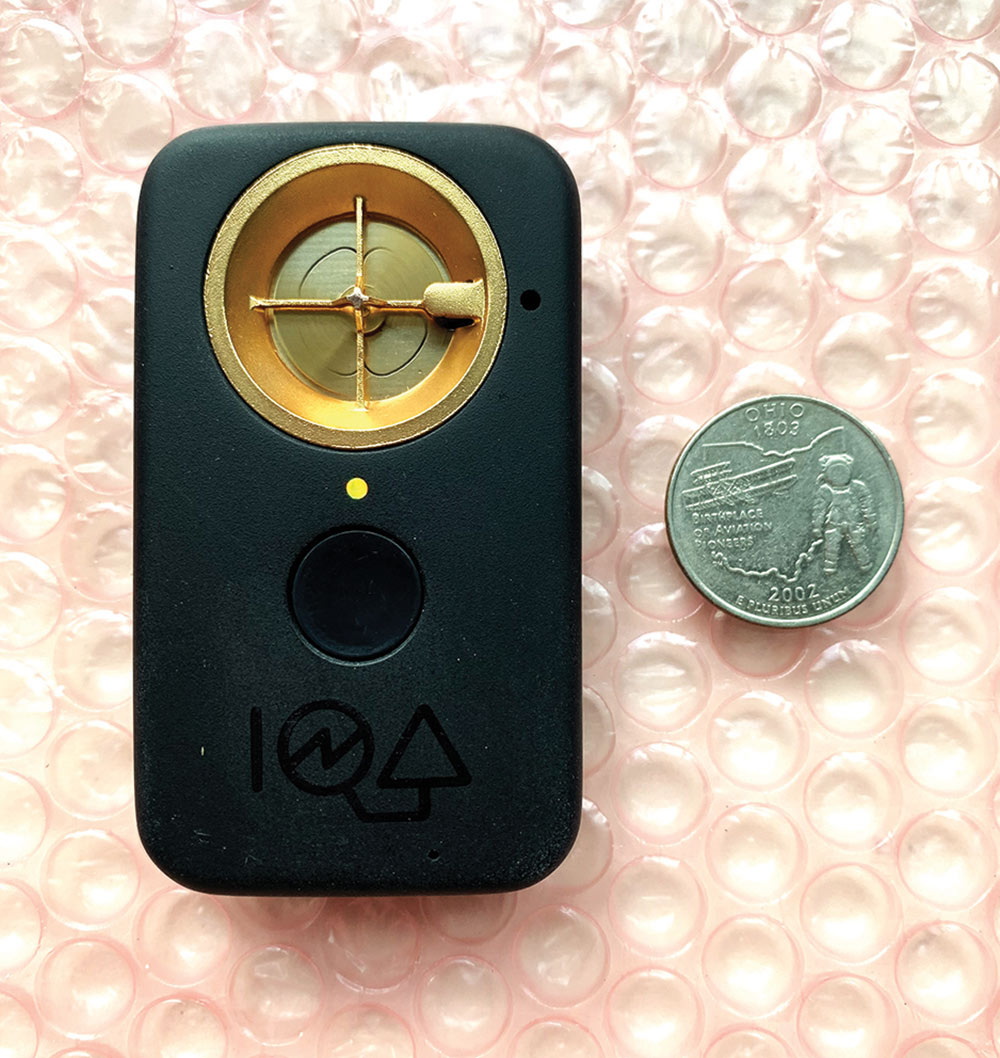

We have chosen to wear the sensor on a hook-and-loop strap on the upper arm. The upper arm is chosen because it is close to the bulk of the body, and the sensor is characteristically pointing out. If the sensor were mounted on the wrist, say, there could be two problems. The first is that as a body extremity, the wrist is less likely to reflect a charge density representative of the average body charge density. The second is that if the wrist is tilted so that the electric field sensor points towards the chest, the field measured will be that of the interior of the conductive surface, i.e., close to zero.
Figure 3 shows the sensor unit in use on a wearer’s arm. The unit is enclosed in a conductive housing and is connected to the wearer’s skin in one of two ways: either it is worn with a short-sleeved shirt so that the base plate is directly contacting the skin, or it is worn over a conductive smock so that the surface of the smock effectively becomes the conductive surface of the body.
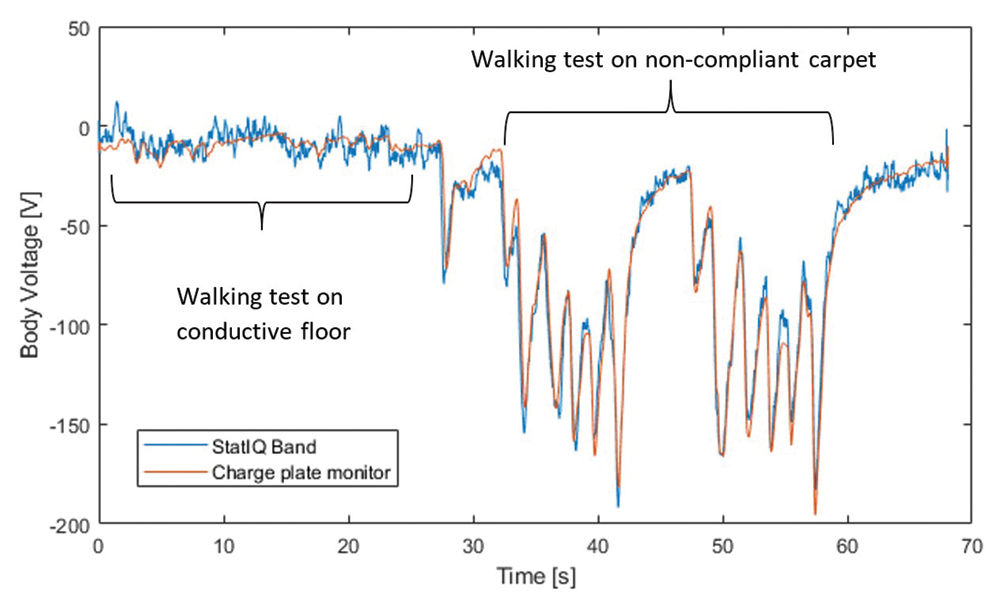
Figure 4 shows a comparison of the body voltage measured using the wireless sensor and a simultaneous measurement made with a gold-standard electrostatic voltmeter (a 3M Model 711 Charge Analyzer). It can be seen that while the dynamics of each signal are somewhat different, owing to different noise filter time constants, the signals are essentially identical.
The astute reader will be wondering about the assumptions that are necessary for this method to work. Briefly, they are:
- The field perpendicular to the body at one point should be representative of the average field induced by the average charge density on the body;
- The charge density under the sensor is representative of the charge density of the whole body;
- The field induced at the point of measurement is not significantly affected by external sources of charge; and
- The total capacitance of the body does not increase significantly from the self-capacitance.
In practice, we are finding that wearing appropriate ESD garments is the single biggest factor in achieving accurate measurement. A person clad in an ESD smock and hat can achieve errors of less than 10V when compared to charge plate analyzer voltmeters. Cotton apparel also gives good results, with errors of typically less than 100V. Not surprisingly, if the device is worn over synthetic apparel, the accuracy degrades significantly, with errors up to 1000V being possible.
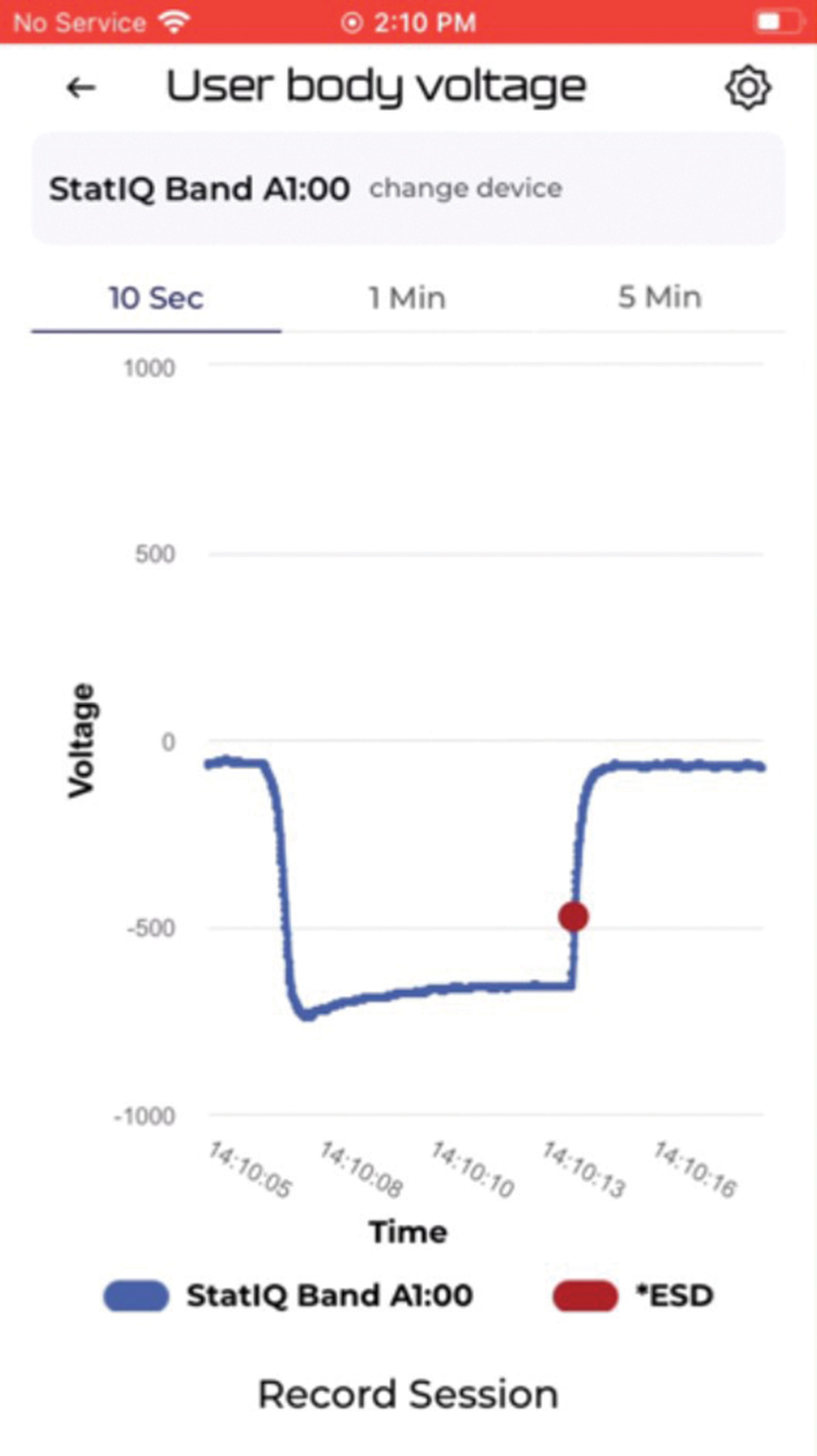
Given that the measurement is intrinsically wireless, it makes no sense to interface it to a PC or similar display except by wireless network. The device has a Bluetooth network interface, and we are able to view the data on a mobile phone app or via a browser on a Bluetooth-enabled PC. This makes mobile use of the system within the workplace very simple.
A novel application of this system is that, because we have a real-time measurement of the body voltage, we can detect when a static charge has been discharged from the body into an object (such as a PCB). We do this simply by detecting sudden reductions in body voltage, which allows us to establish a rate of voltage change dV/dt, which is unambiguously a discharge to ground. Figure 5 shows such an event displayed on a mobile phone app. We can measure the actual magnitude of the discharge in voltage terms, allowing an ESD manager or production manager to make an educated guess, on the spot and in real time, as to whether the system which received the discharge should be assessed for ESD damage.
For example, carts and trolleys, which are the bane of many an ESD manager, can be actively monitored, with alarms generated when they exceed a safe voltage level. In the chemical transport industry, the presence of static on vehicles is an ever-present combustion hazard, and the ability to measure vehicle static levels could be a considerable boon to that sector.
We are in the infancy of understanding this measurement technique, but the sky is the limit (literally – airplanes have their static buildup issues too!).