

EC 61000-4-6 is titled “Electromagnetic compatibility (EMC) – Part 4-6: Testing and measurement techniques – Immunity to conducted disturbances induced by radio-frequency fields.” This “conducted RF immunity” standard covers the conducted immunity requirements of electrical and electronic equipment to electromagnetic disturbances from intended radio-frequency (RF) transmitters in the frequency range 150 kHz up to 80 MHz.
As one can imagine, the coupling (C) part of the CDN is used to couple energy into the equipment under test (EUT). In contrast, the decoupling (D) part of the CDN is used to prevent unwanted injected test signals from disrupting any auxiliary equipment used to provide functional signals to the EUT.
From 150 kHz – 26 MHz, the standard requires Z equal 150 Ω ± 20 Ω.
From 26 MHz – 80 MHz, the standard requires Z equal 150 Ω + 60 Ω, -45 Ω.
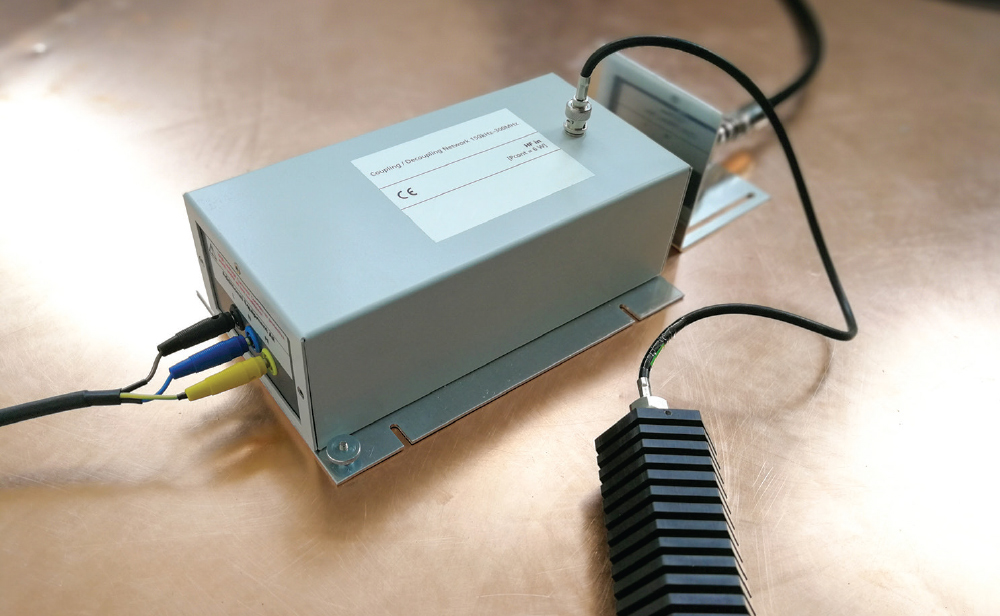
Reference 1 contains two sets of example Spice simulations that show how a change in CDN-Z from 150 Ω to 300 Ω, using an identical EUT load of 1000 Ω while applying the same laboratory calibrated 10V test level, resulted in an increase in current applied to the load of 7.8 mA to 8.4 mA. This change resulted in 7.8 V and 8.4 V developed across the EUT load, respectively. This is a 7 % increase in current applied from what should have been the standard level and could make the difference between a pass or fail of the EUT.
The second step in maintaining correct CDN impedance is to have the Z of all your CDNs periodically calibrated at an ISO17025 accreditation test facility (or alternatively, learn how to do it yourself).
- “Why is it important to control and measure CDN impedance for EN61000-4-6 testing?” The Equipment Calibration Business.
- IEC 61000-4-6:2013. Electromagnetic compatibility (EMC) – Part 4-6: Testing and measurement techniques – Immunity to conducted disturbances, induced by radio-frequency fields.
Available from https://webstore.iec.ch/publication/4224