

his article explains how to use a Smith Chart to determine the voltage standing wave ratio (VSWR). The concept of the standing waves and VSWR was described in detail in [1], while the Smith Chart construction and its use for determining the input impedance to the transmission line was discussed in [2,3,4].
Let’s briefly review these concepts to provide the background needed for determining the VSWR graphically using a Smith Chart. Consider the transmission line circuit shown in Figure 1. A sinusoidal voltage source  S with its source impedance
  S drives a lossless transmission line with characteristic impedance ZC, terminated in an arbitrary load L.



where |+| denotes the amplitude of the forward propagating voltage wave, β is the phase constant, related to the wavelength, λ, by

and  L the load reflection coefficient given by


Except for the case of a matched load, the magnitudes of the voltage and current vary along the line. This variation is quantitatively described by the voltage standing wave ratio (VSWR) defined as
 min| = 0 , and


The magnitude of the load reflection coefficient is plotted as a directed line segment from the center of the plane. The angle is measured counterclockwise from the right-hand side of the horizontal Γr axis.
For passive loads, the magnitude of the load reflection coefficient is always

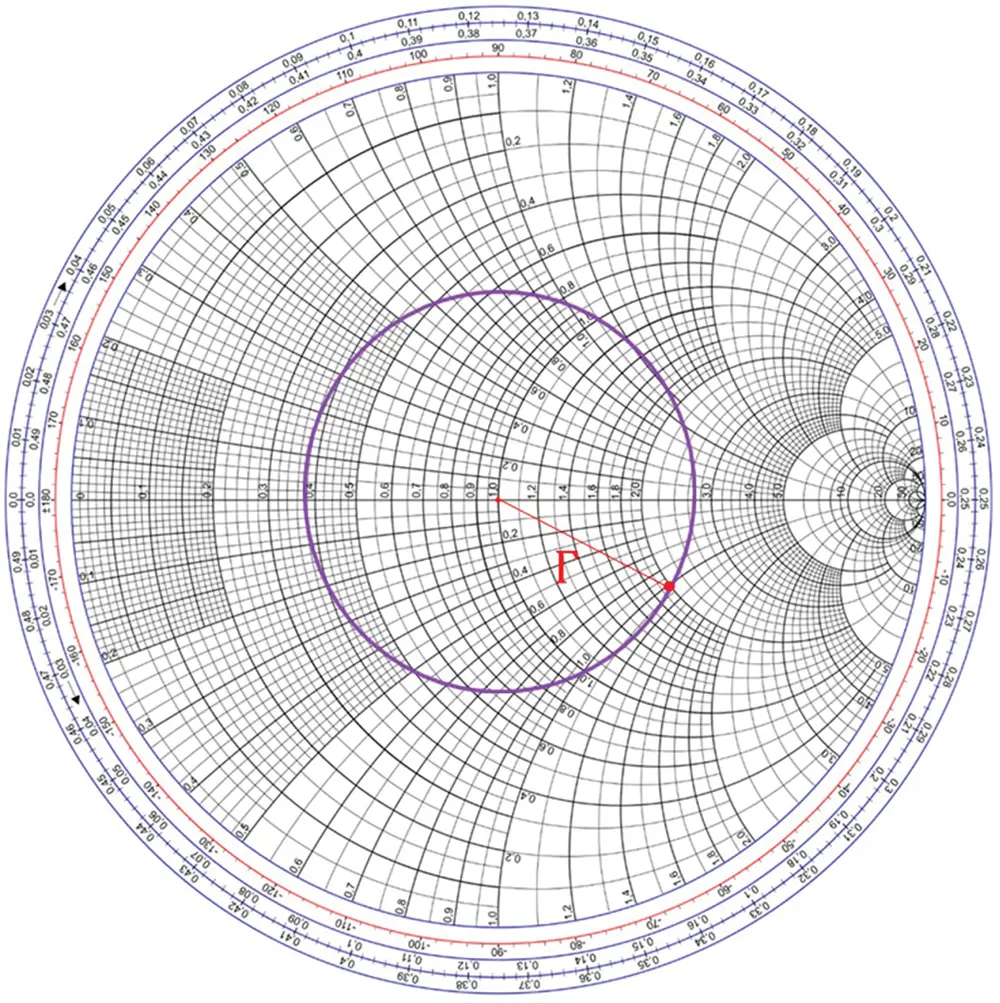
All points on this circle have the same value of |L| = Γ. Thus, this is a constant Γ circle. Now, recall Eq. (8), repeated here


Since Γ is constant, all points on this circle will have the same value of S. Thus, this is also a constant VSWR circle. To determine the value of S, we proceed as follows [5].
Consider a load with the normalized load impedance [2]


Figure 5: Smith Chart and the constant S circle


Now, the load reflection coefficient in Eq. (3) can be expressed in terms of the normalized load impedance as [2]


Points C corresponds to rL < 1 and point B corresponds to rL > 1 . Let’s compare Eq. (17) with Eq. (11), repeated as Eq. (18).


- Adamczyk, B., “Standing Waves on Transmission Lines and VSWR Measurements,” In Compliance Magazine, November 2017.
- Adamczyk, B., “Smith Chart and Input Impedance to Transmission Line – Part 1: Basic Concepts,” In Compliance Magazine, April 2023.
- Adamczyk, B., “Smith Chart and Input Impedance to Transmission Line – Part 2: Resistance and Reactance Circles,” In Compliance Magazine, May 2023.
- Adamczyk, B., “Smith Chart and Input Impedance to Transmission Line – Part 3: Input Impedance to the Line,” In Compliance Magazine, June 2023.
- Fawwaz Ulaby and Umberto Ravaioli, “Fundamentals of Applied Electromagnetics,” Pearson Education Limited, 7th Ed., 2015.