

How to Select the Correct Type
-type capacitors suppress differential mode conducted emissions in applications such as switch-mode power supplies, DC‑DC converters, variable-speed motor drives, and other similar devices. The X designation means they are applied line-to-neutral, as shown in the simple diagram below.
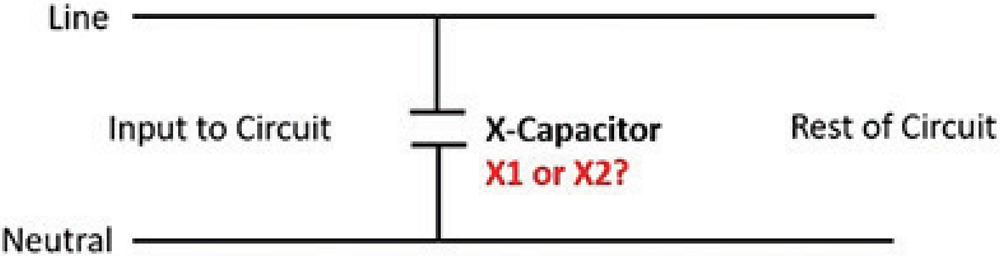
IEC 60664-1 (latest edition is dated 2020) describes the overvoltage categories. There are four overvoltage categories, designated as I, II, III, and IV. Devices installed in category IV locations are subjected to the most severe transients (surges), whereas category I locations are the least severe, protected environments. This post focuses on categories II and III. Examples of category II locations are household appliances plugged into the standard home wall outlet. Category III locations are closer to the voltage supply and subjected to harsher transient conditions. Examples are switches in the fixed installation and equipment for industrial use with permanent connection to the fixed installation.
Annex B (informative) of IEC 60664‑1 describes nominal voltages of mains supply for different modes of overvoltage control. See Table B.1 – Inherent control or equivalent protective control. This table is something you need to look at.
For example, select 300V as the voltage line-to-neutral derived from nominal voltages AC or DC. The rated impulse withstand voltage for the equipment is provided for each overvoltage category. For category II, it is 2.5 kV; for category III, it is 4.0 kV.
Given this information, if your end-product is installed in an overvoltage category II location, then an X2-rated capacitor is acceptable. However, if it is installed in an overvoltage category III location (a location that requires a rated impulse withstand voltage of 4.0 kV), then an X1-rated capacitor is required.