


dvanced system on a chip (SoC) components use multi-die package technologies where single silicon chips are assembled on top of each other, beside each other on a larger interposer, or by combining various 3D packaging methods together. Connections between chips are formed by utilizing multiple technologies such as flip chips, substrates, interposers, silicon bridges, bond wires, micro bumps, and through-silicon-vias (TSV).
A single SoC can have hundreds to thousands of external connections between a component package and a printed circuit board (PCB). These connections require certain robustness against external electrical stress and can often tolerate electrostatic discharge (ESD) withstand voltages of more than 250 V charged board model (CDM) and 500 V human body model (HBM) during qualification tests. Each of these on-chip protection structures requires surface area from the silicon, but due to a limited number of connections, this is still feasible.
There are more die-to-die (D2D) interconnections inside an SoC than between the package and PCB, and it is estimated that the number of interconnections increases with future technologies [1][2]. Most interconnections are well protected after the SoC is assembled and don’t need the same level of ESD robustness as the external interfaces. A certain basic ESD robustness is still required for frontend and backend processes, even though these are made inside a well-controlled cleanroom environment, fulfilling electrostatic protective area (EPA) precautions.
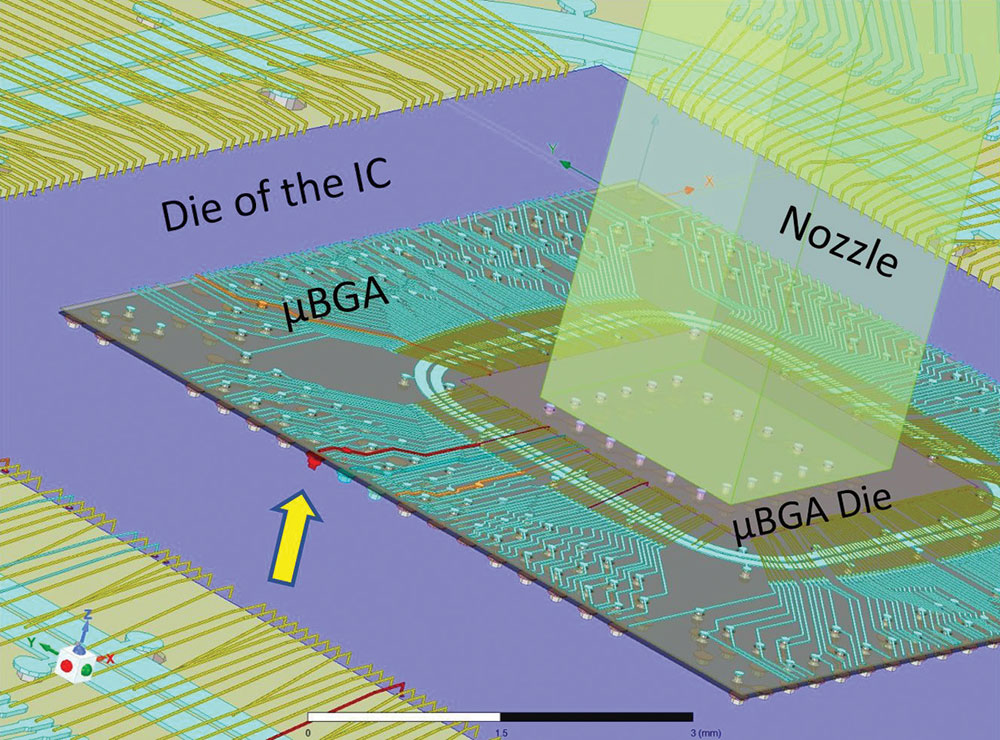
D2D assembly process phase in the backend can have CDM-like ESD risks. Here, bare dies are joined together with an automated handler so that interconnection surfaces directly contact each other. Handlers are well grounded, and ionizers mitigate electrostatic charge buildup. However, it is challenging to control die charging in a fast-paced process where parts contain both dielectrics and conductors. Ionization time is limited, and dies can have charges trapped on opposite surfaces facing trays and pickup nozzles. Ionizers can typically limit charging of large objects below ±10 V, but it is challenging to limit charging of small chips during fast pick and place processes.
There is limited information available about ESD current waveforms from small capacitance sources when the initial potential difference is below 100 V. Several papers discuss discharges between IC packages, and ESD events between dies should have mostly similar initial conditions [3]. Here, the discharge current waveform depends on the initial charge, capacitance, and discharge path. Similarly, the quasistatic ESD source capacitance of the die depends on the size, location, surroundings, and design of the die.
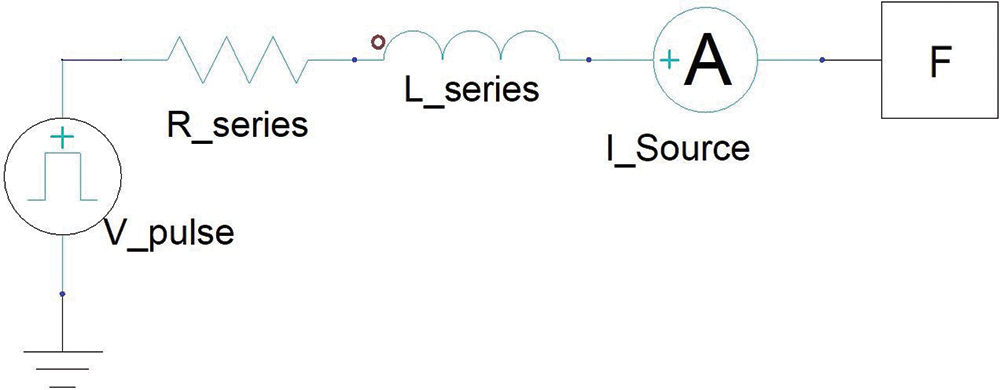
In this study, 3D electromagnetic solvers and circuit calculations are used to study D2D discharge events. Here, the main target is to identify significant discharge parameters affecting ESD current waveforms. The key parameters to study are the contact potential, resistance, rise time, peak current, and length of the pulse. This data is used to estimate reasonable protection targets for D2D interfaces and to give information on how to measure D2D discharge events [4].



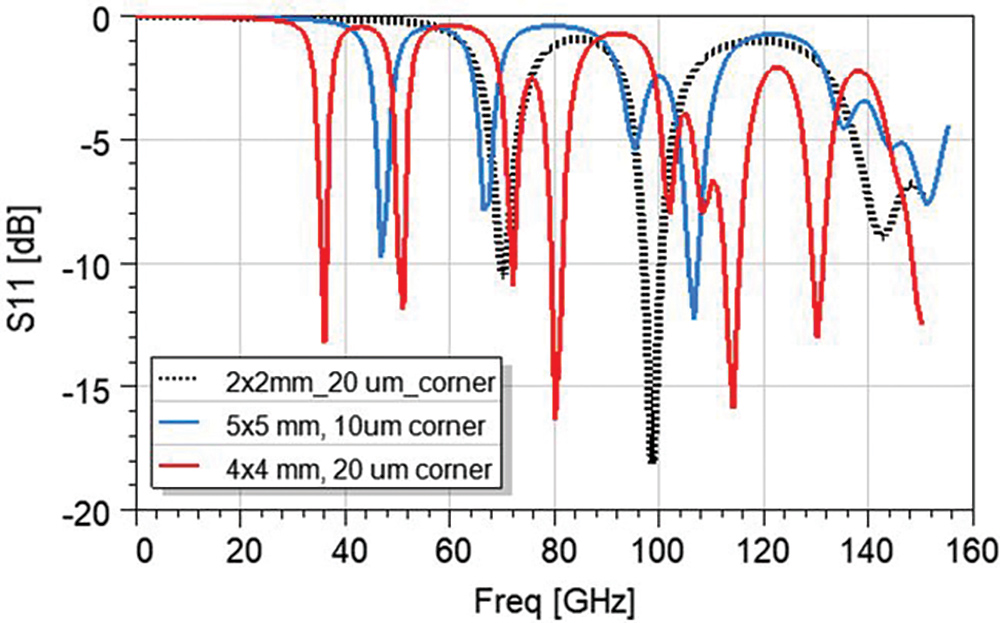
The required bandwidth for a measured or simulated D2D discharge event depends on the materials used, the discharge voltage, and the physical size of the setup. With small dies (a few square millimeters in size) most of the discharge energy is at frequencies above 20 GHz, if external discharge path series parasitics are not included. In this study, the bandwidth is typically calculated for 10 MHz – 100 GHz.
Figure 6 presents an example S11 data for three different discharge scenarios for small-sized dies with 10 μm or 20 μm distance to the ground. This shows that the required calculation and measurement bandwidth should be >25 GHz to capture the rise time and peak discharge current at the contact point.
The strength of the E-field can be high in small gaps even if the potential difference would be just a few Volts. For example, 1 V potential and 1 μm gap create an E-field of 1 MV/m. An electric field emission in air would require significantly higher field strength to pull electrons free; thus, we can assume high resistance and limited current flow before a physical contact [9][10]. In this case, conductors of the die will most likely discharge only when contacting another surface, and thereby, there is no major additional series inductance at the discharge point due to the spark channel.
There can be significant contact resistance during a low voltage transient event between conductors. Therefore, when a die contacts another conductor, the contact resistance can vary from less than one ohm to some unknown higher value. Some additional variation to the contact resistance comes from possible atmospheric pressure differences, surface oxidation, contact area, roughness of surfaces, contact force, protective gases, moisture, power of the discharge current, and varying temperatures used inside the D2D assembly handling environment [10][11]. A contact resistance is treated as a variable and calculated or estimated from RLC circuit waveforms matching with measured discharge current waveforms [6]. The contact resistance can vary during the discharge, but in this study, the resistance is kept constant in calculations [4].

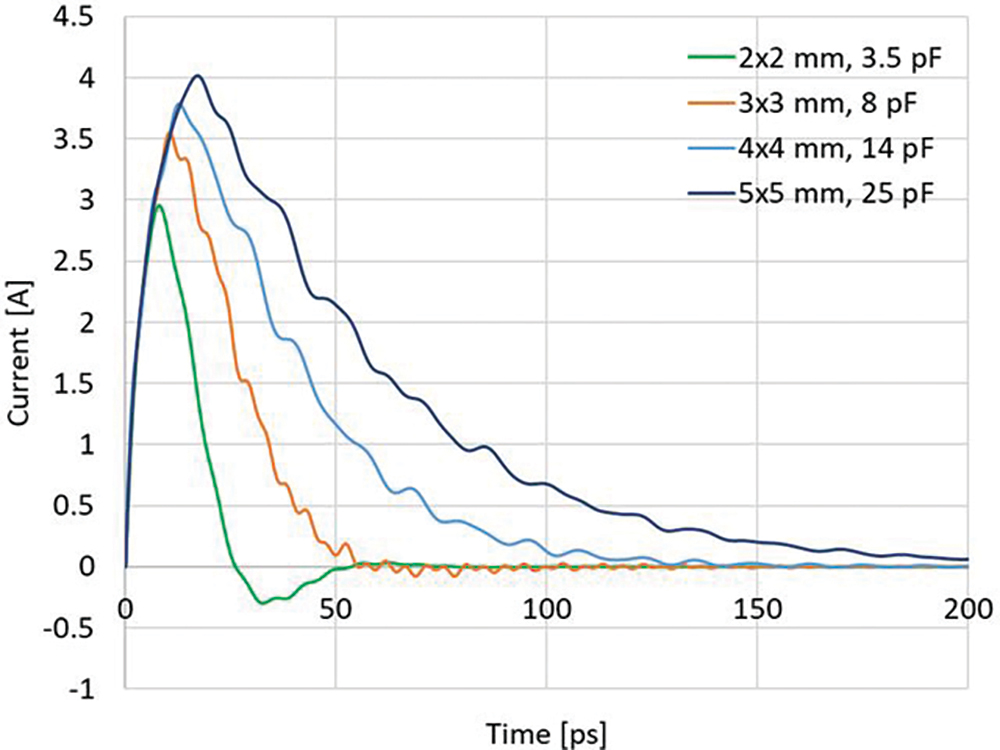



Based on Figures 13 – 15, the expected typical discharge voltage during a D2D ESD event in a controlled environment could be less than about 10 V at 5 μm distance, even if the initial voltage of the die would be >100 V after pickup. However, the real potential values can vary in the die assembly as dies are not ideal solid metal blocks with an even surface at the bottom coupling to the reference surface.
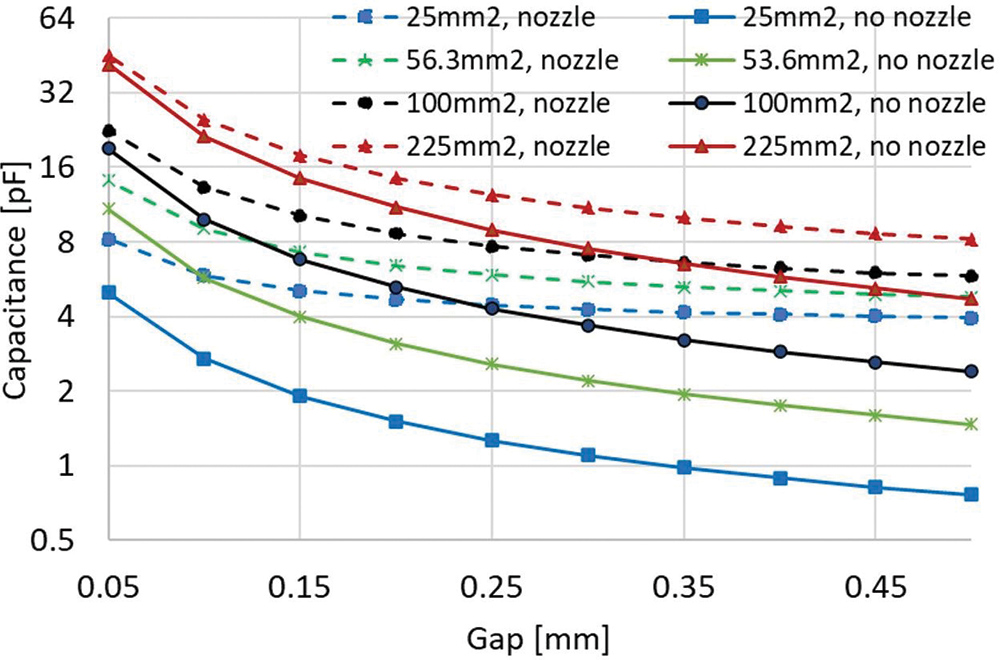
Figure 16 has a calculation where a nozzle with 16 mm2 area is holding a 25 mm2 size die with solder pumps under the package. This is a similar setup as that presented in Figure 3. In this case, the capacitive coupling effect is weaker due to the different charge distribution. The total static charge of the die is set to 1 nC when it is held by a conducting nozzle and 120 pC when the die is held by a non-conducting ceramic nozzle. The reference surface, an electrically floating interposer, has no charge. With these initial charge values, dies have 270 V initial potential when kept at 0.5 mm distance from the interposer. With the conducting nozzle, the voltage difference is about two times higher when the die touches the interposer. However, this phenomenon depends on the nozzle‑die geometry as presented in Figure 17. Here, the size of the metallic nozzle is fixed to 16 mm2, and the size of the die varies. If the size of the nozzle is large in comparison to the area of the die, the capacitive coupling phenomenon is weaker when the die approaches the interposer. Figure 17 also shows results without a nozzle for comparison.

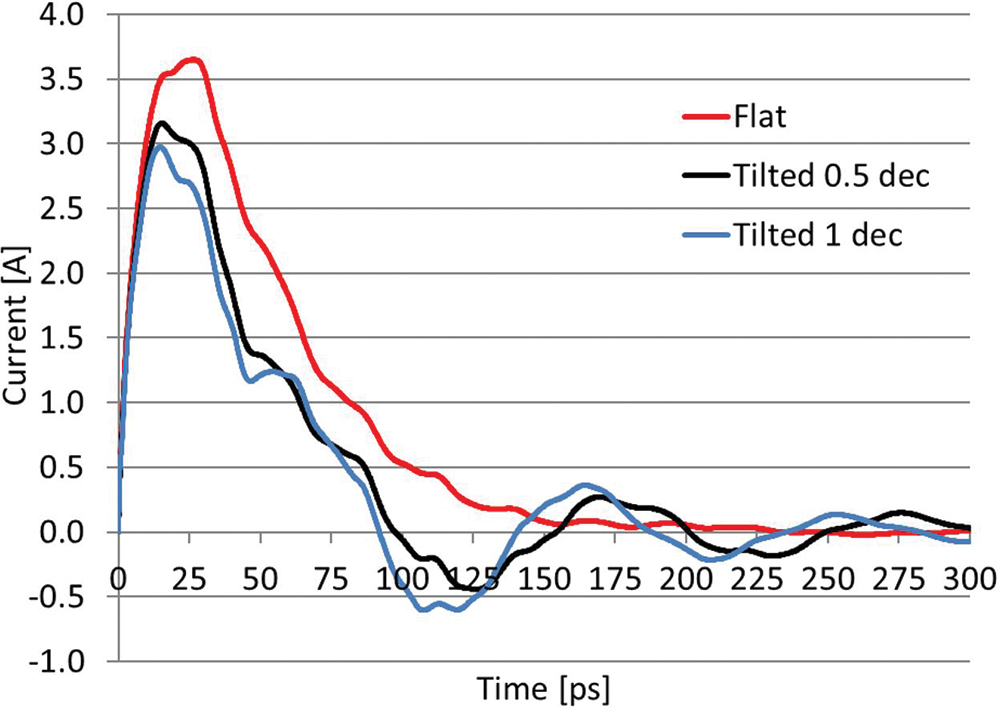


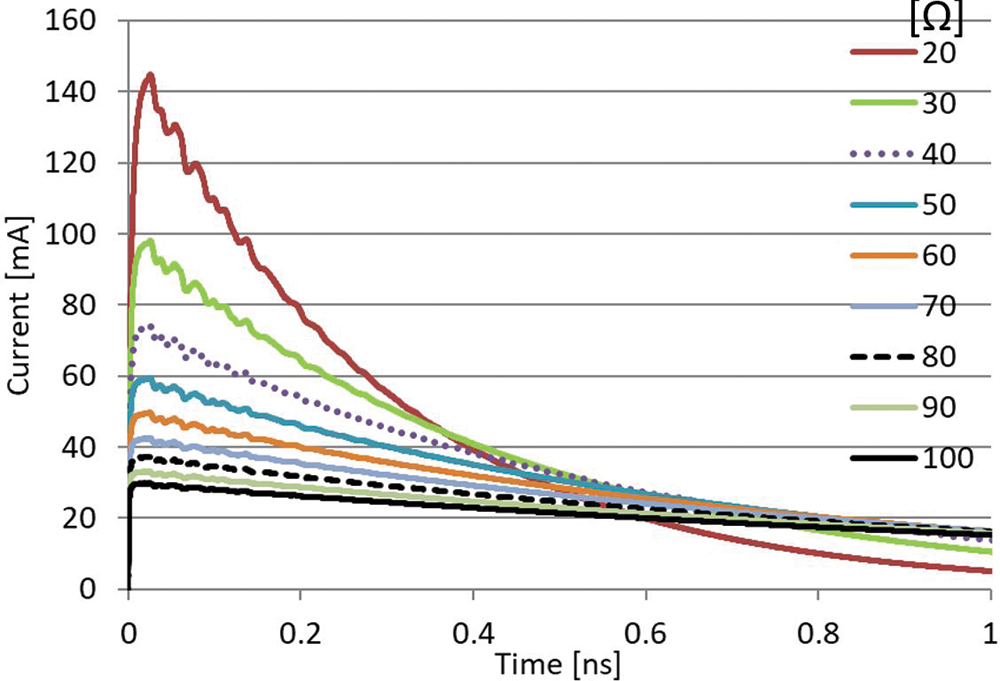


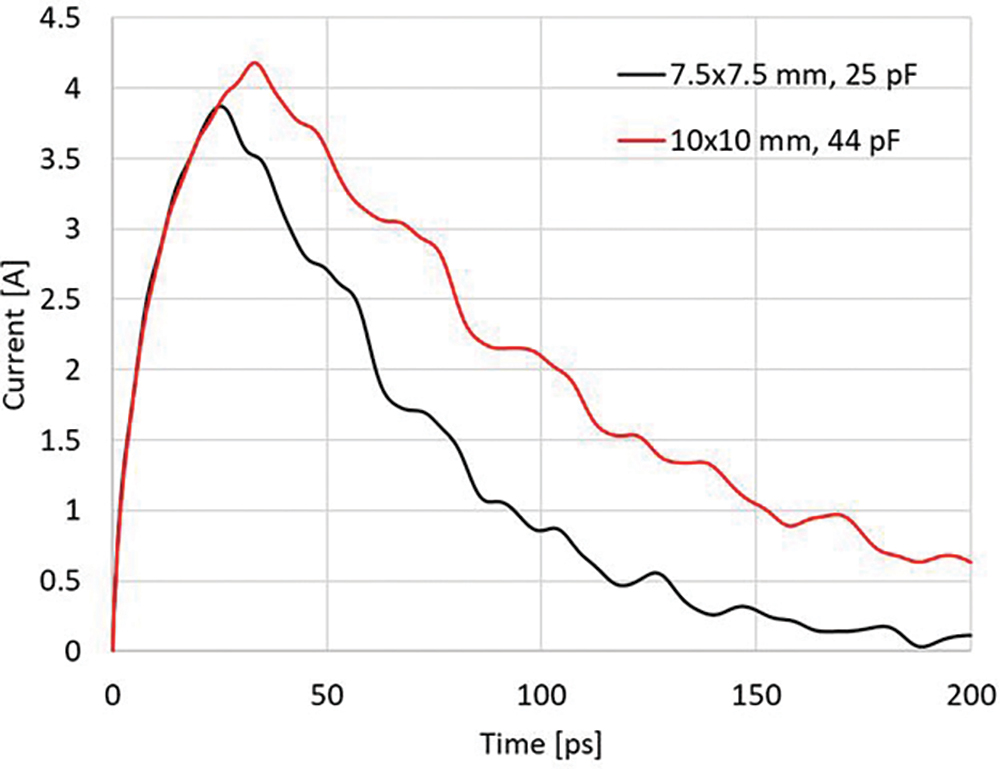
- We can have both underdamped and overdamped discharge current pulses depending on the series contact resistance.
- Due to the low contact inductance, the rise time can be just tens of picoseconds.
- With overdamped pulses, the rise time can be around tens of picoseconds, even so the decay time of the current pulse is several nanoseconds.
- The rise time increases when the die or interposer has inductive structures, such as bondwires or a leadframe.
- Capacitive coupling and non-parallel surfaces affect both the rise time and peak current.
- The discharge current waveform can contain multiple waveforms with varying frequency content.
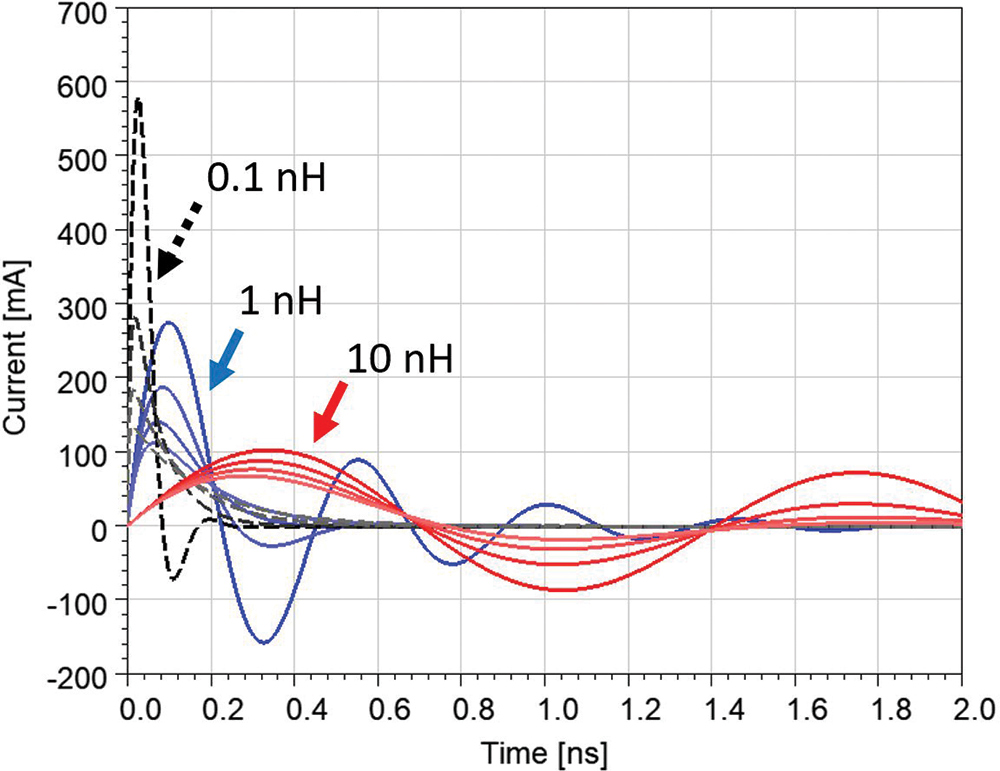
Figures 24 and 25 have calculations for discharge events where the series inductance, resistance, and capacitance are variables. Figure 24 has a fixed 5 pF source capacitance, and Figure 25 has a larger 10 pF source. Both figures have three discharge groups where the series inductance is set to 0.1 nH, 1 nH, and 10 nH. With each inductance value, the series resistance is 5 Ω, 15 Ω, 25 Ω, and 35 Ω. From both figures, we can see that the peak current depends more on the series resistance when the series inductance diminishes. Respectively, with larger inductance values, the series resistance has less effect on the peak current. In addition, both the series inductance and source capacitance affect the peak current, but the series resistance is the most sensitive discharge parameter from the peak current point of view, with low inductance D2D discharges.

When considering the calculation results of this paper, it can be estimated that the potential difference during D2D assembly can be around 2 V – 10 V if dies have more than about 100 pC static charges after pickup. The resulting peak current can be over 1 A. For example, 10 V discharge potential would be at least one decade below a typical IC component CDM rating, but could still initiate a discharge event that can damage sensitive die interfaces with limited on‑chip protection. This largely depends on how much static charge dies have, the physical construction of dies, and how the assembly setup has been realized. The effectiveness of ionization can also affect the final charge and voltage levels found in a real-life assembly environment.
One more open question is how to specify EPA control limits for D2D assembly processes. A voltage limit alone is not valid, as the measured electrostatic potential depends on the capacitance. Discharge current measurements are challenging, especially when done inside the process area. From our experience, it may require multiple attempts to capture the highest discharge current waveform from a charged die with less than 20 V initial potential in a laboratory environment. Here, the contact resistance plays a major role in changing the shape of the current waveform from pulse to pulse.
More challenges come from the die dimensions. Interconnections can have dense 25 μm – 400 μm pitch, making physical ESD testing difficult [2]. Discharge detection with antennas is also challenging due to weak discharge events from small-sized dies with a low initial potential difference. Die charge and potential measurement together would give good information for control purposes, but would require contacting the die with measurement probes inside the assembly equipment.
Based on this study, the contact resistance has a significant effect on the peak current of low-voltage discharges. Other affecting parameters are the initial source capacitance, charge of the die, capacitive coupling, location of the discharge, positioning, internal design of the die, and design of the reference die, IC, or interposer. D2D assembly setup can also alter the discharge current waveform. For example, changing the size or type of the pickup nozzle from conductor to dielectric changes the source capacitance, capacitive coupling, and discharge voltage during the assembly phase.
The required bandwidth to capture D2D discharges is typically more than about 20 GHz. This is due to the low series parasitic inductance in pH scale and source capacitances around ten picofarads. Simulation tools do not have strict bandwidth limitations, but practical D2D ESD current measurements can be challenging to carry out with a wide bandwidth. This also makes it challenging to directly compare measurement and simulation results.
There is no simple method to specify limits for D2D ESD control or for internal interfaces, as the die voltage or charge alone does not specify the discharge current waveform. Similarly, it is challenging to define one safe peak current or rise time limit for interconnection on-chip ESD designs. In addition, CDM tester current measurements may not correlate with real-life D2D discharge events due to different discharge scenarios. Finding a more suitable measurement method for D2D events requires more research.
- L. Peters, “Enabling Test Strategies For 2.5D, 3D Stacked ICs,” Semiconductor Engineering, September 8, 2022.
- Z. Zhi Li, “Scaling Solder Micro-Bump Interconnect Down to 10 μm Pitch for Advanced 3D IC Packages,” 2021 IEEE 71st Electronic Components and Technology Conference (ECTC), DOI: 10.1109/ ECTC32696.2021.00082,
- P. Tamminen, J. Smallwood, W. Stadler, “The Main Parameters Affecting Charged Device Discharge Waveforms in a CDM Qualification and Manufacturing,” 2017 39th Electrical Overstress/Electrostatic Discharge Symposium (EOS/ESD), September 10-14, 2017.
- D. Johnsson, P. Tamminen, H. Gossner, T. Viheriäkoski, “Peak Currents of Low CDM Die-to-Die Discharges,” 2023 45th Annual EOS/ESD Symposium (EOS/ESD), October 2-4, 2023.
- P. Tamminen, “Charge distribution and discharge current analysis with charged connector pins,” Electrostatics, 2019.
- T. Maloney, N. Jack, “CDM Tester Properties as Deduced from Waveforms,” IEEE Transactions on Device and Materials Reliability, Volume 14, Issue 3, September 2014.
- E. Hourdakis, B. J. Simonds, N. M. Zimmerman, “Submicron Gap Capacitor for Measurement of Breakdown Voltage in Air,” Review of Scientific Instruments, Volume 77, Issue 034702, March 24, 2006.
- A. Peschot, N. Bonifaci, O. Lesaint, “Deviations from the Paschen’s Law at Short Gap Distances from 100 nm to 10 mm in Air and Nitrogen,” Applied Physics Letters, 105, 123109, 2014.
- R.H. Fowler, L. Nordheim, “Electron Emission in Intense Electric Fields,” Proceedings of the Royal Society A, Volume 119, Issue 781, May 1, 1928.
- I.A. Ivanov, I.G. Kiselev, S.V. Urushev, “The Transient Electric Resistance of Contacts Taking the Surface Roughness into Account,” Russian Electrical Engineering, Volume 88, October 2017.
- ASME B46.1-2019, Surface Texture (Surface Roughness, Waviness, and Lay), American Society of Mechanical Engineers [ASME].
- P. Tamminen, T. Viheriäkoski, “Characterization of ESD Risks in an Assembly Process by Using Component-Level CDM Withstand Voltage“, 2007 29th Electrical Overstress/Electrostatic Discharge Symposium (EOS/ESD), September 16-21, 2007.
- A. Jahanzeb, Y-Y. Lin, S. Marum, J. Schichl, C. Duvvury, “CDM Peak Current Variations and Impact Upon CDM Performance Thresholds,” 2007 29th Electrical Overstress/Electrostatic Discharge Symposium (EOS/ESD), September 16-21, 2007.