

lectrostatic discharge (ESD) control programs often focus heavily on individual components, such as conductive flooring, ESD shoes, heel grounders, or wrist straps. Yet one of the most important lessons emerging from recent research is that no single component determines success. Instead, the interaction between footwear, flooring, environmental conditions, and human behavior ultimately dictates walking body voltage performance.
The ANSI/ESD S20.20 standard requires personnel grounding systems to maintain body voltages below 100 volts during normal movement. ANSI/ESD S20.20 also requires that the footwear/flooring system keeps body voltage below 100 volts when tested as a system per ANSI/ESD STM 97.2. While many facilities assume that installing an ESD floor or purchasing certified ESD footwear guarantees compliance, practical testing demonstrates that the reality is far more complex. Different combinations of floors and footwear can produce dramatically different results, even when each component independently satisfies specification requirements.
Electrostatic discharge (ESD) control programs frequently emphasize compliance with resistance specifications for flooring materials and personnel grounding devices while overlooking the dynamic interaction between those components during actual use. Walking body voltage generation, however, depends on the complete footwear/flooring system rather than any individual element.
Data of a variety of footwear/flooring systems demonstrated significant variability in body voltage generation among different footwear models, flooring types, humidity conditions, and resistance ranges, even when individual components satisfy conventional requirements. Systems exhibiting resistance to ground values below 1 × 10⁸ ohms consistently produced lower and more stable walking body voltages, while higher‑resistance systems frequently exceeded the ANSI/ESD S20.20 threshold of 100 volts.
The findings reinforce the importance of qualifying complete flooring and footwear systems under actual operating conditions rather than relying solely on component specifications.
Despite these technological advances, one of the most persistent misconceptions in ESD control remains surprisingly simple, that is, the belief that installing an ESD floor or purchasing ESD footwear automatically guarantees compliance. In fact, we’ve had some users think that they only needed an ESD floor or ESD footwear (not both) to have proper control.
In practice, electrostatic performance is not determined by any single component. It emerges from a complex interaction involving flooring materials, footwear design, environmental conditions, human movement, and maintenance practices. A floor that performs exceptionally well with one shoe may fail with another. A system that passes testing during humid summer months may exceed allowable body voltages during winter operation. A resistance measurement that appears acceptable on paper may not predict actual walking body voltage generation.
Our recent research and testing sought to investigate these interactions and quantify how flooring systems and footwear combinations influence walking body voltage generation under realistic conditions. We believe that our findings can provide important guidance for organizations designing, specifying, and maintaining ESD-protected areas.
In uncontrolled environments, this process can generate thousands of volts. A person walking across conventional carpeting in dry winter conditions may accumulate 20,000 volts or more. Sensitive electronic devices, however, can suffer damage at discharge levels well below 100 volts.
Yet resistance values alone tell only part of the story.
Dynamic body voltage generation depends upon multiple factors, including:
- Contact area between shoe and floor
- Material composition of flooring and soles
- Moisture content and ambient humidity
- Walking speed and gait characteristics
- Contamination and maintenance conditions
- Localized variations within flooring installations
The standard recognizes walking body voltage as one of the most meaningful indicators of real-world system performance. Meeting this requirement demands more than purchasing compliant components. It requires demonstrating that the combined flooring and footwear system functions effectively as an integrated whole. Unfortunately, many facilities continue to specify flooring materials primarily according to resistance to ground measurements without evaluating actual walking performance. The research highlights why such an approach can produce misleading conclusions.
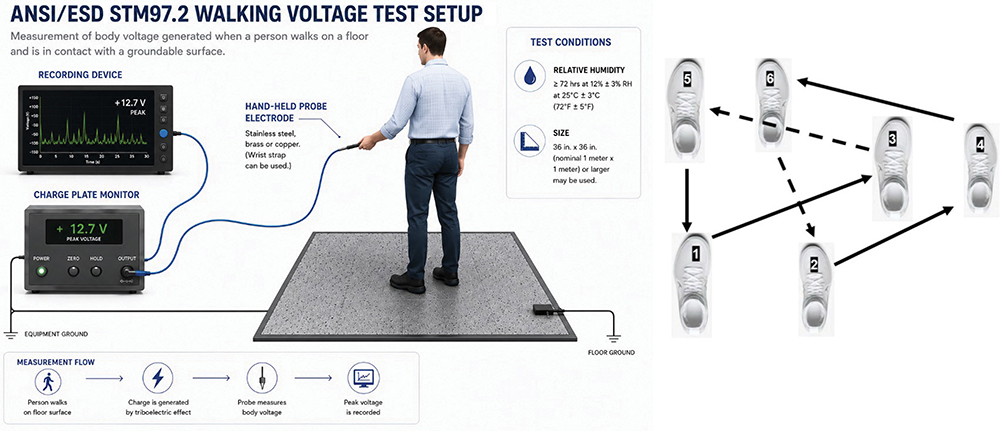
- First, it accounts for triboelectric charging mechanisms that static resistance tests cannot capture.
- Second, it incorporates human variability, including differences in gait, stride length, and body movement.
- Third, it evaluates complete systems rather than isolated components.
For organizations pursuing robust ESD control programs, walking body voltage testing should therefore be considered an essential qualification tool rather than an optional exercise.
- Different footwear brands and models
- Flooring and footwear resistance values
- Various flooring materials and constructions
- Distinct personnel grounding methods
- Conventional street shoes
- Relative humidity conditions
The results revealed substantial differences among seemingly comparable systems.
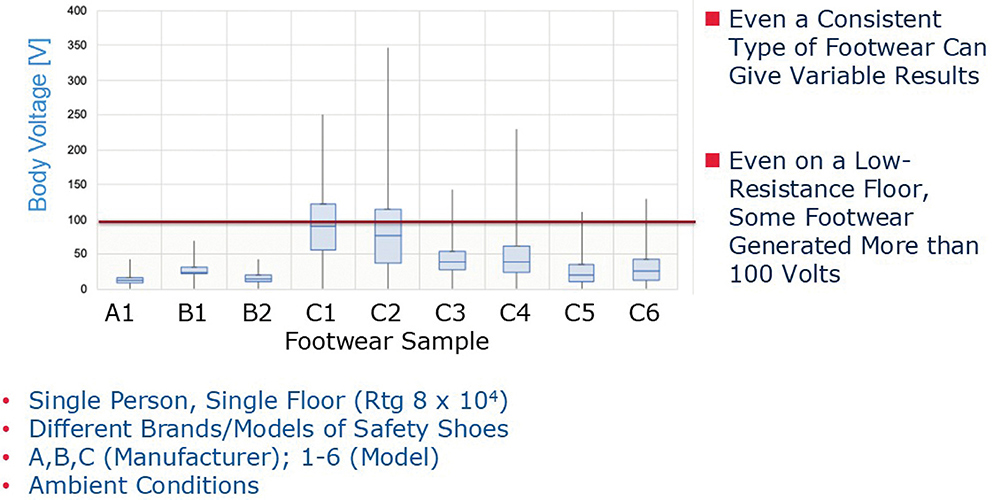
Potential causes include:
- Sole compound formulation—Different manufacturers utilize varying conductive additives, carbon loadings, and polymer systems. Small formulation changes may significantly influence triboelectric behavior.
- Contact geometry—Tread patterns affect the effective contact area between shoe and floor. Reduced contact can increase localized charge generation and impede dissipation pathways.
- Conductive path placement—The location and continuity of conductive elements within footwear designs vary among manufacturers. Interruptions in these pathways can degrade overall performance.
- Wear characteristics—Footwear performance evolves over time. Abrasion, contamination, and sole degradation may alter resistance and charge generation behavior.
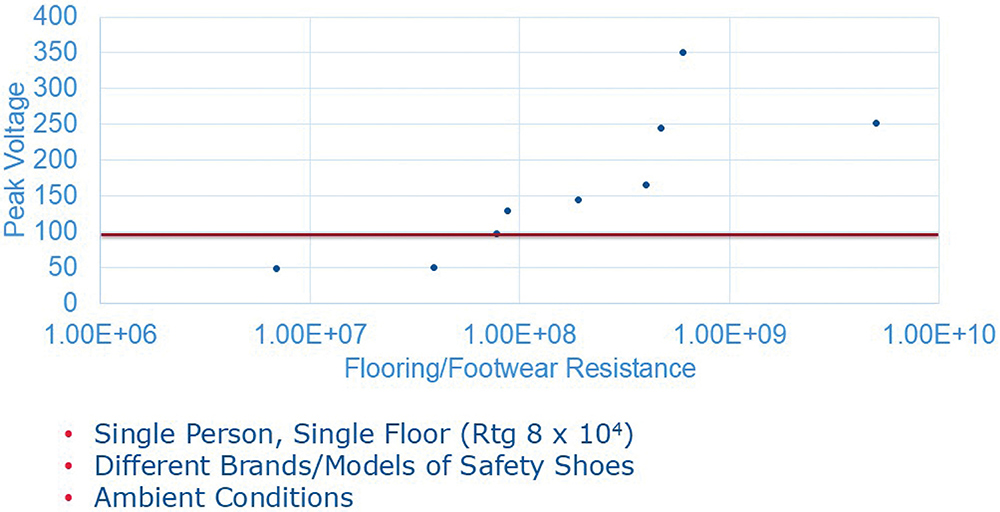
For facility designers, this threshold offers an important guideline when selecting flooring technologies. Most flooring systems marketed as “dissipative” have resistance that measures closer to 1 x 10⁹ ohms and so have a higher likelihood of not providing an adequate footwear/flooring system. Flooring systems sold as “conductive” will measure below 1 x 10⁶ ohms and will generally provide a higher likelihood of producing a footwear/flooring system that meets the requirements of ANSI/ESD S20.20.
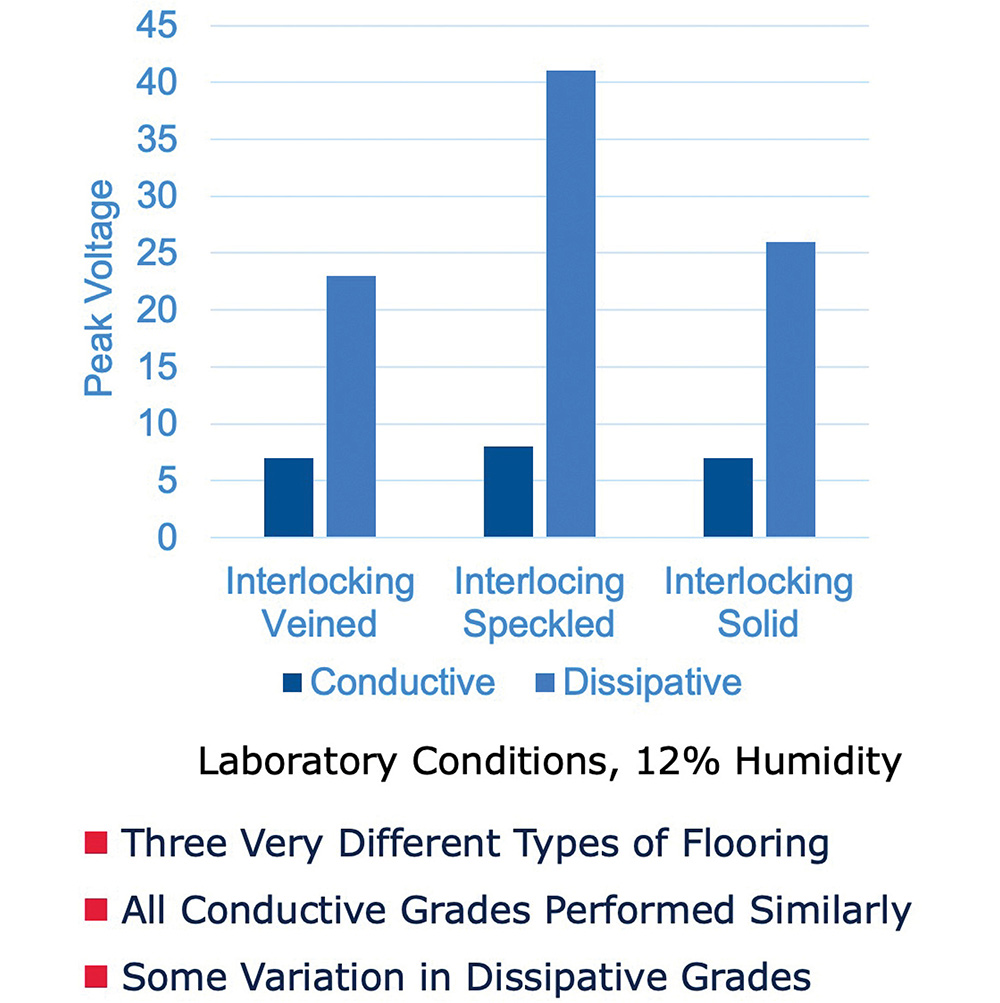
We then compared three visually distinct interlocking floor products under extremely dry conditions of 12 percent relative humidity. Each product was available in both conductive and dissipative formulations.
Figure 4 plots the peak voltage measured in the walking body voltage test on the various flooring samples. As shown, the conductive grades exhibited remarkably consistent performance regardless of product type. Dissipative grades showed greater variability and higher peak voltages.
The choice between conductive and dissipative materials should therefore consider environmental conditions, process sensitivity, and reliability of maintaining low body voltage rather than relying solely upon initial cost comparisons.
- ESD shoes
- ESD booties
- Heel grounders
- Sole grounders
Figure 5 plots the peak voltage measured in the walking body voltage test using the different footwear on both conductive and dissipative flooring samples.
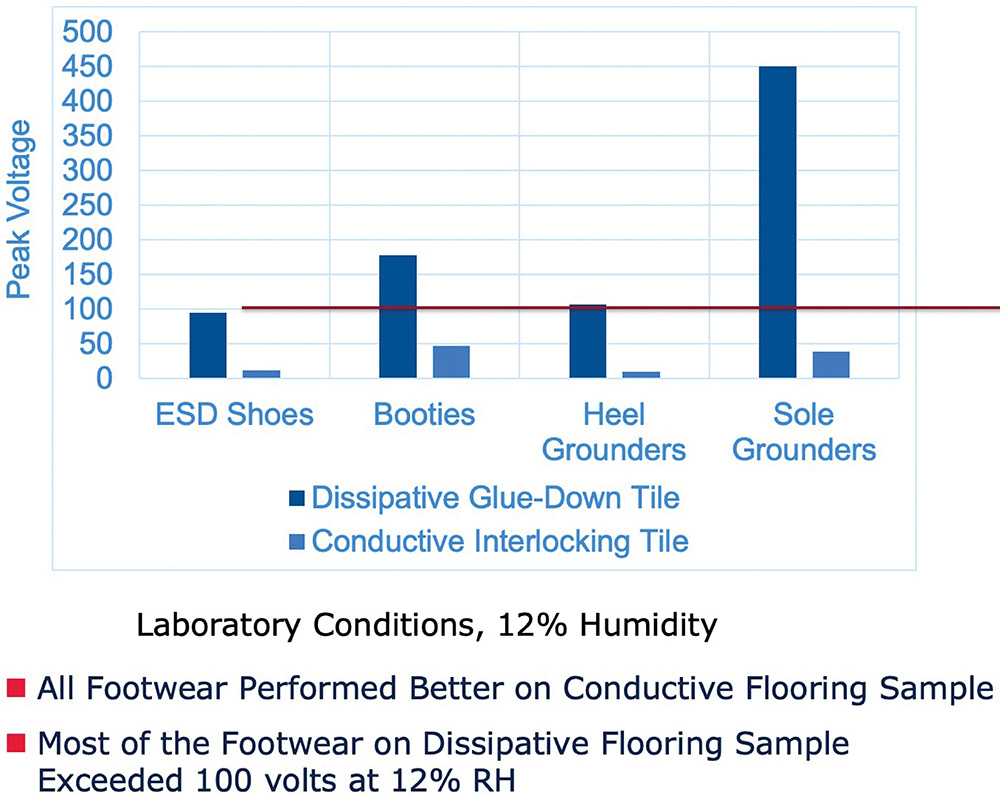
- Every footwear category performed better on the conductive flooring system; and
- Many exceeded 100 volts when used on the dissipative flooring system.
Facilities frequently debate whether premium ESD shoes justify their higher cost. The research suggests that optimizing flooring performance may produce greater improvements than upgrading footwear alone. The best outcomes occur when both components are designed and qualified as a unified system.
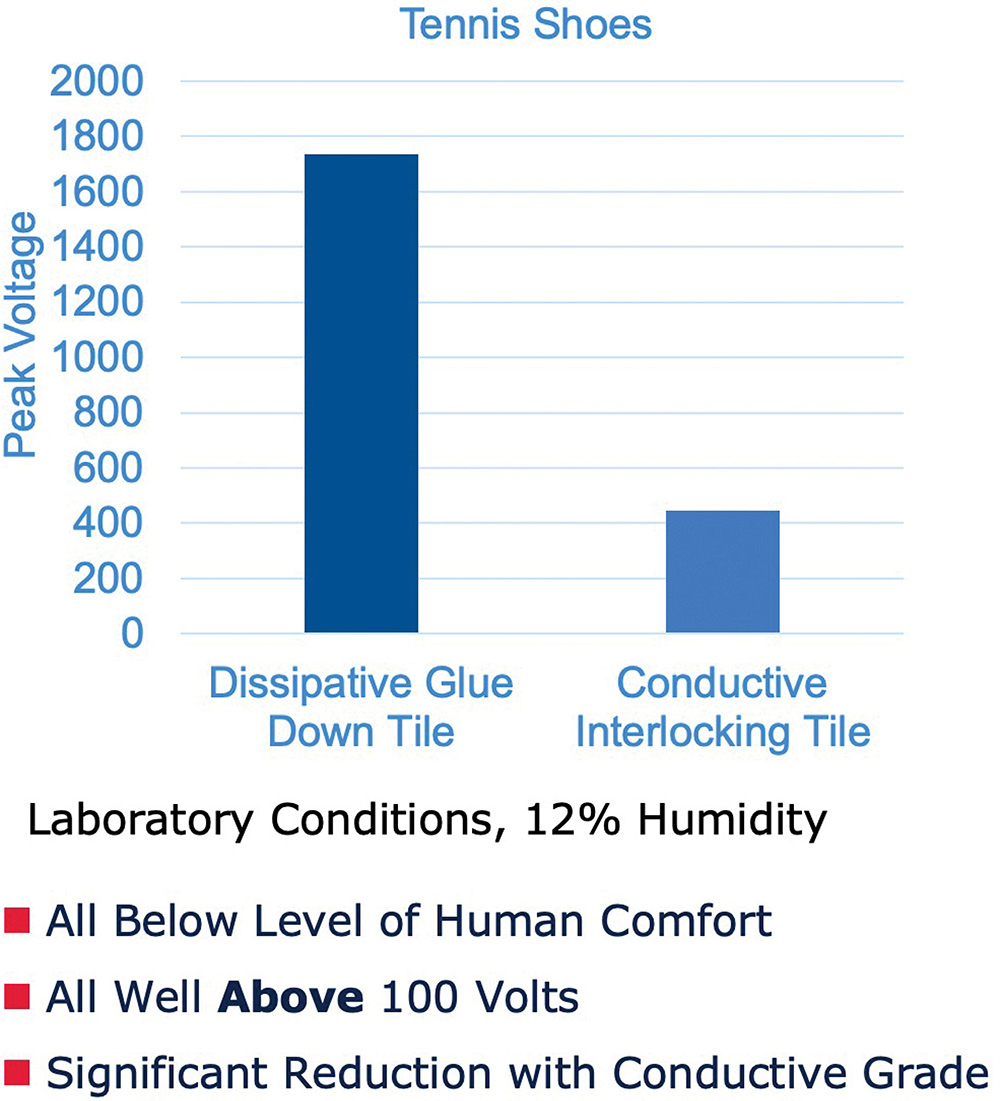
The findings demonstrate two important points:
- First, conductive flooring significantly reduces charge generation even for non-ESD footwear. This can be helpful to protect enclosed electronic products, like computers and data tablets, and to prevent painful shocks to personnel.
- Second, flooring alone will not provide compliance with the requirements of ANSI/ESD S20.20. Without a proper footwear/flooring system, human body voltage will generally not be maintained below 100 volts and will therefore not provide protection to sensitive electronic components.
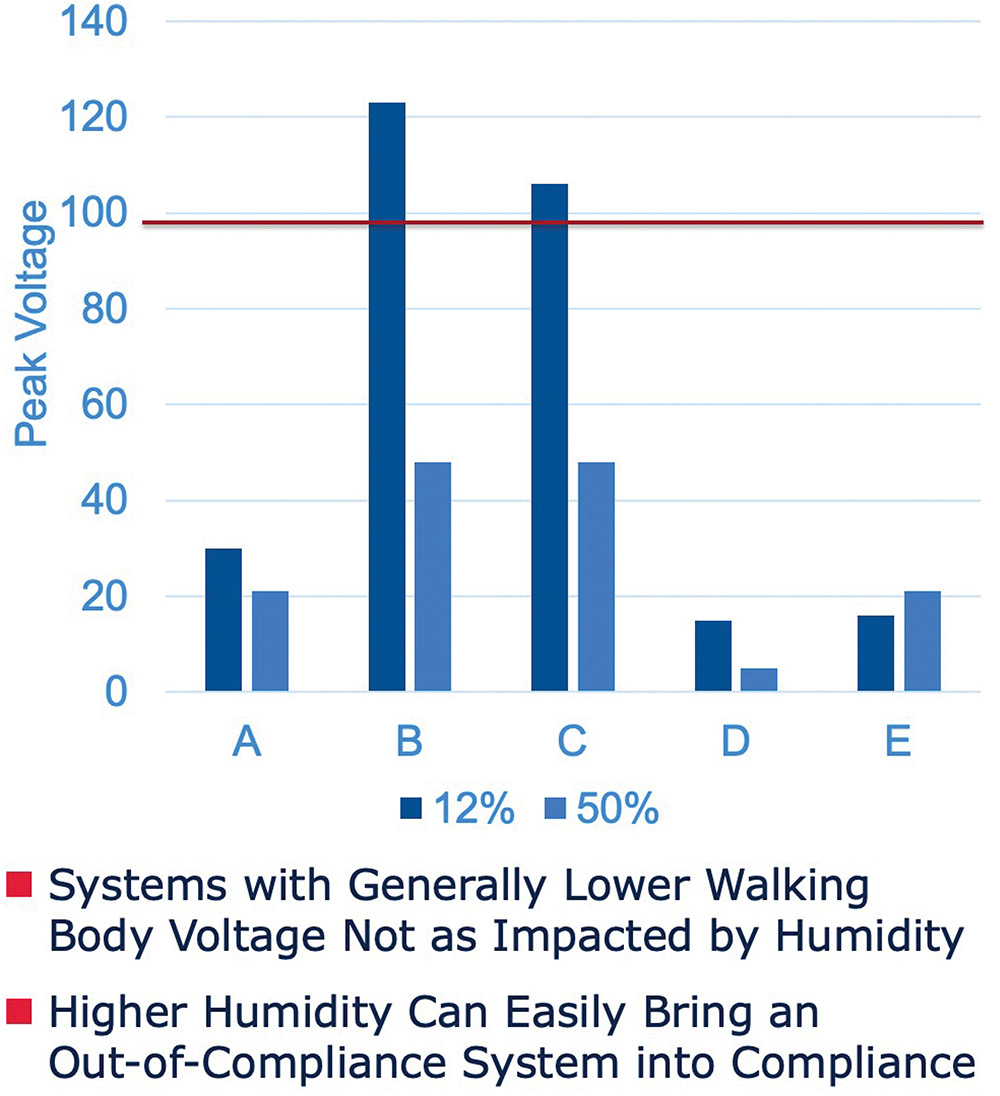
Water molecules adsorbed onto surfaces enhance conductivity and facilitate charge dissipation. As humidity declines, insulating behavior increases and triboelectric charging intensifies. The data in our testing clearly illustrated this relationship.
Figure 7 plots the peak voltage measured in the walking voltage test for five different footwear/flooring systems under both 12% and 50% relative humidity. Systems exhibiting marginal performance at 12 percent relative humidity often achieved compliance at 50 percent humidity. Systems already producing low voltages showed comparatively little change.
That objective typically requires:
- Lower resistance flooring
- Proper footwear qualification
- Comprehensive maintenance procedures
- Routine walking body voltage verification
- Test complete systems—As required by ANSI/ESD S20.20, qualification should always include actual flooring and footwear combinations rather than individual products evaluated separately.
- Test under worst-case conditions—Low-humidity environments provide the most meaningful performance data. Product qualification testing, as prescribed by ANSI/ESD S20.20, generally requires testing at low humidity.
- Establish resistance targets—Systems below 1 × 10⁸ ohms consistently demonstrated superior performance. Most flooring systems marketed as “dissipative” have resistance that measures closer to 1 x 10⁹ ohms and so have a higher likelihood of not providing an adequate footwear/flooring system. Flooring systems sold as “conductive” will measure below 1 x 10⁶ ohms and will generally provide a higher likelihood of producing a footwear/flooring system that meets the requirements of ANSI/ESD S20.20.
- Monitor performance over time—Wear, contamination, and maintenance practices influence long-term effectiveness.
Organizations evaluating ESD infrastructure should therefore consider lifecycle risk reduction rather than initial installation costs alone. Robust systems deliver value through consistency, reliability, and reduce operational uncertainty.
Our research demonstrated that:
- Footwear/flooring systems with resistance to ground values below 1 × 10⁸ ohms generally maintained compliance with
ANSI/ESD S20.20 requirements. - Higher-resistance systems frequently exceeded the 100-volt threshold.
- Different ESD footwear models produced dramatically different results on identical floors.
- Conductive flooring consistently outperformed dissipative alternatives under challenging conditions.
- Humidity can mask deficiencies in otherwise inadequate systems.
- Street shoes remain incompatible with protected manufacturing environments.
Only by walking that line can organizations ensure reliable protection for the increasingly sensitive technologies upon which modern industry depends.

Tom Ricciardelli founded SelecTech in 1993 to create products from recycled materials and invented an adhesive‑free, interlocking static-control flooring system. He joined the ESD Association in 2013 and currently chairs multiple working groups. Ricciardelli can be reached at tricca@selectech.com.